Michael Carvin wanted to buy a home. It was 2010, close enough to the financial crisis for the question to deserve a little more attention than a brisk calculation of monthly payments. He had worked in finance. He knew how to examine a decision before putting money behind it. Yet the tools available to an ordinary buyer left him dissatisfied. So he opened Excel and built a financial model of his own.
There is something quietly comic about that beginning. A person trained to understand money tries to buy somewhere to live and ends up creating homework. The mortgage calculator, that cheerful little rectangle promising certainty, had failed to settle the matter. Carvin wanted an answer that reflected his circumstances and the consequences of a decision over time.
That private exercise became the starting point for SmartAsset. With software developer Philip Camilleri, he developed a platform that could turn personal information into a more useful financial answer. Their different backgrounds mattered: Carvin brought experience evaluating financial choices; Camilleri brought the ability to build the software. A problem encountered by one buyer was becoming a product for other people.
The trouble with an average buyer
Before SmartAsset, Carvin had used models in private equity to help companies make decisions. His earlier roles included senior associate at Altima Partners and analyst at Leucadia National Corporation. He graduated from Princeton, where he studied economics. His professional equipment was well suited to examining trade-offs. The surprise was how much of that equipment seemed to disappear when the customer was a household.
A business considering an investment expects to investigate how the numbers fit together. A homebuyer has similar questions, often with fewer people available to answer them. Income, savings, taxes, location and the time someone expects to stay all matter. A payment that can be calculated neatly may still belong to a decision that is anything but neat.
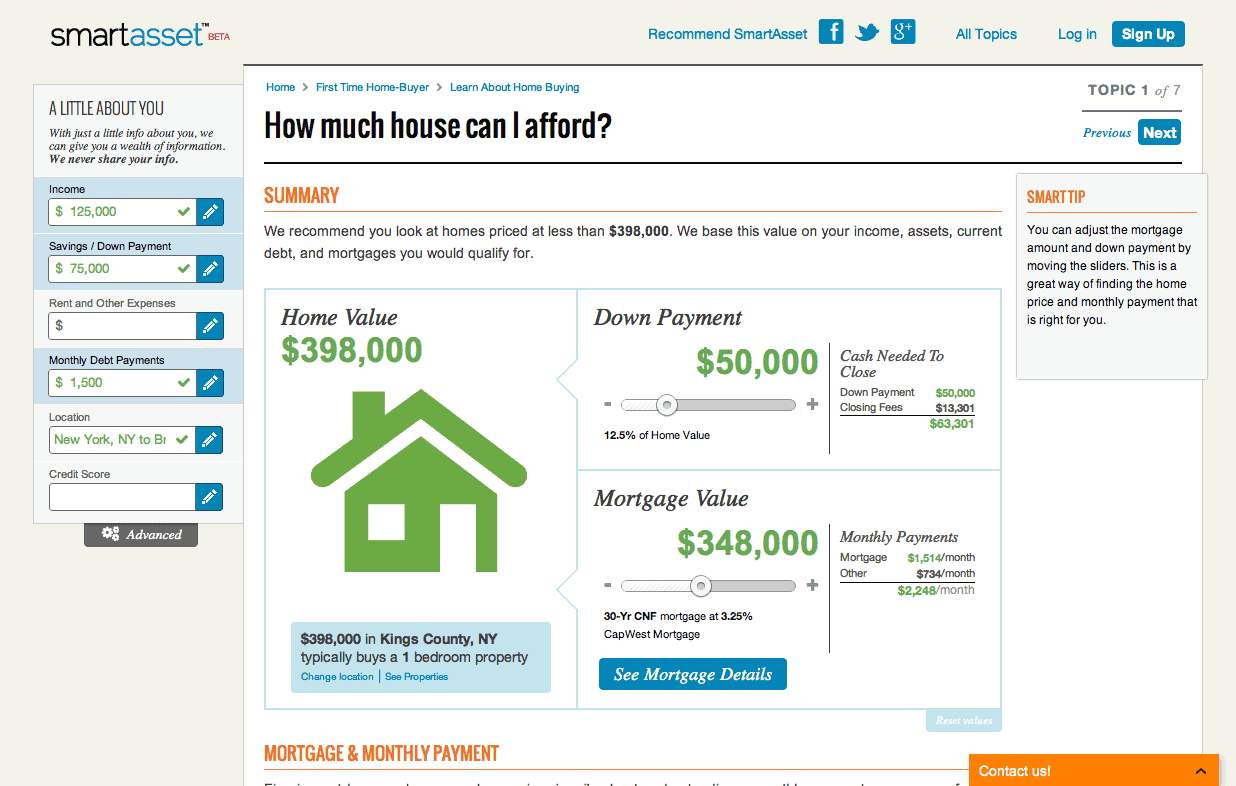
SmartAsset emerged publicly from Y Combinator’s Summer 2012 batch. Its early homebuying product asked people for information and returned personalized, visual explanations. The ambition extended beyond producing a number. It had to make the number intelligible to someone who had a real purchase to consider and no particular desire to become a financial analyst first.
The design itself made an argument. In the launch-era product, affordability indicators changed color as a user adjusted a home price, and explanations described why the answer changed. The hard work involved deciding how much information to show. A system capable of calculating a great deal could easily become a system that explained very little. Restraint was part of the engineering.
An overthinker, with customers
By 2014, Carvin was using the product for his own refinancing. “I am an over thinker when it comes to financial decisions,” he said. It is an unusually apt confession for someone selling financial clarity. He was still using the machinery he had helped create, still concerned with the difference that a more careful answer could make.
He also described a visitor whose finances resisted the tidy categories a calculator might prefer: an actor with $500,000 in savings and no current income. A large balance and an empty income line can coexist. The example reveals why personalization was more than a pleasant feature. The person standing in front of the software might have a financial life that refused to look average.
Behind the interface sat the less glamorous work of reconciling data from different places. Names, formats and gaps had to be made consistent. The clean answer on the screen depended on work the customer would never see. For Carvin, the difficulty of getting the unusual case right belonged inside the product, rather than being left for the user to solve.
MICHAEL CARVIN / 2014“I am an over thinker when it comes to financial decisions.”
The experiment with one employee
The company expanded into articles, calculators and tools covering more of a person’s financial life. Captivate allowed publishers to place SmartAsset tools alongside their own content. Then came a different kind of answer: helping a person find a financial advisor. A calculator could take someone a useful distance; a professional relationship could carry the discussion further.
Carvin described testing SmartAdvisor with just one employee working on the product. By 2019, he said, almost the whole company was involved. That is a revealing sequence for a founder whose original idea came from detailed analysis. The new business was given a small trial before it received a large commitment. The scale followed the experiment.
His explanation of delegation was equally practical: “Finding the right people and trusting them to execute on their expertise was a crucial part of learning to delegate.” The founder who began by building his own answer had to make room for other people’s judgment. A growing company gives its chief executive plenty of decisions; it also requires him to stop making some of them.
- 01CalculatePersonal inputs and financial models
- 02ExplainTools and content people can use
- 03ConnectIntroductions to financial advisors
An editorial diagram of the product’s progression, rather than a measurement of results.
A billion-dollar milestone, and an older family story
In June 2021, SmartAsset raised $110 million in Series D financing at a valuation above $1 billion. TTV Capital led the round, joined by investors including Javelin Venture Partners, Citi Ventures and New York Life Ventures. The announced uses for the money included new products, technology infrastructure, data partnerships and hiring. Behind the large figure lay the familiar demands of building and running a company.
Carvin’s account of the business that summer supplied another measure. He said revenue had grown tenfold since the 2018 Series C, that the company was approaching $100 million in annual recurring revenue and that it was operating at breakeven. These were figures for that period, describing a business whose advisor connections had become central to its economics.
When he won EY’s Entrepreneur Of The Year 2021 New York award, Carvin placed the achievement in a longer, more personal frame. His mother had won a similar award for Black entrepreneurs in Europe more than twenty years earlier. He said the recognition honored her memory as well as the work of the SmartAsset team. An award ceremony had brought an older family accomplishment back into view.
That detail changes the texture of the usual funding story. The valuation describes what investors were willing to pay for a stake in a company. The memory of his mother describes what an achievement meant to him. Both belong in the account, though only one fits comfortably on a financing chart.
Historical company figures. The valuation describes SmartAsset, rather than Carvin’s personal wealth.
The work after the introduction
Carvin’s later advisor interviews show him returning to the particulars. Speaking with WinCap Financial founder Michael Collins, he asks about acquisition channels, the history of using SmartAsset and the process for turning introductions into clients. Collins describes following up with people who read his newsletter, including prospects who have been quiet for years. Interest does not always arrive on a convenient timetable.
In a conversation with Pure Financial’s Joe Anderson, Carvin asks how a prospect moves from an initial contact to meetings and eventually a client relationship. Anderson describes a process involving different people at different stages. The striking part is the attention to the steps between the headline numbers. Introductions have value only when someone does the work that follows.
There are limits to what an introduction can accomplish. In 2021, some advisors praised digital lead generation while others complained about the quality of prospects and the volume of outreach those prospects received. Those differing experiences are part of the business Carvin runs. Matching criteria, expectations and the way an advisor follows up all affect what happens after a name appears.
The product continued moving into that territory. SmartAsset acquired DeftSales, a prospect-engagement tool, and introduced its Advisor Marketing Platform, AMP, in March 2024. The platform combined referrals with capabilities such as nurture campaigns and automated outreach. The task had widened from finding someone who wanted help to supporting the process of actually getting in touch.

Back to the question behind the number
In a 2026 conversation with advisor Melissa Day, Carvin presses for the practical details again: contact rates, meetings, closes and the tools used to keep in touch. He also points to people who return later, when the timing has changed. The questions suggest a founder still interested in how a process behaves once real people enter it, with all their delays and shifting priorities.
Day describes an outreach campaign covering the first forty days, followed by another extending from day fifty to day 180. She talks about automated emails, a tool that organizes calls and a newsletter. These are unromantic details, which is precisely why they are useful. They show how much of the relationship begins with remembering to return to someone who has already asked for help.
The same concern appears in the Financial Advisor Value Calculator, introduced in June 2025. It uses personal inputs to estimate the long-term financial value of working with an advisor. Such an estimate depends on assumptions; it cannot promise an individual outcome. But the question is recognizably Carvin’s: take a consequential decision, identify what matters, and try to make its implications visible.
His stated ambition remains helping people make better financial decisions. The route has involved modeling, publishing, distribution and a marketplace for professional help. It now includes the patient mechanics of follow-up. Each step addresses a different place where a person can get stuck between asking a question and being able to act.
The first version of that person was Carvin himself, trying to buy a home. He had enough expertise to know that the available answer was incomplete, and enough impatience to build another one. Years later, his work still circles the space between a number and a decision. A spreadsheet can be an excellent beginning. Eventually, someone has to live with the answer.
Keep following the question
Explore the tools, the early interviews and Carvin’s conversations with financial advisors.