A hotel room is a perishable piece of real estate. At midnight it has a price; by morning, if nobody slept in it, the inventory is gone forever. The building may stand for fifty years, but its merchandise expires daily. Michael Cahill has spent his career in that contradiction, translating the bustle of a lobby and the discipline of a balance sheet into the same language.
His résumé begins somewhere more physical. At Cornell University, Cahill studied at the School of Hotel Administration and played offensive tackle. In 1983 he was named an Academic All-America football player. The next item on his public employment history is a management-trainee post at Hyatt Waikiki, also in 1983. In one year he moved between a line of scrimmage and a Hawaiian hotel, two places where an operation succeeds only when many specialized roles work in sequence.
There is an easy metaphor available here, and it happens to be useful. An offensive lineman must notice the entire formation while concentrating on the collision directly ahead. A hotel adviser does something similar with demand, labor, brand rules, renovation costs, debt and the intentions of an owner. The glamour arrives later, usually in the announcement of a sale. The consequential work happens before the room knows a deal exists.
Learning to price the invisible
After Cornell, Cahill joined Hospitality Valuation Services in Mineola, New York. He stayed from 1984 to 1994 and rose to senior vice president. The timing gave him an education that could not have been neatly scheduled. His published work from those years moves from average-room-rate forecasts and real-property taxes to distressed assets and market repositioning. The titles are wonderfully unromantic: “Follow Logical Steps to Project Income and Expense,” “The Valuation of Distressed Hotels,” and “Hotel Workout Checklist: What are the Real Problems?”
Those subjects get to the peculiar heart of hospitality. An office lease can last years. A hotel must renew its compact with the market each evening. Value depends on the physical asset, certainly, but also on the operator, the flag over the entrance, the competitive set, the local convention calendar and tomorrow’s willingness to pay. Cahill accumulated the credentials of someone expected to defend an answer: CRE, MAI, FRICS and CHA. His work later took him into courtrooms and arbitration proceedings involving hotels, resorts and casinos.
He made that observation in a 2016 interview about the year ahead. The royal title came with a constitutional limit. Owners could control cash flow more directly than cap rates, he explained. In hotel economics, management may not command the weather, the broader economy or the bond market, but it can still examine expenses and the income produced by the property. Cahill’s enduring subject is the gap between what owners can influence and what they merely have to survive.
A small room with a large idea
Valuation was not his only apprenticeship. From 1987 to 1999, Cahill was a founder and board member of Microtel Franchise & Development Corporation and Hudson Hotels Corporation. He is identified as one of the original co-founders of the Microtel brand and concept. Economy lodging is a stern design exercise: strip away what a traveler does not need, protect what the guest notices and make the arithmetic work at scale.
He also co-founded HVS Executive Search in 1992, establishing a lodging and gaming practice. By the time he founded Hospitality Real Estate Counselors in 1994, he had worked in operations, valuation, recruiting, ownership, management, development and franchising. HREC was less a leap into a new business than the assembly of several views of the same one.
The firm built between disciplines
HREC began with consulting and advisory work. In 2002, Cahill and Geoff Davis formed HREC Investment Advisors, adding a lodging-focused brokerage and investment-banking arm. Cahill also co-founded HREC Development Resources, which worked with hotel investors and municipalities on development counseling and tax-exempt bond financing until 2015.
The architecture matters because hotel questions rarely respect departmental borders. A valuation can become a sale. A feasibility study can stop a bad development before concrete is poured. A property-improvement plan can change the capital stack. A financing constraint can turn an ordinary disposition into an exercise in identifying a buyer with different money, different patience or a different intended use.
HREC says Cahill and chief operating officer Scott Stephens have more than 65 years of combined hospitality experience, while its brokerage leaders have arranged more than 600 sale and finance transactions worth over $9 billion. Those are firm figures, not a personal scorecard. They nevertheless describe the platform Cahill helped build: national in reach, narrow in sector and deliberately mixed across brokerage, financing and advice.
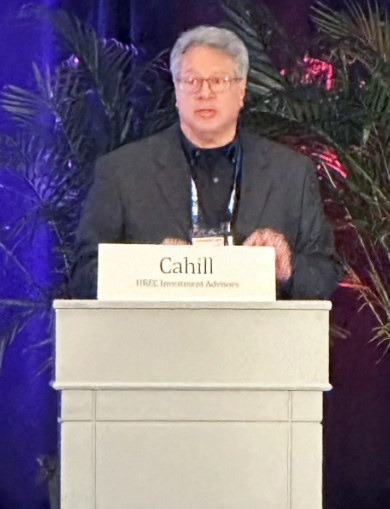
Windows, cycles and the buyers nobody knows
Cahill’s public commentary becomes particularly useful when the market is between moods. In 2015, he called the environment a rare opportunity and borrowed the conference theme: “The windows are wide open and it’s beautiful outside.” Buying, selling, building and refinancing could all make strategic sense at once. The operative word was strategic. What belonged in a portfolio? What was the exit? What was an owner trying to assemble?
By late 2024, the scenery had changed. Cahill said HREC’s closed deals had increased about 30 percent year over year, but the interesting activity was in transactions around $10 million to $20 million. He described first- and second-time hotel buyers who had sold car dealerships or quick-lube chains, heard about hotel ownership through friends and arrived with wealth but little digital footprint. Institutional sellers sometimes did not recognize their names.
It is a broker’s line and a useful rebuke to spreadsheet omniscience. Markets contain people who do not appear in the obvious database. Cahill called them an underground transaction market. They could use local relationships, family money and financing suited to the middle market. Finding them required industry contacts of the decidedly human kind.
Two signals from Cahill’s 2024 market view
Relative bars visualize Cahill’s reported year-over-year rise in HREC closings and his expected annual transaction growth over the following four to five years, absent a major shock.
Making a room think together
Since 2000, Cahill has served as co-chairman of the Lodging Industry Investment Council, a group of owners, lenders, brokers and other hotel-investment executives. The council’s annual Top Ten survey turns informed opinion into a kind of industry weather map. Cahill produced the 2025 edition, which found cautious optimism alongside familiar complications: interest costs, a shortage of acquisitions that met return targets, expensive brand-mandated property improvements and construction costs affected by tariffs.
A survey is a fitting instrument for him. It does not require one forecaster to perform certainty. It shows where experienced people agree, where they do not and which anxiety has become ordinary enough to price. Cahill’s many conference appearances follow a similar pattern. He is often the moderator, framing the question that makes a panel disclose its assumptions.
At the 2026 NYU hospitality investment conference, that question concerned artificial intelligence: did the room expect AI to improve hotel profits fundamentally over the next few years? The discussion moved through revenue optimization, labor scheduling, energy procurement and food-and-beverage menu engineering, as well as the costs of adopting the technology. Cahill was still doing what his career had trained him to do: put an emerging claim in front of operators and capital providers, then ask where it touches the income statement.
The long usefulness of seeing the whole hotel
Cahill’s professional record is broad, yet it circles one object. He has written about distressed properties, seasonal resorts, riverboat gaming, replacement cost and hotel market depth. He has lectured at Cornell, NYU, the University of Denver and UNLV. He appeared as a casino expert on the History Channel in 2012. The settings change; the analytical problem keeps its shape.
A hotel is a building that behaves like a company and a company whose standard lease lasts one night. Its carpet may be governed by a franchise agreement. Its value may turn on a renovation nobody can see yet. Its buyer may be an institution, an experienced operator or the owner of a recently sold chain of oil-change shops. It refuses to be understood from one angle.
That is why the sequence of Cahill’s career matters more than any single transaction. Operations taught him what guests and staff experience. Appraisal imposed a method. Microtel exposed the decisions inside a brand. HREC joined advice to execution. LIIC made collective judgment part of the practice. Football may have supplied the early lesson: read the formation, do the uncelebrated work and remember that the play depends on positions beyond your own.
Four decades after Hyatt Waikiki, Cahill is still asking practical questions of an industry that enjoys grand forecasts. What can the owner control? Where is the value hiding? Who can finance the next move? What does this asset want to become? A hotel may reset every morning. The advantage belongs to anyone capable of remembering what yesterday taught.