The neatest way to understand MET Technologies is to picture a customer complaint moving backward through a business. First comes the voice on the phone. Behind it sits a customer-service process. Behind that, a CRM. Farther back are the website, mobile app and advertisement that produced the customer in the first place. MET Technologies offered to handle almost every stop along that route. It was part call center, part software shop and part digital agency - a broad, deliberately convenient package assembled in Kolkata and sold to businesses abroad.
That package was the company's central idea. A telecom operator could outsource calls. A retailer could commission an e-commerce site. A growing company could ask for CRM development, search marketing and ongoing technical support without coordinating three unrelated vendors. MET marketed the reduction in handoffs as much as the individual services themselves.
The public growth story begins in 2010, when former Infosys software engineer Kunal Gupta founded the private company with three employees. Corporate records place its headquarters in Kolkata, and its own brochures later mapped a sizable delivery footprint across Godrej Waterside, Candor Techspace and Ecospace. One 2020 profile counted more than 1,300 seats across the three sites. The company now describes a workforce above 1,700; LinkedIn places it in the more conservative 501-to-1,000 band. The supplied company record estimates about 900. Whatever the exact current headcount, this was built as a labor-and-technology operation, not a tiny studio.
The bundle was the product
MET's catalogue stretches unusually far. Its BPO practice lists telecom, financial services, customer service and survey work. The software side offers custom development, product development, enterprise application integration, workflow assessment and CRM implementation. Web teams design and support sites; mobile developers work across iOS and Android; marketers sell SEO, social campaigns and pay-per-click management. Graphic design and e-commerce fill the remaining gaps.
The customers implied by that menu are companies with more work than internal capacity: a telecom brand that needs support coverage, a financial-services business requiring a structured process, an education provider managing inquiries, or a merchant that needs both an online storefront and people to look after its buyers. Company materials say clients span four continents, while its mobile-development page specifically names Australia, the United States, Canada, Panama, Romania and the United Kingdom.
This is not a classic software-as-a-service model. MET primarily sells time, expertise, delivery capacity and managed outcomes. A website or mobile app may carry a project fee; support can run on a recurring contract; call-center work can be priced around seats, volumes or processes; marketing becomes a retainer or campaign. Its published terms also refer to subscription-based support plans. The common economic engine is outsourcing: the client avoids hiring every specialist in-house and MET turns shared infrastructure and a large talent pool into margin.
The problems it promises to solve are ordinary but expensive. A company may have too many support calls, too few developers, an aging customer database, an online store that loses buyers at checkout or paid campaigns that do not convert. MET's answer is not a single piece of intellectual property. It is a managed team assembled around the bottleneck. That makes the offer legible to small and midsize businesses that cannot build a full digital department, while still leaving room for larger enterprises to carve out a process or extend an existing team. The tradeoff is familiar in services: a customer gains speed and variable capacity, but must transfer context, access and some operational control to the vendor.
“We see our customer as an invited guest to a party, and we are the hosts.”MET Technologies, on its public website
Kolkata as an operating system
The headquarters is more than an address. Kolkata gives the company access to English-speaking graduates, technical workers and a lower cost base than many client markets. Its old infrastructure brochure reads like a physical inventory of the outsourcing era: more than 1,000 PCs, more than 1,000 IP phones, power backup, global servers, dialers, in-house ERP and 100 terabytes of cloud backup. Software may be weightless, but service delivery still depends on buildings, shifts, bandwidth and trained people arriving on time.
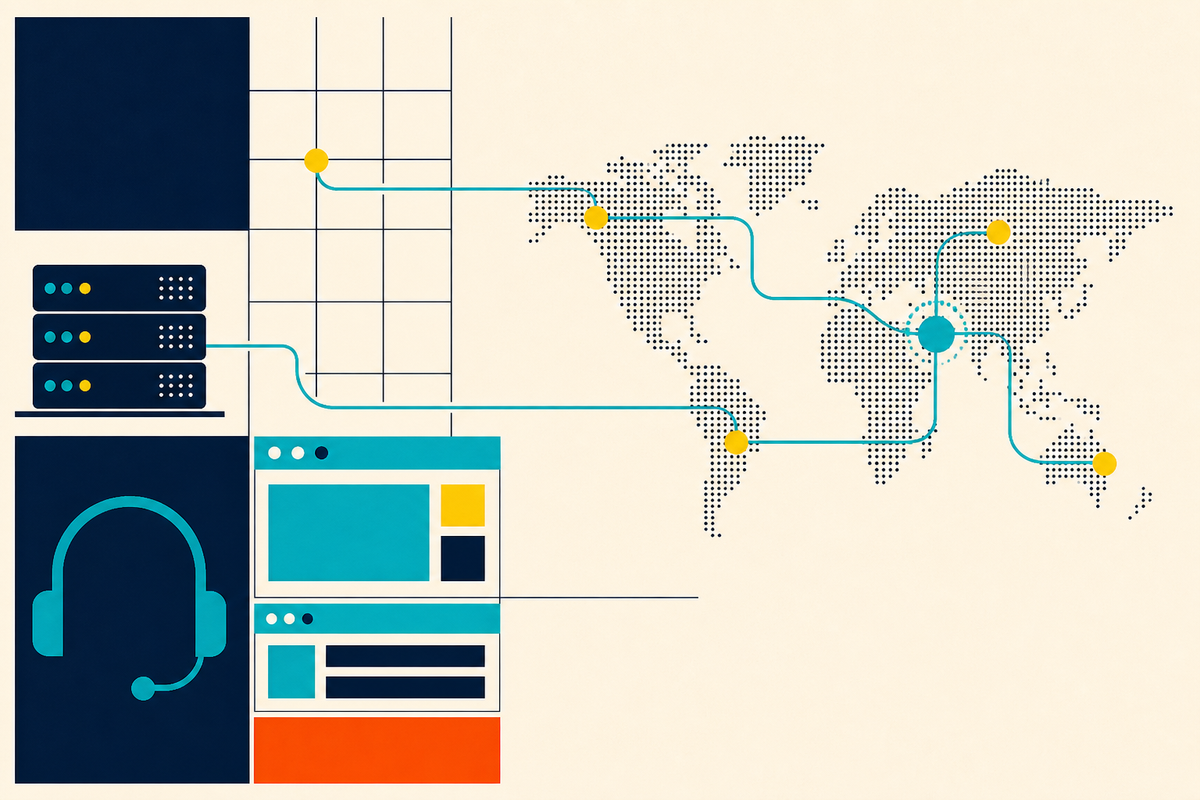
The company says it trains for those handoffs and hires across iOS, React Native, HTML, UI/UX, PHP, Android, .NET, content and digital marketing. That list reveals the practical advantage of its breadth: skills can sit near one another. A campaign team can talk to a web developer; a call-center process can feed requirements into a CRM build. In theory, each service makes the others stickier.
Recognition helped turn that capacity into a market signal. MET's awards page says CIOReview included it among 20 promising call-center technology providers in 2016 and that it won the Growth - IT Services category at the NASSCOM East IT Awards in 2017. The company also lists a 2017 CEO Magazine honor for Gupta and two West Bengal employer and leadership awards from 2018. These accolades are useful historical markers of how the business presented itself during its expansion. They do not measure present-day delivery, but they show that MET wanted to be seen as more than a low-cost voice operation: technology, employment and executive ambition were all parts of the pitch.
A crowded intersection
MET sits at the junction of three competitive markets. Against a local digital agency, it can offer more operational muscle. Against a pure call center, it can offer software. Against a large IT-services company, it can pitch flexibility and a lower entry point. The largest alternatives include Infosys BPM, Tech Mahindra, Wipro, Tata Consultancy Services and Firstsource, but many real bids are probably won or lost against smaller Kolkata providers and a client's decision to split work among specialists.
Breadth is therefore its differentiator and its complication. Buying one connected team can reduce meetings, contracts and blame-shifting. It can also concentrate risk. When the same provider touches customer acquisition, communications, software and support, weak controls in one unit can threaten every other part of the relationship. The more integrated the vendor, the more important its governance becomes.
Then the public record changed
The essential context
In September 2023, India's Enforcement Directorate arrested founder and director Kunal Gupta under the Prevention of Money Laundering Act. The agency alleged that an illegal call center operated by the company targeted people in the United States, United Kingdom and Australia using bogus technical-support offers, deceptive website sales and sham loan offers.
The Enforcement Directorate filed a prosecution complaint against Gupta and eight others in November 2023, seeking punishment for alleged money laundering and confiscation of alleged proceeds of crime. A Kolkata court took cognizance of the complaint that month. The agency later announced additional provisional asset attachments, including an order in December 2024 covering properties valued at INR 5.23 crore linked to Gupta and an associate. In that release, it said the investigation remained in progress.
These are allegations advanced by an enforcement agency, not a final finding of guilt presented here. But they are not a footnote, either. They directly concern the call-center operations at the heart of MET's commercial identity. An official 2023 Falta SEZ agenda also recorded a show-cause matter involving the company's Candor Kolkata IT/ITES unit. Meanwhile, public corporate-data services drawing from registry information continued to list MET Technologies as active in 2026, while displaying financial filings only through the year ended March 2021.
That produces an unusual split screen. The website remains online, career listings remain visible and the corporate status is active. The familiar brochure language - global partner, customer experience, technical breadth - sits beside a prosecution and continuing enforcement claims. Anyone evaluating the company now has to hold both records at once.
What operators can learn
There is still a useful business lesson inside the model. MET understood that outsourced services become more valuable when they connect. A customer does not really want a call-center seat or a PHP developer; it wants fewer unresolved tickets, a faster checkout and more retained buyers. Packaging the people, software and marketing around those outcomes can make a services company easier to buy.
- Bundle adjacent pain. The website, CRM and support queue are separate line items but one customer journey.
- Make infrastructure legible. Seats, backup systems, platforms and specialist roles turn an abstract promise into capacity a buyer can inspect.
- Treat controls as part of delivery. Compliance, audit trails and process ownership are product features when a vendor handles customer data and communications.
- Verify the growth story. Awards and company-reported scale can start diligence; filings, court records and customer references must finish it.
Where does MET fit today? On paper, it remains a Kolkata-based enterprise-services provider positioned between a BPO, a custom-development firm and a digital agency. For a buyer, that could mean one accountable team across several layers of an operation. It also means diligence cannot stop at capability. Corporate filings, ownership, data controls, process monitoring, customer references and the status of legal proceedings all belong in the buying decision.
MET Technologies built a company around removing friction between vendors. Its next chapter is defined by a harder kind of friction - between the useful logic of the service bundle and the grave allegations in the public record. The first explains how the company grew. The second determines how its claims will now be judged.