The first office had one feature no accounting textbook recommends: it sat above an old Irish pub in downtown Syracuse. Matt Gardner and fellow CPA Jim Capparelli had borrowed $50,000 to start their business. In year one, they collected about $30,000 in revenue and made no money. The balance sheet was thin. The patio was excellent.
Gardner remembers sitting out there, talking through the future and meeting prospects. The founders were doing more than filling an empty client list. They were learning how to explain a thing that did not quite exist yet: an accounting firm for owners who expected their financial life to work with the speed and clarity of the rest of their cloud-based business.
He calls that unprofitable opening stretch his favorite part of building the company. It was humbling, certainly, but also clarifying. A founder with little history has to sell a believable future. Every patio conversation exercised the storytelling muscle. The lesson Gardner carried forward was less cinematic than the startup canon prefers. Patience mattered. Overnight success, he concluded, did not exist.
The pub-era ledger
Restless inside the profession
Gardner studied accounting at SUNY Oswego from 2003 to 2007, earned his New York CPA license, and began in traditional public accounting as an accountant and auditor. It was a respectable route into a profession built around precision. He also found the surrounding culture stale. Tax, audit, and accounting work appeared to him largely unchanged since the 1970s, with conformity receiving more professional affection than curiosity.
His Syracuse ties were practical as well as sentimental. Gardner served as treasurer and a steering and finance committee member of 40 Below, a network of young professionals interested in the region's future. He later served as treasurer and a board member of Syracuse CoWorks, whose members treated collaboration as part of local economic growth. A board and finance committee term at Jowonio School added another view of how organizations make choices when money has to support a mission. These were not remote case studies. They placed the accountant inside the rooms where imperfect information, finite resources, and civic ambition meet. Long before Hiline developed a national nonprofit practice, Gardner had seen that a clean report is only the beginning. Someone still has to turn it into a decision.
The curious part kept wandering. Gardner has described himself as an "accidental accountant," an odd label for a licensed CPA who built an accounting company, until you look at the other rooms he entered. He got involved in restaurants, food trucks, commercial real estate, and early-stage technology investing. He became an owner or investor in Syracuse hospitality businesses Original Grain and XO Taco. Each venture made finance less abstract. A missed process was no longer an item for a memo. It was the rogue bill, the payroll deadline, the cash decision keeping an owner awake.
“The traditional approach valued conformity over curiosity and it sacrificed innovation.”Matt Gardner, on the accounting model he wanted to change
Those operator lessons gave Gardner a useful double vision. He knew what accountants were trained to deliver, and he knew what an entrepreneur actually wanted when the decisions arrived faster than a conventional reporting cycle. The creative founder did not need a lecture in the language of finance. The founder needed an interpreter, a current view, and enough order to make the next bet without flying blind.
02 / Productizing the back officeOne system, with humans left in it
Gardner & Capparelli began as a boutique practice for small and midsize businesses. Its earliest clients included SaaS companies, gaming businesses, and software developers. These companies already worked in the cloud, and their referrals behaved differently from the hyper-local pattern of a typical CPA firm. A good word traveled from Syracuse to the other side of the country. Geography loosened its grip on the client list.
The practice that became Hiline in 2016 moved toward what Gardner calls finance as a service: accounting, bookkeeping, tax, payroll, human resources, and strategic finance assembled as a managed operation. The idea sounds simple after someone has done the integration. Before that, a small business might have separate vendors, separate invoices, separate systems, and no single person responsible for making the parts speak coherently.
Gardner is emphatic about the distinction between a software interface and the service underneath it. Routine work should be automated. Systems should connect. Reports should arrive while they can still influence a decision. Yet he argues that accounting remains a services business. A transaction can be categorized by a machine; the consequences of a cash shortage still require judgment, trust, and someone willing to answer the phone.
This is Gardner's practical middle ground in an industry fond of false choices. He is neither defending the annual pilgrimage to a CPA's office nor suggesting that expertise can be compressed into a dashboard. Hiline uses technology to amplify the accountants. The human layer stays because the work becomes especially valuable where the tidy rules stop.
A firm cannot scale on introductions alone
Professional services firms love referrals for sensible reasons. They are warm, flattering, and inexpensive. Gardner's warning is that a firm built only on them eventually reaches a plateau. The founder becomes a human switchboard, growth remains irregular, and the pipeline reflects who happens to know whom. A pleasant beginning turns into a ceiling.
Hiline's response was to choose niches, invest before demand forced the issue, give sales a real structure, and build a recognizable brand. Gardner talks about moving past "founder hustle" as an operating necessity. A company that can repeatedly explain its value to the right market has a growth mechanism. A company waiting for its next introduction has a very agreeable dependency.
Five years on the Inc. 5000
The numbers suggest the machinery found traction. Hiline appeared on the Inc. 5000 in 2022, 2023, 2024, 2025, and 2026. Its 2025 entry placed it at No. 2,190 with reported three-year growth of 196 percent. In August 2026, Gardner announced the company's fifth consecutive appearance at No. 2,452, including a No. 3 ranking among Syracuse companies. In 2023, Red Iron Group made a strategic investment intended to support organic growth, technology, and acquisitions. The modest office above the pub had become a company designed to operate beyond a single city and beyond the founders' personal networks.
04 / A wider definition of missionSyracuse finds Silicon Valley by another route
Gardner has written candidly about coming from what he called a second-tier city and feeling drawn to the startup world's energy. He wanted the pace, the innovation, the sense of being where things were getting built. There was an old answer to that hunger: leave. His career produced another. Serve the industries already connected to that world, form relationships with the people building their tools, and turn Syracuse into a vantage point rather than an apology.
The market then led Hiline somewhere Gardner did not initially expect. Nonprofits shared much of the operating anatomy of venture-backed startups. Both had boards. Both raised money. Both had a product and a mission. The nonprofit version often carried fewer tools and tighter budgets while facing comparable complexity. Hiline began building more of its work around that need and, by Gardner's public account, was supporting close to 100 nonprofits by 2025.
His ambition has adjusted with the evidence. The startup ecosystem he once admired from afar is now one Hiline participates in through software partners, investors, and clients. The company also works with mission-led organizations far outside the glamour of venture capital. The connective tissue is not industry fashion. It is the operator facing a consequential decision with messy information.
“You have to listen to the market.”Gardner's compact rule for following the signal05 / The profession after the spreadsheet
Keep the judgment, retire the drudgery
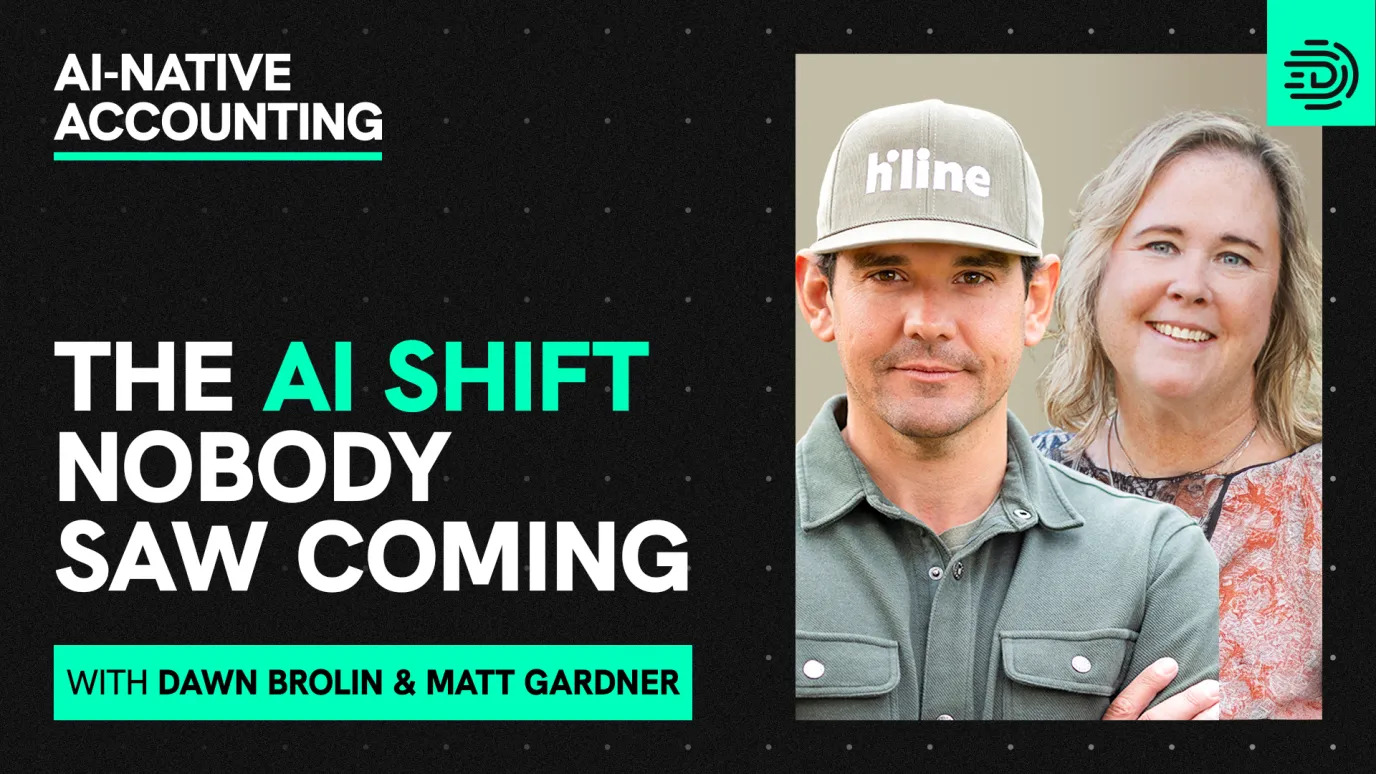
Gardner now carries his argument into public conversations. He hosts Fiscally Awesome, interviewing founders, CEOs, and nonprofit leaders about financial strategy and the less orderly parts of building organizations. In 2025, he joined Dawn Brolin and Kacee Johnson for the first episode of AI-Native Accounting, recorded at Scaling New Heights, to discuss how firms were using artificial intelligence in everyday work and decisions. In early 2026, he appeared on Growing Your Firm to dissect Hiline's path beyond referrals.
The public persona is consistent with the company thesis: curious, informal, and mildly impatient with professional theater. Hiline's own biography lists a father, husband, entrepreneur, investor, business builder, golf-head, and music lover. The vocabulary is not the usual CPA-firm gray. Neither is the baseball cap in his company portrait. Gardner appears interested in making the career itself more attractive, not merely making the client portal faster.
That may be the larger project. If software performs more of the transaction work, an aspiring accountant can spend less of a career moving figures between systems and more of it interpreting, advising, and building. Gardner's aspiration is a profession where technology raises the value of human attention. The dull work shrinks. The accountable relationship does not.
There is a neat irony in this accidental accountant's path. He chased the energy of startups and found it inside an old profession. He looked beyond Syracuse and built a company there. He adopted more software while insisting the service was still human. And the patio above the pub, with its unimpressive first-year ledger, supplied the lesson that held through all of it: build the muscle, listen carefully, and give the numbers time to catch up.