A car contains plenty of things its owner never thinks about. Martin Eberhard could give you a rather precise count of one of them: 6,831. That was the number of small lithium-ion cells in the original Tesla Roadster's battery pack. When the subject came up with the hosts of Car of the Future, the obvious joke followed. Couldn't they have rounded it up to 7,000? Engineering has an unfortunate habit of spoiling a tidy number.
The little cylinders resembled the cells inside a laptop battery. Put enough of them together, manage their temperature and electrical behavior, and an object associated with answering email could help propel a sports car. The connection looks almost quaint now. At the beginning of Tesla, it was a wager about what an electric vehicle could be, who might buy one, and which existing industry could supply its essential parts.
Eberhard, Tesla's co-founder and first CEO, had spent years making electronic products before he tried making an automobile. His route to the Roadster ran through computer terminals and an electronic book. Follow that route and the car begins to look less like a sudden conversion than a particularly ambitious change of enclosure. There were still components, customers, suppliers and difficult tradeoffs. This time, the enclosure needed wheels.
A book with a battery
Eberhard earned his computer engineering bachelor's degree at the University of Illinois Urbana-Champaign in 1982, followed by a master's in electrical engineering in 1984. His early work at Wyse Technology included designing the WY-30 ASCII terminal. He later co-founded Network Computing Devices and served as its chief engineer. These were products for people who needed computers to do useful work, a good education in the distance between an elegant circuit and a saleable machine.
Then came Marc Tarpenning. In 1997, the two founded NuvoMedia, whose Rocket eBook launched the following year. Long before reading on a handheld screen became ordinary, they were trying to persuade readers to carry a dedicated electronic device. Books, an industry with several centuries of practice at being portable, had acquired a charging requirement.
NuvoMedia was sold to Gemstar in 2000. Tarpenning's later account of the venture describes their shared interest in science fiction and space exploration; even the name Rocket eBook carried that enthusiasm. The partnership also gave them experience with portable electronics, rechargeable batteries and the less romantic work of getting hardware made. Tesla would require a larger budget and rather different crash tests, but they were already accustomed to building something that customers had to hold, use and trust.
The accelerator as an argument
Eberhard's interest in an electric sports car had an important practical reference: AC Propulsion's tZero. Alan Cocconi and Tom Gage had already demonstrated that electric propulsion could deliver startling performance. Eberhard borrowed the car to show potential investors what he meant. A business plan can promise acceleration. A passenger seat offers a shorter explanation.
One demonstration involved asking a passenger to reach for the dashboard, then accelerating hard enough to make the task difficult. There is something agreeably impolite about a sales pitch that briefly prevents its audience from completing a simple gesture. The point was immediate: people who associated electric cars with modest expectations needed to reconsider the machinery underneath them.
Tesla Motors was incorporated by Eberhard and Tarpenning in July 2003. Elon Musk led its first major investment round in 2004 and became chairman. Ian Wright and JB Straubel also belonged to the early founding group. The familiar argument over founder titles can obscure the sequence of actual work: a company was formed, money was raised, engineers joined, and a small team tried to produce a car.
Musk mattered enormously to that effort, as financier and later chief executive. Eberhard's earlier place in the story matters too. A useful history can accommodate both without turning every battery connection into a referendum on one personality. The Roadster came from a network of people, including engineers outside Tesla whose work made the initial proposition credible.
Desire, with the charger included
The choice of a sports car was a business decision as much as a matter of taste. A young company could start with a small number of expensive vehicles for buyers willing to pay for performance. Those buyers would also give the company a chance to challenge an awkward assumption: that choosing an electric car required settling for less fun.
By early 2007, Eberhard was already discussing a subsequent sports sedan and American production. The ambition extended beyond a two-seat curiosity. The Roadster supplied a first encounter, a way to make the technology tangible while the company worked toward a broader range of vehicles. A customer might come for the acceleration and leave with a different opinion about electricity.
Small lithium-ion cells. One large exercise in getting the neighbors to cooperate.
Illustration is schematic; each mark does not represent a fixed number of cells.Of course, thousands of cells do not become a roadworthy battery merely by being introduced. In his explanation on Car of the Future, Eberhard described the early concern that a failing cell could ignite its neighbors. The team designed around containing that failure. The pack needed controls, cooling and protection as well as stored energy. This was the less photogenic part of the proposition, and an essential one.
Contemporary descriptions of the Roadster's energy storage system included microprocessors to manage charge balance and temperature, a cooling system and independent safety provisions. That level of coordination helps explain why a background in electronics could be relevant to cars. The battery pack was an engineered system, with many small pieces whose collective behavior mattered more than their individual familiarity.
Eberhard helped lead the Roadster through design and testing, including regulatory safety work. The team grew across disciplines. This kind of progress offers few convenient scenes for a founder legend: meetings about requirements, tests that must be repeated, parts that must agree with other parts. Yet those are the activities that eventually allow a stranger to take a set of keys.
A departure before the deliveries
Progress did not make Tesla easy to run. The Roadster encountered production difficulties and rising costs. Eberhard lost the CEO role in 2007 and left the company's operating leadership before customer deliveries began in 2008. His work on the original car and his absence at its arrival belong in the same account. The timing gives his story a discomfort that a list of achievements cannot quite tidy away.
A lawsuit against Musk followed in 2009, and the dispute was settled. Five people are recognized as Tesla co-founders: Eberhard, Tarpenning, Musk, Wright and Straubel. The circumstances of Eberhard's departure have remained contentious. What requires no adjudication is the sequence: he helped establish the company and lead its first car's development, then watched the business continue under other leaders.
His attachment to the product survived the separation. In 2009, he described building a mobile charger for himself, then friends, then more Roadster owners than he had initially anticipated. It is an unusually revealing postscript. After all the arguments over a car company, there was still a practical problem with a car, and he had started making something to solve it.
Back to the parts that mattered
Eberhard's subsequent career kept returning to batteries. He worked with Volkswagen, co-founded InEVit, and later co-founded Tiveni. InEVit's battery-pack technology found its way into SERES vehicles. At Tiveni, his work addressed battery systems and manufacturing cost. The company names changed; the underlying interest remained recognizable.
That continuity is easy to miss if every account begins and ends with his former employer. Tesla made his name familiar, but his engineering career had a substantial first act and a continuing one afterward. Reducing the cost of a battery pack is a quieter ambition than unveiling a sports car. It also bears directly on whether more people can afford an electric vehicle.
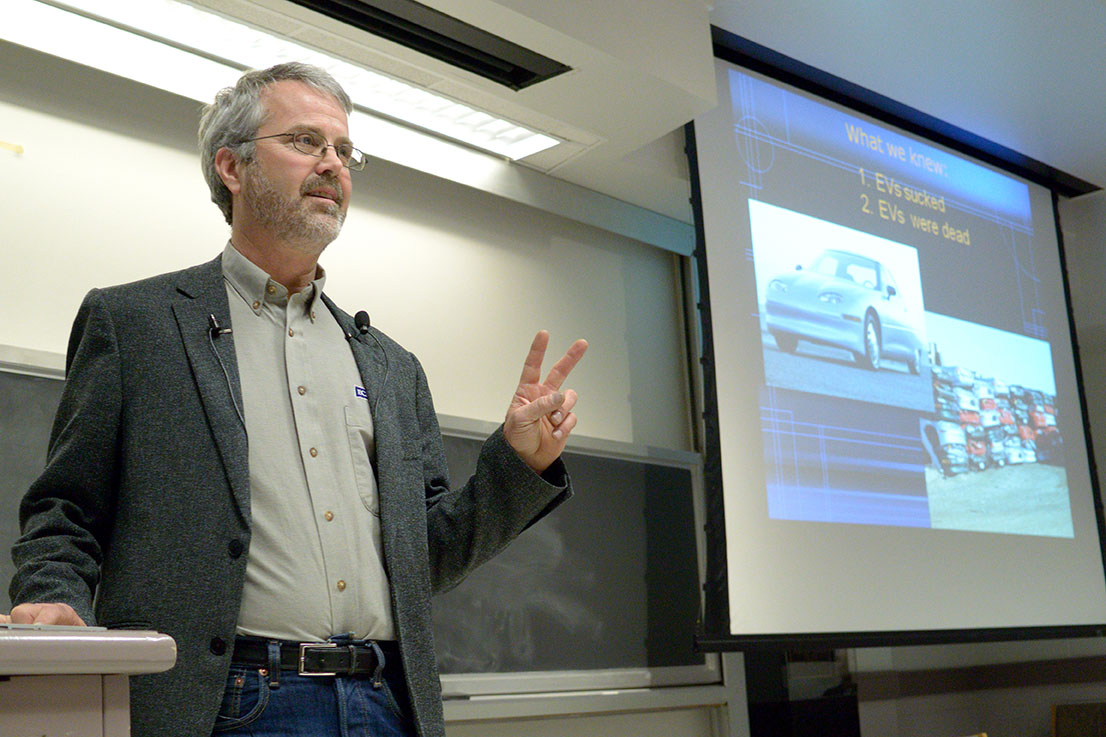
There is another thread at Illinois. Eberhard and his wife, Carolyn, established a scholarship for women in engineering. On a 2014 campus visit, he spoke about the need to encourage girls to continue with mathematics and science. He also described the enduring value of learning to investigate how things work, even as particular technologies and programming languages change.
“My education has served me for a lifetime.”
Martin Eberhard, 2014
In 2025, he was elected to the National Academy of Engineering for leadership in electric vehicles and entrepreneurship in transportation. In 2026, he returned to Illinois as a commencement speaker. His advice to graduates included: “Don't let your degree define you.” Coming from someone whose products moved from terminals to books to cars, that instruction has a fairly substantial exhibit attached.
His public LinkedIn profile now lists him as retired. He continues to appear in interviews, including Alex Gibney's 2026 documentary Musk. The arguments over Tesla's beginnings remain available to anyone who wants them. Alongside those arguments sits a more durable record: products built, companies started, and an electric sports car whose battery pack helped change what buyers expected.
The pleasing detail is still the number. Six thousand eight hundred and thirty-one is awkward to remember and difficult to put on a bumper sticker. It brings the story back to scale, materials and decisions. Before the familiar brand, there were small cells, an engineer who thought they could do another job, and the long task of making them work together.
Keep following the circuit
- LinkedIn - Martin Eberhard
- Watch: Kim Java in conversation with Eberhard
- Watch: Do Something Meaningful - Stanford
- Watch: Car of the Future - PBS NOVA
- Read: Rocket - Marc Tarpenning’s NuvoMedia account
- Read: National Academy of Engineering election
- Explore: 2026 Illinois graduation program
- Read: Eberhard’s Illinois reflections
- Read: The early tZero demonstrations
- Read: The original Roadster battery system
- Read: Eberhard’s mobile charger project
- Read: The 2026 documentary interview
- Company profile: Tesla