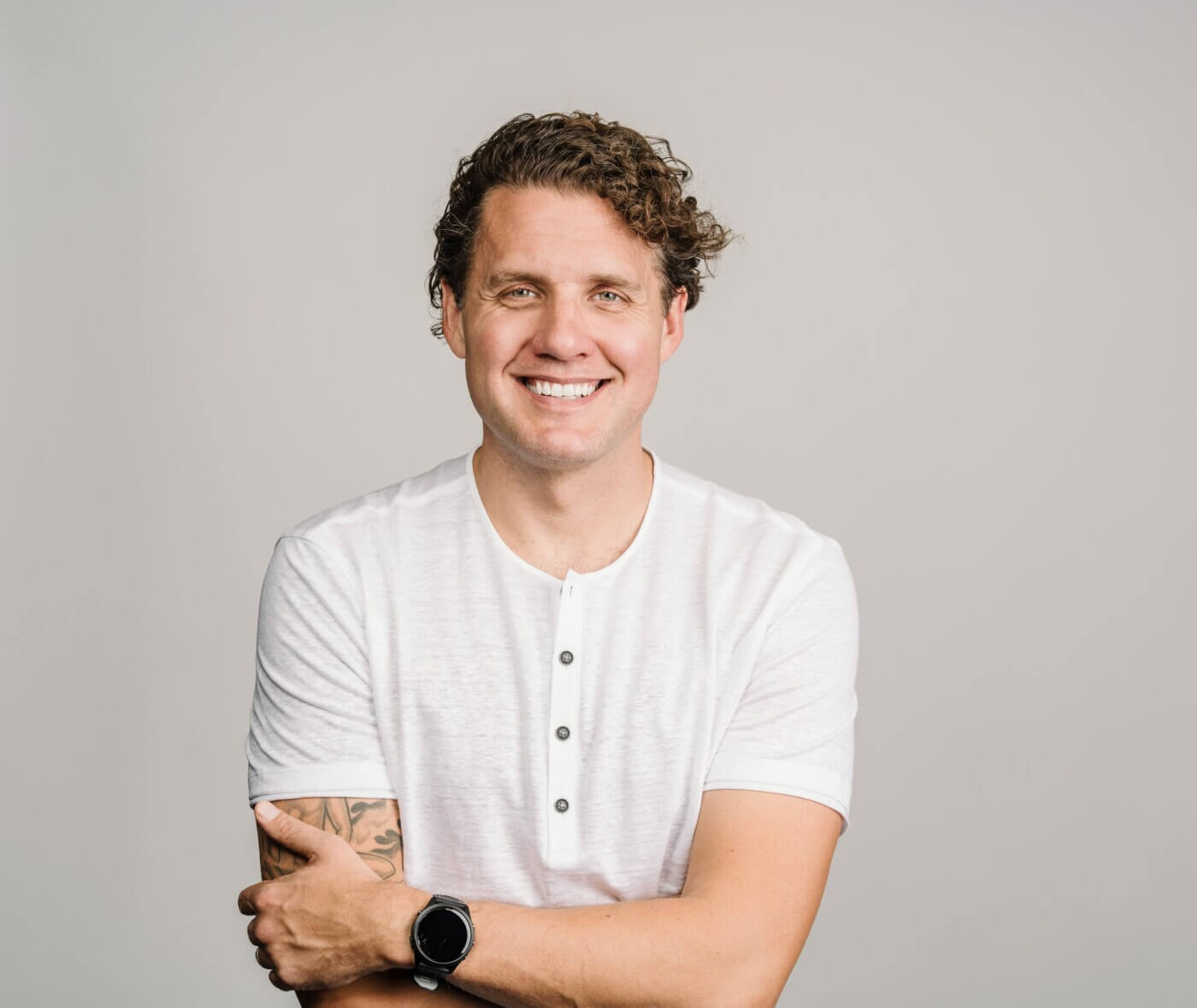
Austin, Texas born 1984 • Lives in Los Angeles
THE PROFILE
The Counterintuitive Case for Caring Less
Mark Manson did not arrive on the world stage with a PhD, a TED talk, or a theory that the universe wants you to vibrate at higher frequencies. He arrived with a blog, a swear word in a title, and a thesis that most self-help is making people worse. It turned out that the world had been waiting for exactly this.
Born on March 9, 1984, in Austin, Texas, Manson studied International Relations at Boston University - a degree that trained him to think about systems, incentives, and why people behave against their own interests. He graduated in 2007 with, by his own admission, no clear plan. What he had was a laptop, a voice, and enough frustration with conventional wisdom to fill several books. That frustration, productively deployed, eventually became a category-defining literary career.
The early years were unglamorous. Manson started writing dating advice for men in 2008 - the kind of internet niche that attracts hustle-porn merchants and charlatans in equal measure. He was neither, but he was learning. By 2010, he had pivoted toward broader life advice under the banner of what he called "post masculine" writing: practical, honest, anti-posturing. The audience grew. Then it exploded.
Who you are is defined by what you're willing to struggle for.
- Mark Manson, The Subtle Art of Not Giving a F*ck
In 2015, Manson published a blog post titled "The Subtle Art of Not Giving a F*ck." It went viral in the way things did before the algorithm swallowed everything: organically, through people sharing it because it said something true out loud. The post argued, without apology, that caring about everything is exhausting and counterproductive - that choosing what to care about is the actual work of living a meaningful life. It was simultaneously obvious and revelatory. Publishers noticed.
HarperOne released the book version in September 2016. It debuted at #6 on the New York Times Bestseller List. By July 2017, it had climbed to #1. It stayed in the Top 10 for 279 weeks - nearly five and a half years of consecutive bestseller presence, an achievement that places it in the company of books like "Gone Girl" and "Lean In." As of 2024, the book has sold more than 20 million copies across 65-plus languages, been adapted into a Universal Pictures documentary, and spawned enough imitators that "anti-self-help" has become its own crowded genre, which Manson almost certainly finds both amusing and annoying.
The desire for a more positive experience is itself a negative experience. And, paradoxically, the acceptance of one's negative experience is itself a positive experience.
- Mark Manson
The genius of the book - and Manson's broader project - is that it doesn't ask you to be happier. It asks you to be more deliberate about what you let matter to you. Drawing on stoicism, existentialism, Buddhist philosophy, and hard-won personal experience, Manson makes the case that pain, failure, and discomfort are not obstacles to a meaningful life. They are the preconditions for one. This is not a comfortable message. It is, however, a useful one. The book's commercial success suggests that a lot of people were quietly desperate for someone to say it.
In 2019, his follow-up "Everything Is F*cked: A Book About Hope" debuted straight at #1 on the NYT list, a rarer achievement that confirmed his first book was not a fluke. Where "The Subtle Art" was personal, "Everything Is F*cked" was civilizational - a diagnosis of why modern societies, despite unprecedented wealth and comfort, are drowning in anxiety and nihilism. The answer, again, was counterintuitive: hope itself can be the problem when it becomes a substitute for action.
By 2021, Manson had become someone Will Smith wanted to write his autobiography with. "Will," co-authored with the actor, became an instant #1 NYT bestseller in November 2021. The timing was, to put it diplomatically, complicated - the book arrived months before the Oscar slap incident recontextualized everything Smith had said in it about anger, identity, and self-control. Manson, characteristically, did not shy away from acknowledging the irony.
In 2023, Universal Pictures released a documentary feature about Manson's life and ideas, also titled "The Subtle Art of Not Giving a F*ck." It screened in theaters and was released digitally through Universal Pictures Content Group. The film follows Manson alongside Disappointment Panda - a character from the book whose superpower is delivering hard truths - through the philosophical terrain of the book. It was, by most accounts, exactly as strange and entertaining as it sounds.
Manson married Brazilian wellness influencer Fernanda Neute in 2016, the same year "The Subtle Art" launched. They now live in Los Angeles, having shed the digital-nomad lifestyle Manson maintained for years - writing from hostels and Airbnbs across Southeast Asia, Europe, and Latin America. His website describes that period as formative: confronting different cultures' ideas about meaning, happiness, and failure sharpened his thinking in ways that no amount of library research could have.
You and everyone you know are going to be dead soon. And in the short amount of time between here and there, you have a limited amount of f*cks to give. Very few, in fact. And if you go around giving a f*ck about everything and everyone without conscious thought, then you're going to get f*cked.
- The Subtle Art of Not Giving a F*ck
What sets Manson apart from the sprawling self-help industrial complex is not just that he swears. It's that he does the actual intellectual work. Every book is researched obsessively; every counterintuitive claim is grounded in psychology, philosophy, or neuroscience. His website, markmanson.net, attracts over 15 million readers annually because the content earns that traffic - not through SEO games, but through writing that is genuinely more rigorous than most peer-reviewed papers on the same topics, and considerably more readable than all of them.
His newsletter, "Your Next Breakthrough," lands every Monday morning with ideas designed around one goal: meaningful personal change. Not inspiration. Not motivation. Change. The distinction is everything. The newsletter is a direct line from Manson's research obsession to the reader's week. It is, by any measure, one of the most substantive personal development newsletters on the internet.
More recently, Manson launched the Purpose app - an AI-powered personal growth mentor that learns your patterns, challenges your blind spots, and helps you build on what you actually care about. It is, in some sense, the logical evolution of his entire project: scaling the honest, research-backed conversation he has been having on his blog for fifteen years into a tool that can be personalized to a single user's life. Whether an app can replicate the intimacy of his writing remains to be seen. But the ambition is entirely consistent with who he is.
His podcast, now titled "SOLVED with Mark Manson," replaced his earlier guest-driven format after he concluded - honestly, publicly - that he didn't enjoy the interview show enough to do it well. The new format is solo, deeply researched, and structured around one audacious promise: by the end of each episode, the topic is solved. Not simplified. Solved. It is either the most confident thing in podcasting or the most insane, and possibly both. Episodes on finding purpose, living by your values, and navigating the AI future have drawn significant audiences of people who want depth without mysticism.
At 42, Mark Manson has achieved something most writers never do: he has genuinely changed how a generation thinks about pain, responsibility, and meaning. He has done it without becoming a guru, without selling a methodology, and without abandoning the intellectual humility that made his work worth reading in the first place. The books are not perfect. The philosophy is not complete. He would be the first to say so. That, precisely, is the point. Certainty is the enemy of growth. The man who taught the world to give fewer f*cks still gives a great many of them - just the right ones.
SELF-HELP
PHILOSOPHY
NEW YORK TIMES BESTSELLER
AUTHOR
BLOGGER
PODCASTER
MENTAL HEALTH
STOICISM
EXISTENTIALISM
PERSONAL DEVELOPMENT