Long before an AI assistant could summarize a document, open a service ticket, or rummage through a company's scattered memory, Marcel Pividal was learning a less fashionable form of intelligence: how a complicated system behaves when somebody actually depends on it. His early world was networks. Packets moved or they did not. Access was granted or denied. Reliability was not a slogan, because the blinking equipment had no interest in slogans.
That apprenticeship began in 2001 with network administration at the United Nations, followed by work at Cisco, Roche, Alorica and Bayview Financial. The organizations changed. So did the stakes. The recurring task was to turn intricate machinery into something people could safely use. It is a useful education for the current AI moment, in which a charming interface can conceal a small republic of data stores, identity systems, policy rules and brittle integrations.
Today Pividal is based in Asheville, North Carolina, and works at Glean as a Founding Senior AI Solutions Engineer. The job sits at the lively border between promise and proof. Companies have plenty of information and a growing supply of models. What they often lack is a dependable way for those models to locate the right knowledge, respect the right permissions and do something useful with the answer.
The education beneath the interface
Pividal's career can be read as a tour of the enterprise stack. He started with the network layer, moved through security and infrastructure, then took responsibility for teams and operations. At Independent Purchasing Cooperative, he rose from managing infrastructure engineering and operations to Director of Engineering. By then, the cables and routers had become only one part of a larger question: how should technology be organized around a business?
Networks, consulting and security
Roles at the United Nations, Cisco and Roche established the operational base.
Infrastructure at financial scale
A CCIE credential arrived in 2007, followed by seven years leading infrastructure work at Bayview Financial.
From systems to engineering leadership
At Independent Purchasing Cooperative, management of infrastructure and operations led to a Director of Engineering role.
Cloud AI goes worldwide
At AWS, Pividal became a senior worldwide specialist working across fraud, identity, computer vision, search and generative AI.
Enterprise knowledge becomes the product
At Glean, the old concerns of access, context and action converge in workplace AI.
A career measured in layers
Approximate chapter length, not a boundary between skills
“I'm an avid learner, a seasoned network engineer who fell hard for AI/ML.”Marcel Pividal
Falling for AI, with the skepticism intact
The phrase “fell hard” suggests romance. Pividal's published work suggests something more exacting: romance with a checklist. At AWS, he wrote and presented about fraud prevention, identity verification, content moderation and computer vision. These are fields where a demo can be delightful and a mistake can be expensive. The work repeatedly returns to thresholds, false positives, security controls and the point at which a person should remain in the loop.
In 2022, he co-presented a Spanish-language AWS session on using AI services to prevent fraud and verify identity. The same year, at AWS re:Invent, he helped lead a workshop that combined image, video, audio and text services into a content-moderation workflow. The subjects were different, but the architecture of thought was consistent: separate the problem into parts, understand what each service can see, and design the handoff between machine judgment and human responsibility.
His work on Amazon Fraud Detector made the theme unusually concrete. A 2023 article explained a cold-start feature that could train with as few as 100 events, including 50 classified as fraud. The achievement belonged to the service and its research team, but the communication problem was Pividal's territory: show practitioners how a lower data threshold changes what they can attempt, then show them how to review, label and retrain rather than treating the first model as an oracle.
Pividal also contributed to an IEEE conference paper on lightweight unsupervised learning for detecting anomalous user behavior. The paper belongs to the academic side of his record; his certifications reveal the vocational side. He earned Cisco's demanding CCIE credential in 2007 and later added AWS architecture and advanced-networking certifications. One foot remained in theory, the other in the machine room.
A technology career, visible in its changing questions
Read chronologically, Pividal's technical writing acts like a set of trail markers. A 2022 article on identity-verification metrics asked how teams should judge a face-matching system rather than merely admire one. The operational choices included confidence thresholds and the costs of false matches and false rejections. A later identity-verification whitepaper placed those choices inside a broader architecture of encryption, activity logging, personal-data protection and carefully controlled access. The model was one component. The surrounding controls made it deployable.
In 2024, another article addressed the retirement of Amazon Rekognition's people-pathing capability. Pividal and his co-author did not stop at the announcement. They laid out open alternatives, including a combination of YOLOv9 for detection and ByteTrack for tracking, and described how those tools could run with services such as SageMaker and Lambda. It is a characteristic kind of bridge work: acknowledge the closing path, then give builders enough landmarks to find another.
That same year brought a wider frame. Pividal was listed among contributors to the AWS Well-Architected Generative AI Lens, guidance organized around the less photogenic questions of architecture: security, reliability, performance, cost and sustainability. He also co-presented a re:Invent session on generative AI for inclusive media experiences. The subjects had expanded from a single managed service to the design of whole systems and the people those systems might otherwise leave out.
There is a temptation to describe this sequence as a pivot, because technology prefers dramatic nouns. The evidence looks more cumulative. Fraud models require data discipline. Identity systems require thresholds and controls. Content moderation requires multiple media types and human review. Retrieval requires connectors and permissions. Agents require all of it, plus the authority to act. Each assignment enlarged the diagram without erasing what came before.
The difficult middle, where answers become actions
By late 2024, the center of Pividal's AWS work had shifted toward enterprise retrieval and action. He co-authored the introduction to the Amazon Kendra GenAI Index, a retrieval layer designed for conversational systems over company content. Days later, he appeared on an article about Amazon Q Business plugins, which let an assistant reach beyond indexed information and perform live actions in systems such as Jira, ServiceNow, Salesforce and Google Calendar.
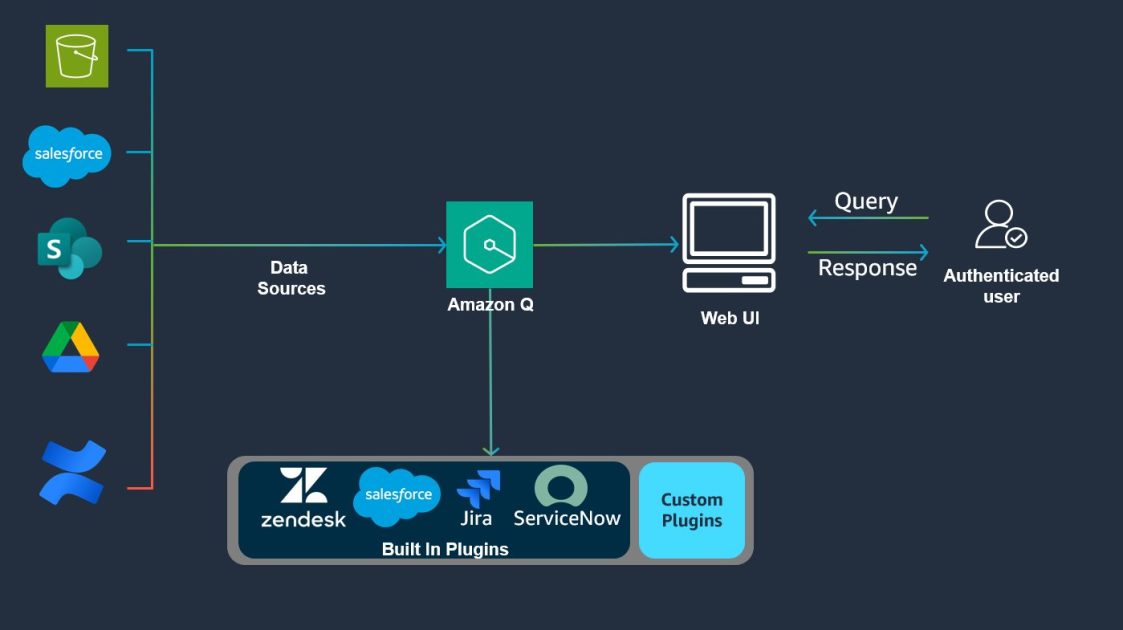
This is the hinge in his story. Search finds information. Plugins act on it. The distance between those verbs is where an enterprise either gains a capable assistant or acquires a very confident nuisance. The system has to distinguish indexed knowledge from live data, authenticate the user, map natural language to an allowed operation and preserve the application's own controls.
A small public moment captures Pividal's working style. In February 2025, after Kendra's new GenAI index appeared, he opened an issue in the Terraform AWS provider. The new index edition could not yet be expressed in the infrastructure configuration. He described the missing option, linked the documentation and, when the issue template asked whether he would implement a fix, answered yes. It was not a keynote. It was the tidy repair of a gap between a product announcement and repeatable deployment. Enterprise technology advances by such gaps being noticed.
The move to Glean later that year therefore looks less like a sharp turn than the next room in the same house. Glean's work sits amid search, organizational knowledge, permissions and agents. These are the subjects that had already begun to converge in Pividal's AWS portfolio. The employer changed; the difficult middle remained.
A patient engineer in an impatient field
Pividal speaks English, Portuguese and Spanish, an apt detail for someone whose professional role is translation even when everyone is using the same language. Solutions engineering asks for fluency between executives who want an outcome, developers who want an interface, security teams who want a boundary and employees who simply want the software to help. The technical vocabulary is only the beginning.
His record does not offer a theatrical origin myth. It offers something rarer in technology: continuity. Network administration taught dependencies. Security engineering taught limits. Infrastructure leadership taught operational consequence. Cloud AI supplied models and managed services. Enterprise search and agents brought the earlier lessons back, now attached to natural language.
From Asheville, Pividal is working in a field that prefers to count progress in model releases. His career proposes another clock. It counts in systems made repeatable, permissions kept intact, thresholds explained, and actions made safe enough to use on a Monday morning. The result is not less ambitious. It is ambition with an operations manual.
AI may feel new because it speaks. The enterprise beneath it remains full of old obligations. Marcel Pividal arrived at this moment by learning those obligations one layer at a time, then following them all the way to the agent.