There is a window in the floor of Lulu Designs’ Mill Valley flagship. Look through it and you can see the creek beneath the building. Most jewelry shops arrange things so that you look down at something expensive. Here, you can also look down at moving water.
The setting suits a company whose designs borrow from leaves, celestial shapes and the natural world. The studio occupies part of an 1892 lumber-yard structure, with original redwood and windows. Furniture makers and woodworkers preceded the jewelers. Making things is a useful tradition for a shop to inherit.
But scenery does not settle an invoice. Behind the soft shapes and gemstone colors is a business that has had to reconsider what it means to get bigger. For founder Stacy King, the work of designing jewelry and the work of deciding how to sell it have become closely connected.
A potter changes the scale
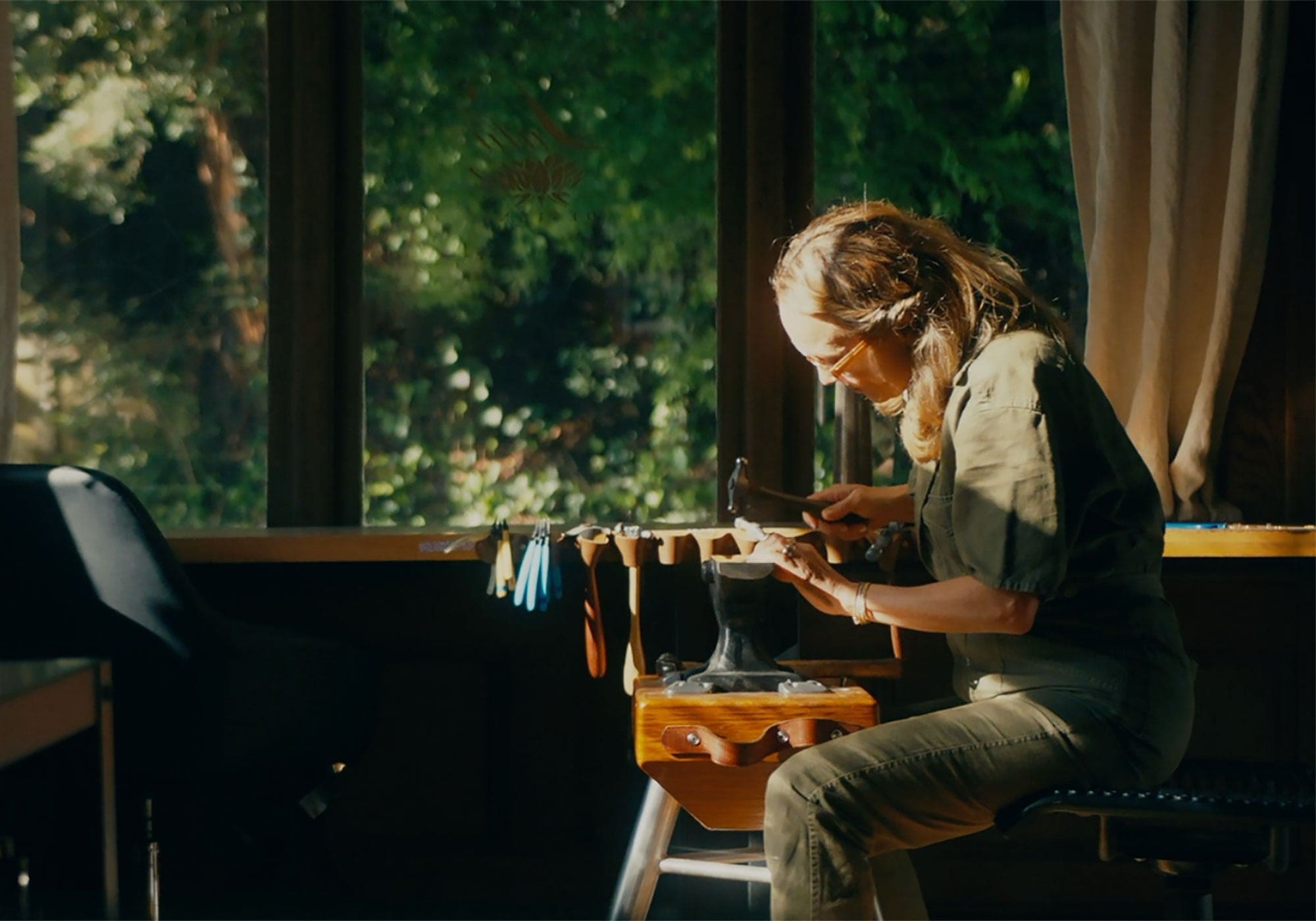
King founded Lulu Designs in 1997. She had studied fine art at San Francisco State, graduating in 1991 with an emphasis in ceramics, and worked as a production potter. Jewelry gave her another material through which to think about proportion, color and balance. The object became smaller; the sculptural problem remained.
A 2013 Marin Magazine profile describes pregnancy prompting her to step away from the pottery wheel. It also supplies a pleasingly modest origin for the company name: Lulu comes from Louise, King’s middle name. By then, the team had moved beyond her garage, and a fine-jewelry offshoot, Lulu Luxe, was in the plans.
Today the creative partnership includes Kristina Crotti, a master metalsmith trained at the Rhode Island School of Design. King and Crotti work with the studio’s jewelers across casting, fabrication and finishing. That combination matters: an appealing shape on paper still has to become an object with weight, edges and a comfortable relationship to the body.
The order that did not become cash
In a May 2026 interview recap published by Courtney Gray Arts, King’s wholesale years come with an uncomfortable detail: a corporate customer failed, leaving an $11,000 invoice unpaid. The account also describes a house refinancing during a cash shortage and years of personal money supporting the business.
The problem extended beyond one customer. Catalog accounts and retail galleries brought volume, while margins, complexity and control over the product story became concerns. The response described in the interview was a greater emphasis on direct selling, the flagship, custom work and fewer, closer wholesale relationships.
A corporate customer’s failure left completed work unpaid, according to the 2026 interview recap.
My reading of this shift is straightforward: the studio wanted more say in the conversation surrounding its work. A retailer places an order; a person commissioning a ring explains what it means. Those are different relationships, with different demands on the maker’s time.
“Become best friends with change.”Stacy King, quoted in the May 2026 interview recap
A collection with rules attached
Lulu still wholesales. Its policy effective January 1, 2026 makes the desired relationship explicit. A new fine-jewelry account opens at $4,000; a bridge-collection account at $2,000. Existing accounts have a $1,500 seasonal minimum. Zip-code exclusivity requires $6,000 in annual purchases.
The company’s stated aim is to have shops present a coherent collection. Standard production takes four to six weeks. Bridge and fashion collections can be ordered through Faire, while fine jewelry and one-of-a-kind pieces are excluded from that channel. These are practical boundaries around what a partner can buy, where and on what timetable.
The transferable idea is to make the desired relationship visible in the terms. For another maker, the useful exercise would be to examine whether an account supports a full presentation of the work and a manageable production schedule. A shop needing tiny opening orders or immediate replenishment would have a harder time fitting this arrangement.
What the customer actually gets
For the wearer, Lulu offers several entry points: necklaces, earrings, rings, bracelets and cuffs; fine and bridal jewelry; and pieces organized around birthstones, zodiac signs or other symbols. Someone choosing a gift can begin with a meaning. Someone choosing for themselves can begin with a color or shape.
The price spread reflects that variety. At research time, retailer Unique Boutique listed a Muse Necklace at $175 and a Raja Ring at $275. Lulu’s own catalog listed the 10K Prayer Necklace at $980 and the 10K Cairo Diamond Shield Necklace at $3,750. These are examples, rather than a quoted budget for a commission, and listings can change.
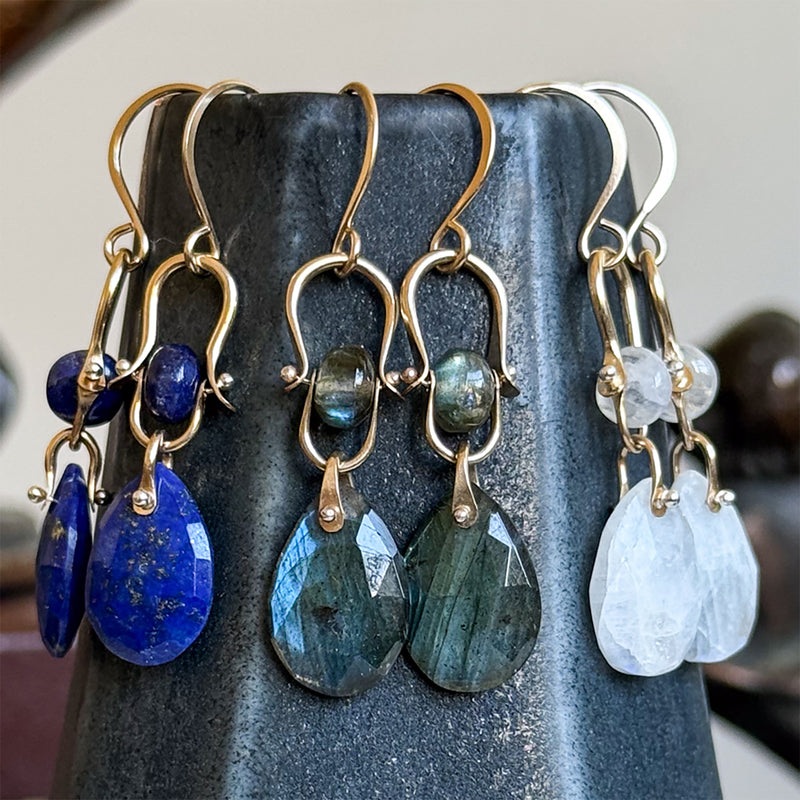
The company occupies the space between an everyday jewelry purchase and a personal fine-jewelry commission. Alternatives include other artisan labels and neighborhood custom jewelers. Lulu’s particular combination is a sculptural design practice, a recognizable vocabulary of natural and symbolic forms, and a working studio that also serves customers directly.
Its materials account names recycled-metal supplier Hoover & Strong and describes reusing studio scraps. It also says the majority of pieces are made locally, while acknowledging outsourcing. That is a more specific description of the operation than assuming that every component originates at the Mill Valley bench.
Your grandmother’s stone, your drawing
The custom process begins with a conversation about expectations and budget. Clients gather reference images or make a mood board. The studio draws a design and discusses materials, including whether to use stones and metals the customer already owns. CAD artists then produce a three-dimensional rendering for review and revision before casting or fabrication.
- 01Conversation
Expectations + budget - 02Images + drawings
Shape + materials - 033D rendering
Review + revisions - 04Studio making
Casting or fabrication
For an inherited stone, this offers a way to preserve the material while changing the setting. For a wedding-ring buyer, it gives preferences a visible form before the finished piece exists. The process asks the customer to participate, so it suits someone prepared to make choices and review them with a jeweler.
Keeping jewelry in use also requires less glamorous work. Lulu’s in-house repair offering includes ring resizing, resetting stones and laser welding, with a quote after discussing what the piece needs. The same customer may arrive wanting something new or carrying something already loved. A bench can serve both.
There is also permanent jewelry: chains fitted and welded for wear without a clasp, with choices of metals, charms and birthstones. It gives friends or gift buyers another reason to make an appointment together. Here the experience of choosing becomes part of the purchase.
Keeping the conversation close
On the company website, custom-design testimonials describe choosing stones, working through iterations and incorporating a grandmother’s diamond. These are company-selected accounts, but they reveal the kind of relationship Lulu wants to invite: a customer bringing a personal history into a technical discussion about an object.
That is the interesting connection between the business and the jewelry. A design can become more personal as the wearer gets closer to the making. The shop above the creek gives that exchange a physical address. You can walk in with a stone, some pictures and an unfinished thought. The next step is a conversation.