Luca Barabino’s company has a cyclist carrying a tree for a logo. As business emblems go, it is agreeably inconvenient. A tree has roots. A bicycle has somewhere to be. Combining the two requires balance, a little nerve and considerable faith in the person doing the pedalling. The image came from a cyclist Barabino saw passing the first office in Genoa. For someone who began with an interest in visual identity, it was a useful discovery: a company could have a picture with an argument inside it.
In December 2025, forty years after founding Barabino & Partners, he left its executive leadership. The business had become part of Excellera Advisory Group the previous year. Federico Steiner became CEO; Massimiliano Parboni became chairman. A career spent helping companies explain consequential changes had arrived at a consequential change of its own.
A designer takes the microphone
Before financial transactions and international offices, there was a young Genoese with several interests that did not fit neatly into one profession. Barabino studied architecture because he wanted to work in visual design and corporate identity. He wanted to draw the image of a company. Architecture offered a route towards that ambition.
There was also radio. In the 1970s, he helped establish two private-radio ventures, Radio Genova 76 and Radio Genova Libera. Broadcasting gave his interest in communication an outlet beyond the drawing board. Then came involvement with Confindustria’s young entrepreneurs, where businesses appeared as an assortment of products, founders, markets and public perceptions.
In his later recollections, these interests converged. He travelled to English-speaking countries to learn about communications businesses, then established his own in 1985. The first workplace was the basement at home, followed by a small Genoese office. He used the local word scagno for the latter. “Startup” would acquire considerably more glamour.
The ambition was larger than the premises. He described the work as management consultancy in corporate communication. That description put him close to the decisions a company made and the people those decisions affected. For a visual designer, the canvas had become rather large.
Italy starts explaining itself
The firm opened in Milan in 1987. Its subsequent assignments placed it in the middle of Italy’s changing relationship with corporate ownership. In 1995, it won the communications tender for the STET privatisation. In 1996 came the listing of the utility MGA. The Rome office followed in 1997. Enel’s 1999 privatisation added another assignment with a public far beyond the usual circle of financial specialists.
A listing turns a company into a proposition people must examine. A privatisation adds questions about public ownership, price and confidence. Communications advisers work where those questions meet. Barabino’s business grew around events whose meaning had to travel beyond a transaction document.
The geography widened too. Brussels opened in 2002, London in 2007, Berlin in 2009 and New York in 2011. Later came the acquisition of B2P Communications Consulting in 2022, strengthening the German presence and taking the firm into France. Madrid followed in 2024. The cyclist was covering some distance.
- 1985Genoa
- 1987Milan
- 2002Brussels
- 2007London
- 2009Berlin
- 2011New York
Selected office openings during Barabino’s leadership.
Recognition followed the international work. In London in 2008, he received a Dolce Vita Award for communicating Made in Italy. Other recipients included photographer Oliviero Toscani, creative businessman Lapo Elkann and football coach Marcello Lippi. It was a gathering of different professions connected by the job of making Italy legible abroad.
The partners in the name
There was a quieter decision inside the company name. Barabino placed “Partners” beside his surname from the beginning. Partnership was intended as an operating principle: colleagues would share the undertaking and its results. A consultancy, after all, has an awkward industrial characteristic. Most of its productive equipment goes home in the evening.
His advice on building a business returns to giving, listening, reputation and detail. He regards profit as necessary, while describing a certain distance from money as useful. The combination is practical rather than ascetic. A company needs enough financial strength to choose its course; people need reasons to stay aboard.
“Give, and then you receive.”
Luca Barabino · translated from Italian
In 2022, the firm gave that argument a conspicuously concrete form. It introduced a payment for eligible employees, collaborators and interns outside existing incentive arrangements. The amount was between €1,000 and €2,000. The stated basis was the commitment and motivation they would bring during the year.
Businesses generally prefer to congratulate people after the result. Here the payment arrived with the work still ahead. Calling it a recognition of the future made the proposition plain. There was money attached to the expectation that people would contribute, including people near the beginning of their careers. In a profession fluent in declarations of intent, a payment has the advantage of being difficult to mistake for a slogan.
The firm’s payment to eligible staff, collaborators and interns for the commitment they would bring to the year.
The firm’s 25th-anniversary party had displayed a more theatrical version of togetherness. Around 800 guests attended. Luca Bizzarri and Paolo Kessisoglu supplied entertainment; Checco Zalone closed at the piano. Business history shared the programme with comedy. Even a corporate anniversary benefits from someone prepared to puncture the solemnity.
A second team in Genoa
Football gives Barabino’s language of teams a literal home. His allegiance is to Genoa. The connection extended into sponsorship and involvement with its football school, bringing him into the less glamorous, more persistent business of youth sport: facilities, coaches, families and children who need somewhere to play.
From 2011, he personally invested in renovating the Sciorba sports facility in Genoa. The project involved bringing neglected and weather-damaged structures back into use. An interest that might have stopped at a seat in the stands became a commitment to the place where other people trained.
His account of the youth-football work also describes a network of affiliated teams and support for football schools in Kenya and Nigeria. After an interruption, sponsorship with Genoa resumed for the 2023–24 season. The relationship ended in June 2025. It belongs to a defined period of his life, with work behind it and an ending of its own.
Football is often used as a convenient metaphor for business. Here it complicates the portrait in a helpful way. The adviser accustomed to transactions and executive decisions also had a stake in whether a local sports ground could serve its users. A balance sheet and a training pitch ask different questions of their patrons.
An ambassador comes home
On 12 October 2023, Genoa named Barabino an Ambassador of Genoa in the World. The ceremony took place at Palazzo Ducale during the city’s celebration of Genoa and Columbus. Mayor Marco Bucci presented the recognition. Barabino, microphone in hand, was briefly the subject of the public message.
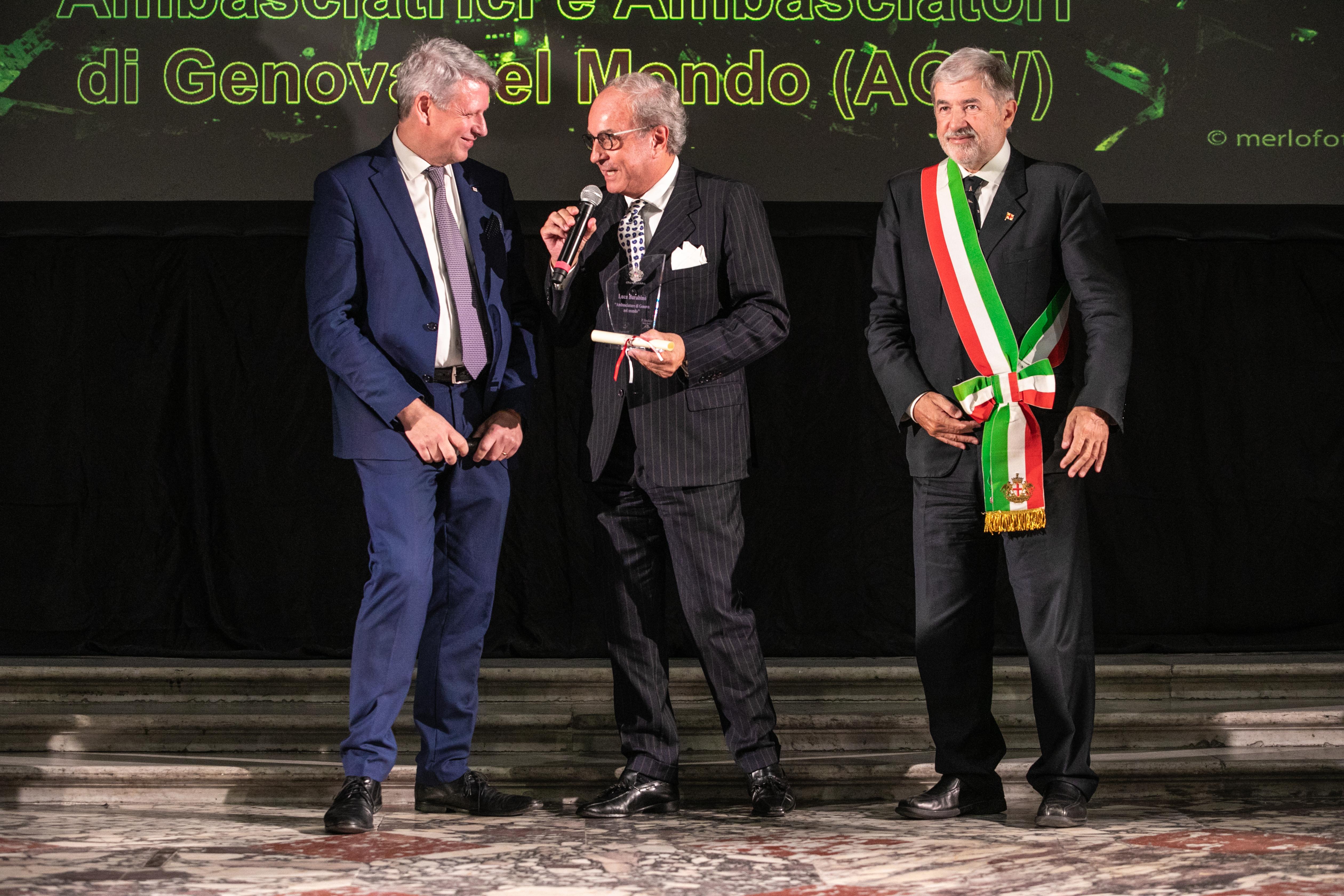
He shared the credit with his colleagues, connecting the personal honour to the business they had helped build. The gesture fits the partnership idea. A founder’s reputation accumulates through work carried out by many people, even when only one surname appears on the invitation.
The civic title also gives the international expansion a point of return. Genoa was the place of his early broadcasting ventures and the company’s first premises. It remained the location of his sporting involvement. An overseas office could extend the business; a continuing attachment to the city gave the journey a recognisable starting point.
Before the room catches fire
Barabino’s professional argument has always concerned where communication belongs inside a company. In an October 2024 discussion about public relations, he described crisis work as something to prepare before the critical event appeared. It involved a crisis team, coordination with lawyers and the practical use of traditional and digital media.
That sequence matters. By the time a company is answering urgent questions, its choices may already have narrowed. Preparing responsibilities and methods beforehand gives people a chance to respond coherently. The work draws an adviser into operational decisions, well before anyone argues about the wording of a statement.
At a professional training session on 3 December 2025, he returned to the pressures of a world in continuing uncertainty. He discussed communication as a means of maintaining coherence between a company’s identity, decisions and public account of itself. Internal communication received particular attention: colleagues have their own channels and their own capacity to strengthen or weaken a company’s standing.
His argument leaves little room for treating employees as an audience that can be informed last. People need to understand what their organisation is doing. A company’s explanation travels through them, whether or not the communications department has approved every word.
A company learns to carry on
The final executive transition was announced on 11 December 2025, as ICG replaced Xenon Private Equity as Excellera’s financial partner. Barabino would leave his role and turn to personal projects, including charitable activity. The succession had been planned for continuity. Steiner and the team would carry the business forward.
His next public chapter includes a 2026 listing as founder and CEO of Aldebaran Holding. Legalcommunity Week placed him on its programme for a discussion of corporate reputation and trial by media. The subject remained close to his professional territory, even as the line beneath his name changed.
Forty years earlier, he had wanted to give companies an identity people could see. He ended up working on identities people could understand, question and sometimes invest in. The company bearing his name now continues under other leadership. There is still a cyclist in its emblem, still a tree to carry, and room for someone else to take the handlebars.