A family can live in a neighbourhood, speak French at home, and need a French-language school without appearing clearly in the numbers used to plan one. Linda Savard was talking about that problem in western Ottawa in 2014. School buildings were crowded. Money for expansion was difficult to secure. Yet the question underneath the construction question was surprisingly basic: how many families were there?
For a school trustee, an uncertain count has consequences. A building has a capacity. A funding request needs a case. A neighbourhood can change faster than the information describing it. Savard put the difficulty of counting francophone families in new housing developments alongside overcrowding and provincial funding in her account of the challenges facing local schools. An administrative detail had become a question about who would have room.
That concern makes a useful entrance into her career. Savard founded the Ottawa management consultancy Axion in 2004. She has worked in economic development, chaired a French-language public school board, and taken leadership roles in francophone community life. Across those settings, there is a recurring relationship between the people an organization serves and the information it uses to make decisions.
The work before the ribbon
Public buildings lend themselves to ceremony. There is a doorway, a ribbon, a photograph, perhaps a pair of scissors rather more imposing than the task requires. School planning has a less photogenic beginning. Someone must establish demand, explain why existing provision falls short, and help persuade the institution with the money to respond.
Savard came to elected school governance with experience at a smaller table. Before becoming a trustee, she had spent four years chairing the council of the public elementary school her son attended in Barrhaven. It is a concrete detail in a career otherwise described through organizations and titles: a parent’s connection to a particular school preceded responsibility for a wider territory.
She was elected to the Conseil des écoles publiques de l’Est de l’Ontario, or CEPEO, in 2010. Her committee responsibilities included audit, construction, and priorities and means. By her 2014 account, she had become vice-chair in 2013. Those assignments placed her in the part of school governance where aspirations encounter budgets and buildings.
“le travail n’est pas terminé”
Linda Savard, on seeking re-election in 2014
The work is not finished.
She went on to chair CEPEO from 2015 to 2018. The board’s 2017–2018 annual report put its territory at more than 40,000 square kilometres and described a workforce of more than 2,000 people. Savard and education director Édith Dumont signed its opening message together. The scale helps explain why governance occupies so much of her story. A school board must keep many local realities in view at once.
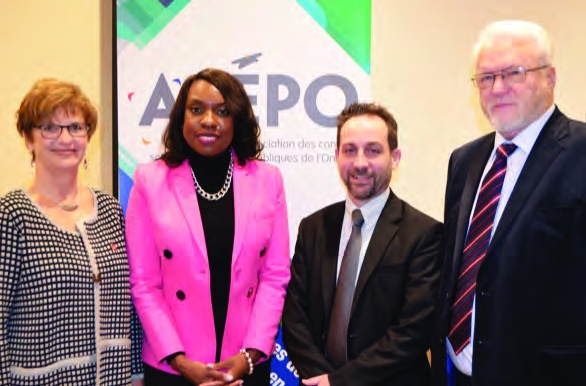
The report’s educational priorities ranged from openness to the world to identity-building and sustainable development. Savard’s role belonged to the board overseeing that work; the classrooms and their daily achievements belonged to a much larger team. Her career is best understood with that distinction intact. Institutional leadership is shared work, even when a photograph requires everyone to stand in a single row.
What the client keeps
Axion began after Savard had spent more than fifteen years managing nonprofit and public-sector organizations in economic development. Her reason for establishing a boutique practice was to bring that experience into other organizations. The consultancy’s fields of work include organizational management, strategy and governance.
Before Axion, her economic-development work already had a francophone focus. A letter from Savard, identified as director of the Chambre économique de l’Ontario, was read into a parliamentary committee’s evidence. It thanked FedNor for backing a gala recognizing francophone entrepreneurs and their contribution to Ontario’s economy.
Its description of her approach puts the emphasis on what remains with the client. Tools and knowledge should help an organization continue after the assignment has ended. Client autonomy is the stated measure of success. That is an exacting ambition for an advisory business: the handover matters as much as the recommendation.
The idea becomes tangible in the work itself. A strategy is useful only when people understand how it relates to their responsibilities. A business plan needs someone willing and able to carry it forward. Advice cannot do the next meeting’s thinking on behalf of a board. It can give that board a clearer starting point.
Savard’s consulting record reaches into organizations with very different purposes. Entraide budgétaire Ottawa’s 2012 activity report records an agreement with Axion, represented by Savard, to coordinate a project intended to develop the organization’s expertise and tools. Campus 3’s 2019–2020 report credits her support in completing its 2019–2023 strategic plan in October 2019. These are specific examples of the organizational work behind the broad job title.
Three recurring questions across her consulting and governance work.
French Ontario, in figures
In 2022, Axion produced a white paper on the Franco-Ontarian economy for the Assemblée de la francophonie de l’Ontario and the Fédération des gens d’affaires francophones de l’Ontario. Here, the people being counted were entrepreneurs and workers. The project used reports and Statistics Canada databases to describe business activity and economic needs.
The published findings included more than 30,000 francophone businesses in Ontario. They also estimated that the francophone and bilingual workforce contributed 12 percent of provincial GDP, representing more than C$80 billion. These were estimates about an economy, rather than financial results belonging to Savard or her company.
2022 Franco-Ontarian economic white paper. Provincial estimates, not Axion company metrics.
The report examined labour shortages, business succession, international positioning, women’s entrepreneurship and immigrant entrepreneurs. Together, those subjects widened the frame around French-speaking Ontario. Community life also takes place through employment, ownership and decisions about who will run a business next.
Two years earlier, Axion had worked on a different kind of economic document: a bilingual, 32-page prospectus presenting French Ontario to entrepreneurs and investors. Its intended circulation included international business missions and embassies. Savard described the assignment as a way of presenting Ontario’s francophone richness and diversity to a business audience. Her closing phrase was brief and cheerful: “Bon recrutement!”
The prospectus and white paper had different jobs. One introduced an opportunity to an outside audience. The other described an economic population and its needs. Read together, they show how her consulting work moved between making a case and assembling the evidence behind it.
A house with a continuing purpose
The Maison de la francophonie d’Ottawa brings the community side of Savard’s career into a physical place. Its cooperative, the Coopérative multiservices francophone de l’Ouest d’Ottawa, now identifies her as president. Her professional profile dates the chair role to June 2025.
Her connection to the project reaches back further. In the provincial announcement of support for a west-Ottawa francophone community hub in 2017, she spoke as CEPEO chair about the partnership with the cooperative. The emphasis was on a real presence of multigenerational French-language community programmes and services in the west of the city.
A school board and a cooperative bring different responsibilities to a partnership. Their common ground here was a place that could serve people beyond a single age group. Savard’s later presidency of the cooperative gives the story continuity: the institution once encountered through a school-board partnership became an organization she would help govern directly.
There is also a smaller, more personal record of how she helped bring people into that work. In the cooperative’s 2024–2025 annual report, departing board member Souhila Timezouert thanked Savard for recommending her and persuading her to join. Timezouert described the experience as participation in a meaningful project supporting French language and cultural vitality in Ontario.
An invitation rarely gets its own line in a career timeline. It can still matter to an organization. Boards need people as well as plans. Timezouert’s recollection provides a specific example of Savard helping connect a colleague to community service, with the account coming from the person who accepted.
After the strategy is printed
The national school-governance work offers another view of her emphasis on participation. The Fédération nationale des conseils scolaires francophones listed Savard as an Axion consultant for an interactive reflection on its next strategic plan at the 2024 congress. The process invited feedback on the directions the federation should take for 2025–2030.
At the 2025 congress in Kelowna, the programme again listed her, this time for sessions around the new plan. Participants were invited to make the strategy their own and consider how it related to their school board or organization. The progression is telling: first contribute to the direction, then connect the resulting document to the people expected to use it.
A five-year plan can look wonderfully settled on paper. The dates line up. The headings behave themselves. Implementation asks more awkward questions about responsibility, choices and differing local circumstances. Sessions built around participants’ own organizations acknowledge that a common direction still needs local understanding.
Savard’s documented career contains honours, elected office and the founding of a business. It also contains school committees, consultations, project coordination and invitations to join a board. Those smaller units of work explain how her roles connect. They are the means by which an organization learns about the people around it and prepares to respond.
The question from western Ottawa remains useful across that career. Before an institution decides what to build, fund or offer, it needs a picture of whom it serves. Savard has worked repeatedly on bringing that picture into focus. The finished plan may be tidy. The people it must account for are living lives that keep moving.