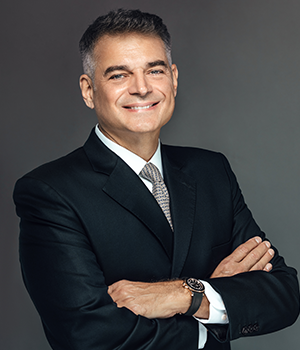
The Mobility 3.0 Guy
LeonardoGannio
He sold a $500M distribution empire, then went looking for a harder problem. He found it in the back seat of every taxi.
He sold a $500M distribution empire, then went looking for a harder problem. He found it in the back seat of every taxi.
Leonardo Gannio runs MAGIIS out of Sunny Isles Beach, Florida, and his pitch is unusual for a software CEO: he insists the software is not the star. "We are not the brand," he says. "We are just the instrument to help you compose your music." The music, in this case, is played by the dispatchers, drivers and small fleet operators who move people for a living - an industry that the apps mostly bulldozed rather than equipped.
MAGIIS is a mobility-as-a-service platform built for transportation-for-hire providers. Think of the corner taxi company, the regional shuttle operator, the limousine outfit with forty cars and no engineering team. They lost the last decade to ride-hailing giants who owned the rider's phone. Gannio's wager is that the same automation, dispatch intelligence and customer-loyalty machinery the giants kept for themselves can be packaged, white-labeled, and handed back to the operators. He calls the result an "Always Available Vehicle Experience."
It is a strange place for a career to land. Gannio spent two decades inside enterprise software and hardware distribution, then built and sold a half-billion-dollar company. Most people stop there. He wrote a book instead, and started over in an industry he had never worked in.
A sustainable business is not just the idea; it is the process of different things and ecosystems that we need to bring together.— Leonardo Gannio
Start with the engineer. Gannio chose industrial engineering for a reason he still repeats: "I want to understand the nature of the forces that help us to make it happen." That is not the language of a man who wants to build one product. It is the language of someone who wants to understand the machine that builds products - and then go find the next machine.
He took that mindset into the corporate world and climbed it across Latin America. At Informix Software he ran Brazil and South Latin America and pushed the company into top-three worldwide market share, then steered his region through the IBM merger. At PeopleSoft he was regional director for the South Cone in 2003, the year mergers with JD Edwards and then Oracle reshaped everything under his feet. He logged time at NCR, at Lexmark running the Mercosur region, and at Ingram Micro. If there is a school for operating inside chaos, he attended all of it.
Then he stopped working for other people's logos. FixIt Urban Hardware Stores came first - a retail chain that tried to make hardware shopping make sense in a dense city. Inventika Solutions followed, a digital agency built around technology resellers. Neither was the headline.
The headline was AKTIO. He founded the value-added technology distributor in 2004 and grew it into a seven-country operation across the Americas doing $500 million in revenue. In 2016 he sold it to a Fortune 500 distributor. That is the exit most founders frame and hang on the wall.
Gannio went looking for the next force to understand. He found an industry that millions of people use every day and almost nobody had bothered to modernize from the operator's side: the business of moving people for hire.
Urban hardware stores that tried to fit the warehouse experience into the rhythm of a city block. His first proof that he could build a brand from scratch.
A digital agency built for value-added technology resellers - the unglamorous middle layer of the tech economy that rarely gets good software.
Founded 2004. A value-added technology distributor that reached $500M in revenue and seven countries before its 2016 sale to a Fortune 500 distributor.
The current obsession. A tech-enabled market network for transportation-for-hire operators, with automation and an embedded marketplace at its core.
The book that doubles as a manifesto - a roadmap for operators staring down autonomous vehicles, MaaS and the digital ecosystems coming for their margins.
As "the Mobility 3.0 Guy," Gannio takes the thesis on the road, arguing that the future of getting around belongs to whoever builds the net-of-networks first.
Executive roles at NCR, Informix, PeopleSoft, Lexmark and Ingram Micro across Latin America - strategy, operations, and a front-row seat to three corporate mergers.
He founds the value-added technology distributor that will become his defining business win.
AKTIO Group is sold to a Fortune 500 distributor after reaching $500M revenue across seven countries.
Named one of Industry Era's Best Industry Leaders; MAGIIS secures seed funding and sets out to re-tool transportation-for-hire.
He publishes "How to Win and Thrive in the Future of Passenger Transportation" - part forecast, part field manual.
Most founders ship a product and call it a day. Gannio published a thesis. Mobility 3.0 lays out where passenger transportation is heading - autonomous vehicles, mobility-as-a-service, and the digital ecosystems that will decide who keeps the customer - and what operators have to do now to survive it.
The title is also the brand. Across Instagram, X, TikTok and Facebook he is simply the Mobility 3.0 Guy, which is either excellent positioning or a man fully committed to a bit. With Gannio, it tends to be both.
"The Future of Mobility Is Here. Are You Ready to Lead the Way?"
The future of mobility will be Electric, Autonomous, Connected and Personalized. Our vision is to be the Net-of-Networks in this future.— Leonardo Gannio
Look at the resume sideways and it scatters: hardware stores, marketing, distribution, now taxis. Look at it straight and there is one habit repeating. Gannio finds an industry where the people doing the actual work are starved of good tools, and he builds the tools.
Resellers got Inventika. Tech buyers got AKTIO. Now the dispatcher and the small fleet owner get MAGIIS. The engineer who wanted to "understand the nature of the forces" never stopped being an engineer - he just kept changing what the machine was for.
He frames sustainability not as a product feature but as an ecosystem you assemble. That is a distributor's worldview, not a startup's. It is also why he keeps describing MAGIIS as the instrument rather than the artist. The operators play. He builds the strings.