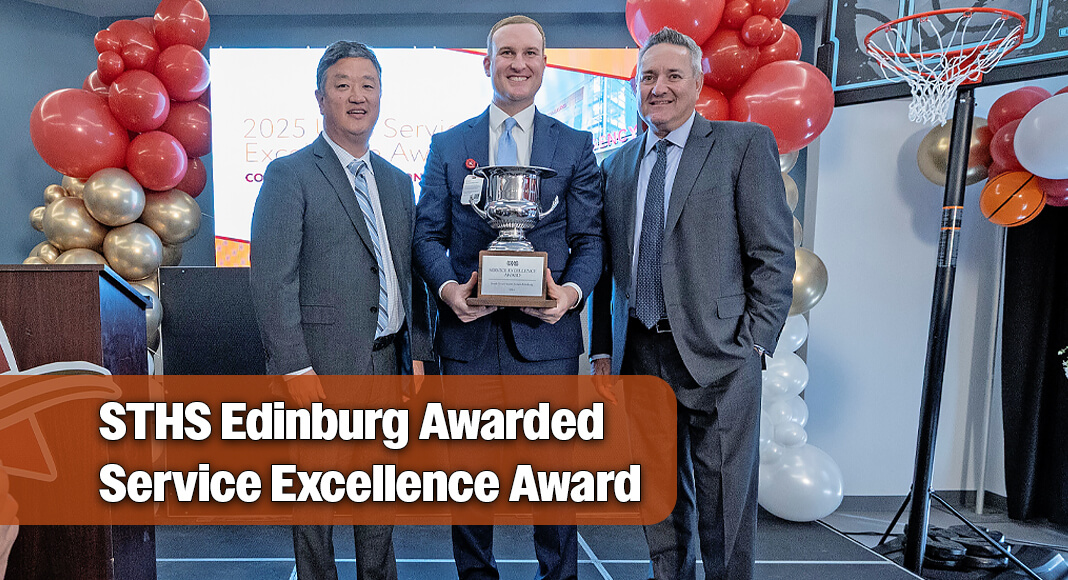
Lance Ames is holding a silver cup. On either side stand two executives from his parent company. There are balloons, dark suits, a screen, and, unexpectedly, a basketball hoop. The photograph has the pleasing jumble of a real workplace celebration: formal recognition has arrived, but the room has other jobs to do. Ames stands in the middle, smiling, with both hands around the award. It is an appropriate place to begin a story about someone whose career has involved learning how many jobs an organization contains.
In September 2025, he accepted the UHS Service Excellence Award on behalf of the teams at South Texas Health System Edinburg and STHS Children’s. Marc Miller and Edward Sim were there for the presentation. Ames’s response directed attention across the organization, including its support, technical, and administrative staff. A photograph can accommodate only so many people. His acknowledgment made room for rather more.
He had become chief executive in 2018, after serving as chief operating officer and interim CEO. The promotion put him in charge of the same Edinburg organizations where he had begun his UHS career as an associate administrator. The route circles back to its starting point with a larger set of responsibilities. Read as a career story, it gives the title a useful prehistory.
First, learn how the place works
The earlier chapter takes place in Virginia. Ames studied at Virginia Commonwealth University from 2009 to 2012, earning a master’s degree in health administration. Before that came a bachelor of science degree at Brigham Young University. The sequence joins university study to a series of working assignments, rather than presenting the diploma as the finish line. His early positions included an administrative internship, a residency, and a business development and performance improvement role with Bon Secours.
Those job titles lack the economy of “CEO.” They are longer, less convenient on a name badge, and considerably more informative about the work. At Maryview Medical Center, Ames moved from administrative resident to manager of business development and performance improvement. He was building a career around the internal workings of institutions before he was responsible for leading two of them.
There is a particularly useful detail in an early professional recommendation. Gregory Sorensen described Ames comparing existing processes with established practices, identifying gaps, and producing both short-term and long-term workflow maps. It was an assignment with tangible outputs: a comparison, a diagnosis of the process, and a sequence for changing it. Sorensen’s account makes the young administrator visible through the work he delivered.
“respectful, open to input from others”
Gregory Sorensen, describing Ames’s work as an intern
At VCU, Ames received the Herman L. Mullins Award for Most Outstanding Management Study in his 2012 class. The award belongs to a specific stage of his education, before the executive appointments and civic boards. It is a small but telling piece of the chronology: management was already something he was being assessed on, in detail, well before it became the shortest description of his occupation.
A career that returns to Edinburg
Ames joined UHS in March 2013 as an associate administrator in Edinburg. His subsequent assignments took him to McAllen Medical Center and an interim chief executive position at McAllen Heart Hospital. In 2016, he became an associate administrator with responsibility for ambulatory services across South Texas Health System. Each move changed the scale or setting of the job while keeping him within the same regional organization.
By January 2017, he was chief operating officer at the Edinburg facilities. The permanent CEO appointment followed in September 2018. The sequence matters because it puts operating responsibility immediately before executive responsibility. He arrived at the top job having already worked in the places and within the system he would lead. His promotion also followed a period as interim CEO, giving the appointment another practical step before permanence.
There is a geographical consistency here. Portsmouth and Suffolk feature in the Virginia chapter; Edinburg and McAllen define the next one. The Texas appointments accumulate within the Rio Grande Valley. For a reader trying to understand Ames’s professional identity, that regional continuity is more useful than treating every new title as an isolated success. The same organization keeps reappearing, with a different assignment attached to his name.
The other boardroom is in Mission
Ames’s public responsibilities extend beyond his employer. In 2022, he was identified as the immediate past chair of the Greater Mission Chamber of Commerce board. That role placed him within a volunteer organization whose directors are elected by its membership. The chamber’s concerns include tourism, business promotion, education, and networking. It is a different set of institutional questions, connected to the same part of Texas.
The chamber’s 2026–27 roster lists Ames as a director. Around him are representatives of construction, banking, transport, hospitality, professional services, and other local businesses. The variety gives the board its character. A local economy has a habit of putting people with very different working days around the same table. Ames’s place on that list is a concrete civic commitment, alongside the responsibilities attached to his chief executive title.
Chamber service also gives this profile a second address in the wider sense of the word. Ames is based in McAllen, leads organizations in Edinburg, and serves on a board in Mission. These are distinct cities, rather than interchangeable labels on an executive biography. His working life crosses them. Following those connections produces a more specific portrait than a national corporate label could manage on its own.
Five years beside a basketball court
From January 2014 to January 2019, Ames volunteered as a youth basketball coach with Upward Sports. That period overlapped with several administrative appointments and the move into the CEO role. The dates put the coaching squarely inside his years of professional advancement. Alongside the changing titles sits a volunteer commitment that lasted five years.
It is an appealing companion to the award photograph’s basketball hoop, although the two settings should be kept separate. The picture records a workplace presentation; the coaching belongs to his volunteer history. Together they supply something executive profiles often need: ordinary, concrete details that survive the removal of the job title. A court is easier to picture than an organizational chart, even when the chart is the reason for the photograph.
Making room for the next class
Education is another recurring connection. Ames has listed service on the University of Texas Rio Grande Valley’s College of Health Professions Advisory Council beginning in September 2019. The appointment adds an academic relationship to his business and civic roles. His own graduate education was completed in Virginia; this advisory work places him in contact with a university in the region where his executive career developed.
His support for local training also appears in a South Texas Health System contribution to the TSTC Foundation. The organization donated $5,000 in support of programs at Texas State Technical College’s Harlingen campus. Ames publicly welcomed the partnership and emphasized expanding opportunities for students. The donation was an institutional contribution, and it belongs in his story as a partnership he supported rather than a personal gift.
“The future looks bright for the Rio Grande Valley!”
Lance Ames, welcoming a new educational cohort in 2024
The people with the longer calendars
In December 2024, South Texas Health System held a tenure awards luncheon for nearly 300 employees who had reached milestones of five years or more. Nearly 40 had completed at least 25 years with the organization. Ames’s comments recognized people working behind the scenes as well as those in more visible roles. The occasion shifted attention from promotions to duration: the accumulated work of people who stayed.
The distinction is useful in a story about a chief executive. His own timeline measures changes in responsibility. A tenure luncheon measures years of contribution, including careers that long predate his arrival in 2013. Setting those calendars beside each other gives the organization a more accurate sense of scale. The CEO has a history there; so do the people whose milestones bring everyone together for lunch.
Still on the local calendar
By 2026, Ames also appears on the Texas Hospital Association’s board of trustees. The appointment adds a statewide forum to a career anchored in the Valley. It sits beside the Mission chamber directorship, rather than replacing it. His public roles now include the employer he joined in 2013, a local business organization, and a Texas association. The breadth comes from several kinds of participation.
There are smaller dates on that public calendar, too. An October 2026 announcement for the annual Children’s Fall Festival described a free community event with costumes, games, treats, and entertainment scheduled for October 23. Ames spoke in support of the gathering. The particulars are cheerfully practical. Someone has to arrange the attractions and make the invitation; families need a date and a place to turn up.
Return to the cup in the photograph. The executive in the middle has spent years taking on different assignments, coaching children, serving on boards, and speaking for colleagues. The image catches one ceremonial moment in that longer sequence. Its most useful detail may be his two hands on the award: someone must receive it, even when the work being recognized belongs to a roomful of people.