An awkward question can be a useful business adviser. At a Camden technology event, Khai Tran and Johnathan Grzybowski were asked how the companies arriving in the city would employ local people. Were they doing that themselves? Their answer was no. For two entrepreneurs promoting Camden’s possibilities, this was an inconveniently short reply.
They already had work under way on a design service. The encounter gave it a sharper purpose. Penji’s public launch followed in October 2017, with a commitment to create opportunities for residents and students. The business would sell graphic design by subscription. The founders would also have to demonstrate that their advice to other employers could survive contact with their own payroll.
Tran’s story is interesting because the question stayed attached to him. It followed the company through early customer milestones, a nonprofit program, and eventually a move across the Delaware River. He had made Camden part of his argument for starting a business. Success would bring its own questions about what that promise required.
The distance between home and opportunity
Tran arrived in Camden from Vietnam with his family in 1994, aged four. His relatives worked in chicken and sewing factories, helping finance an education at Rutgers University-Camden. After graduation, he taught himself web design using YouTube and began finding clients. His recollection of that period was brisk: “I needed to find a job, not find myself.”
There is an entire early-career philosophy in that sentence. The work came first; a polished explanation of the work could wait. He subsequently lived in Philadelphia and Delaware, but Camden continued to matter. An education had expanded his choices. It had not automatically expanded the choices of the family members whose work helped pay for it.
He graduated in 2010 with a general science major and a psychology minor. The combination offers a less obvious preparation for running a creative company than a portfolio does. Tran credited psychology with helping him understand customers and colleagues. A business selling other people’s creative judgment has plenty of use for someone interested in how people think.
The hometown ambition took organizational form in Waterfront Ventures. By 2017, Tran was working on a startup ecosystem that included coworking, events, and connections between young people and employers. He wanted families to be able to imagine a good job nearby, rather than treating departure as the necessary evidence that a child had done well.
That is a demanding brief for economic development. Attracting a company is one achievement. Making its opportunities accessible to a neighbor requires another set of relationships. Waterfront’s approach included working with organizations preparing young people for technical careers. The distance Tran wanted to shorten was measured in access as much as geography.
- 1994Vietnam → Camden
- 2010Rutgers-Camden graduate
- 2017Penji’s public launch
- 2019Operations cross to Philadelphia
A subscription with a second purpose
Tran also ran Owners’ Magazine, telling stories about businesses and emerging cities. Grzybowski brought experience running a design agency. Neither founder came to Penji with a formal design background. They chose a service that could connect paying customers with creative work while opening jobs and internships to people around them.
The commercial proposition was straightforward: a recurring fee, design requests, and revisions. A customer could return with the next piece of work without reopening the entire relationship. The early service covered familiar business needs such as logos, presentations, and web and app design. There was little need to persuade a company that it might someday require another graphic.
Before the official launch, the founders had already secured clients without a finished software platform. That detail matters. They could test whether anyone wanted the service before asking software to make the service look inevitable. By February 2018, Penji was publicly celebrating 200 customers. Tran connected the milestone to proof that the company could employ Camden students.
For a subscription business, repeat customers provide an ongoing verdict. A promising launch earns attention once. The next month asks whether the work was useful enough to keep paying for. Tran’s civic ambition therefore depended on a fairly ordinary discipline: delivering something a customer would want again. The local promise needed a business that could keep its doors open.
An early milestone Tran connected to the ability to hire Camden students.
The dollar that looked suspicious
An unusually small price created an unusually large communications problem. In 2018, Penji offered selected nonprofits design services for $1 a month through its Penji Unlimited initiative. Tran emailed nonprofit leaders. They suspected a scam. An offer meant to remove a barrier had acquired the appearance of a trap.
He responded with a personally signed letter distributed through a third-party mailing list. The episode is a useful glimpse of the operator behind the mission statement. A good intention still has to be explained in a form someone will trust. The price needed context; otherwise, generosity and a questionable sales pitch could look remarkably alike in an inbox.
Penji got to know prospective nonprofit partners through conversations, their missions, and their events. The work helped organizations present themselves with professional materials. A fundraising proposal, a business card, or a logo can seem peripheral until someone has to send it to a donor. The offer addressed a practical task that small organizations still had to complete.
The attraction for Tran was that his company could assist the people already doing community work. Designers could contribute through their own craft. The company could build a relationship through useful output. It was a modest unit of intervention: help an organization make its next appeal, then be available for the next one.
Unlimited, with one rather permanent exception
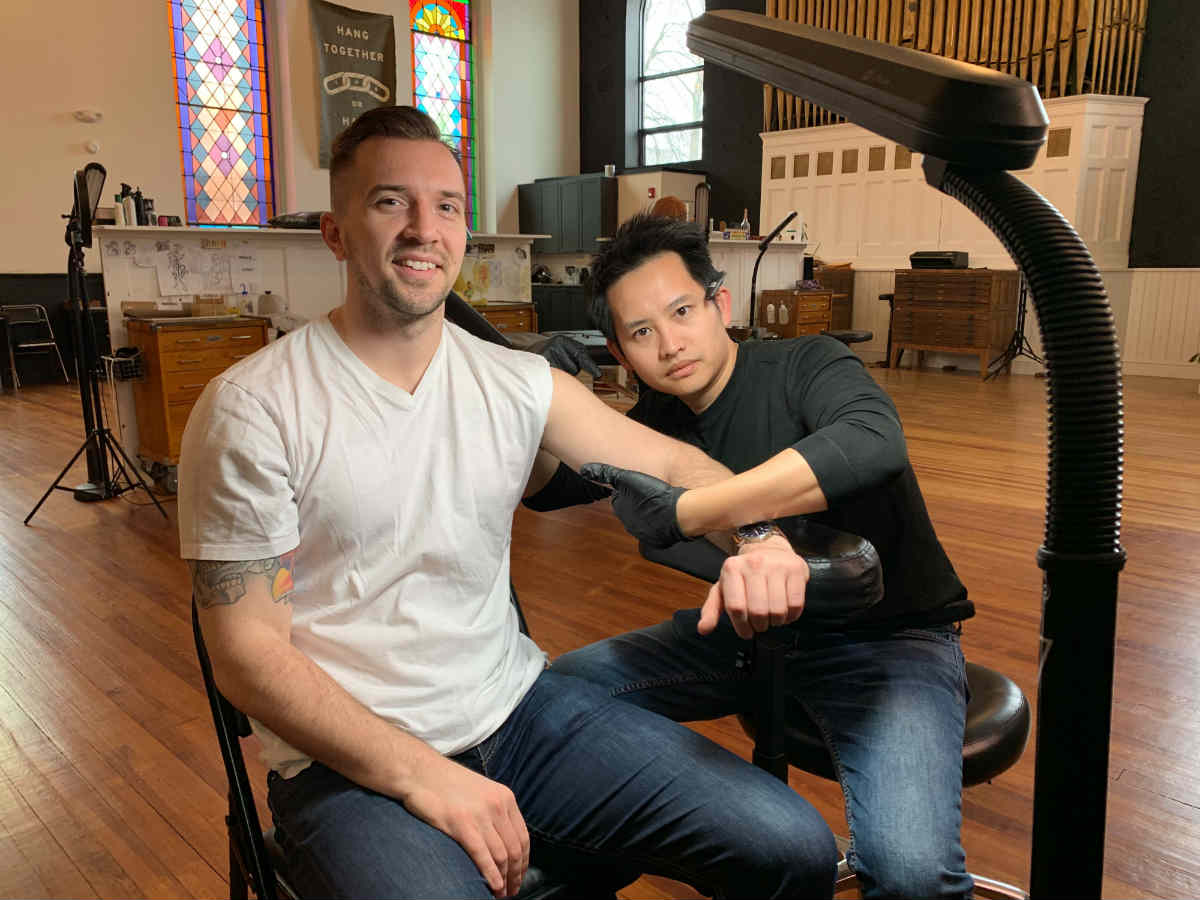
The people building this earnest business also found time to make fun of its central promise. For April Fools’ Day in 2019, Penji announced unlimited tattoo sessions for a flat monthly rate. Its campaign included Tran, Grzybowski, Jie Kuang, Ginny Nguyen, Naciye Cakir, and Liam Ely. They had one week to put the joke together.
The team visited a tattoo studio inside a repurposed church. Photographs show Tran and Grzybowski acting out the proposition. The slogan included an especially sensible condition: “No Revisions.” A subscription service can absorb another round of changes to a logo. The same customer expectation becomes considerably more adventurous when the canvas is a colleague.
The campaign’s account even describes an unused lower-back tattoo gag involving Tran and a marker. It gives the company’s early public personality some texture. Alongside the talk of jobs and community, there was room for a CEO to participate in a thoroughly unserious demonstration of why certain business models should remain confined to graphic design.
When the promise ran out of floor space
In 2019, Penji appeared at number 1,006 on the Inc. 5000. The recognition put Tran and Grzybowski’s company on a national growth list. The everyday consequence of expansion was less photogenic: the team needed room. By November, Penji’s staff had reached 60, and the company had moved its operations to Philadelphia.
Tran said finding enough space in Camden had become a problem. The company had even rented apartments in the neighboring Victor Lofts building to accommodate people. At the end of October, it crossed the river, using WeWork near 15th and Market and CultureWorks in The Philadelphia Building. An abstract question about growth had become a seating plan.
The move complicated the founders’ public identification with Camden. Tran acknowledged that leaving would matter to the city and might disappoint people. He said support for local nonprofit organizations would continue. “The mission didn’t change. Just the location did.” That was his explanation, and the move remained a concrete change in where the business operated.
It is the part of his story that resists an effortless hometown-success ending. Creating jobs and keeping those jobs inside a particular boundary are related ambitions, but circumstances can pull them apart. Tran had to defend a choice made for the company’s capacity while maintaining the community relationships that helped explain its existence.
“The mission didn’t change. Just the location did.”Khai Tran, on the 2019 move
Who gets to do the work?
Tran’s interest in access also appeared in his writing. As a Forbes contributor, he covered startups working in underserved communities. In June 2019, he interviewed Pathrise CEO Kevin Wu about helping underrepresented students find technology jobs. His subject was again the passage between ability and opportunity, this time viewed through another founder’s work.
His writing archive ranges beyond that theme, including entrepreneurship education, small-business marketing, and coworking. Owners’ Magazine carries his byline as well. Writing put him in the position of asking other entrepreneurs to explain their choices, a useful counterpart to the questions he had faced in Camden. He has been both the interviewer and the person required to answer.
The partnership with Grzybowski provides another view of his leadership. In a 2021 conversation about their roles, Grzybowski identified Tran as CEO and described the difficulty of giving a partner control without stepping into that partner’s responsibilities. Behind a shared founding story sat the less glamorous work of agreeing who would make which decisions.
By his October 2023 Entrepreneur’s Enigma appearance, Tran was describing a design service with global reach and an ambition to become dependable and seamless. Local impact remained part of the account. Today, Penji’s offering extends across design, video, motion, web, and other creative work, with human creatives directing projects and AI used to accelerate parts of production.
The company now reports more than 4.2 million creative assets delivered and more than 4,000 teams supported. Those are company-reported totals, rather than a count of Camden jobs. They describe how far the service has traveled. The question that made Tran’s business personal remains closer to home: who gets an opportunity to take part in all that work?
Follow the work
Penji’s website · Khai on LinkedIn · Forbes writing · Owners’ Magazine archive
Listen: Entrepreneur’s Enigma, October 2023
Watch: Penji’s YouTube channel
Further reading: The Camden homecoming · The nonprofit offer · The Philadelphia move · Behind the April Fools’ campaign · The Rutgers connection · Waterfront Ventures · Inc. company profile · The 200-customer milestone · The founding partnership