Before there was a funding announcement, there was an open inbox. Sports editor Daniel Kelley had lost his job at Pro Football Focus and was wondering whether his working life in sports had ended. Then he saw a message inviting people affected by layoffs to get in touch. He answered. A former boss was also pursuing a possible opening for him. Both routes led to Kevin Adams.
Kelley became editor-in-chief of Fade the Noise, the venture that would become familiar to fantasy players as FTN. In his account, the coincidence has the warmth of an unexpected reunion: two separate conversations arriving at the same employer. Adams appears in this early scene as someone assembling a team while another writer was trying to imagine a different career.
It is a useful place to begin with a founder whose public name sounds like a stage act. MagicSportsGuy promises rabbits, hats and improbable results. The work behind Kevin Adams’s handle is considerably more patient. His businesses deal in football information, the people who interpret it and the tools that help a customer use it before the next lineup locks.
FTN launched on July 7, 2020. Adams had already founded Elite Fantasy and exited that business in 2020. A new company followed an earlier one; the audience was familiar, but the task of building an organization had to start again. Kelley’s story puts a person inside that process. A sports-data business first needed people willing to work on sports.
- 2020Elite Fantasy exit
FTN launches - 2022FTN enters
Techstars - 2023FTN CEO
transition - 2025StatRankings
public launch
The numbers before the numbers
Adams came to the business with a financial-advice career behind him. FTN’s fundraising materials describe more than 15 years as an investment adviser representative, co-managing over $100 million in assets, and a Retirement Planning Specialist designation from Wharton. That is a different kind of preparation from a sports desk or a coaching staff. The figures belonged to clients before they belonged to players.
His earlier working life also included owning a California hair salon franchise. Put that next to fantasy sports and the career acquires a pleasingly practical texture. Customers, subscriptions, appointments, staff: even an enterprise devoted to football eventually has to operate on weekdays. An enthusiasm for the Sunday slate does not arrange the rest of the business calendar.
He is a participant in the contests he writes about. His StatRankings biography lists a 29th-place finish in the Westgate SuperContest and 19th place in Best Ball Mania III. Those are finishes rather than promises. They place the founder on the customer’s side of the table, where a choice has to be made and a result eventually arrives.
The same biography identifies his DFS Breakdown work at PFF and One Week Season. Daily fantasy writing has a particular rhythm: the analysis is attached to an approaching slate, rather than an indefinite conversation about the future. That deadline gives the product problem a human scale. A player needs to locate something, understand it and decide what to do with it.
Football, one replay at a time
At FTN, Adams helped build a network with different entrances for different customers: season-long fantasy, daily fantasy, betting and business data. Stefano Vaccarino handled marketing and operations; Jeff Ratcliffe brought his fantasy analysis and broadcasting work. The arrangement allowed written advice, projections and tools to sit around a shared information business.
Some of that information came from an unusually laborious occupation: charting football. Adams described the required enthusiast as “a really big football nerd.” The affectionate description fits an activity in which a game gets watched again for details that the ordinary viewer can happily ignore. A completed pass is only the beginning of what a charter might record.
FTN charting director Mike Talas described roughly 15 hours of combined charting work per game across participation, rushing and passing. His team included people from different backgrounds, including teachers and aspiring data professionals. This is the human machinery behind a neat table. Sunday’s entertainment becomes somebody else’s careful, repetitive assignment before it becomes a customer’s insight.
FTN’s technology partnerships supplied another layer. Its work with Spotlight Sports Group included publishing infrastructure, league synchronization, a bet tracker and tables for sports information. A founder’s ambition can sound abstract until it has to survive an ordinary user action. Can the reader find the rankings? Can a subscriber manage several teams? Does the table make the comparison legible?
In April 2022, FTN entered the Techstars Sports Accelerator Powered by Indy. The program offered access to mentors including FanDuel founder Nigel Eccles and Underdog Fantasy founder Jeremy Levine. Adams spoke about bringing the company’s content, data and tools to a growing audience. The fantasy player’s desire for better information was now also an entrepreneur’s question about distribution.
“a really big football nerd”
Kevin Adams, on the people who chart the game
Combined charting work per NFL game
The almanac that tested the servers
In 2023, one of those questions received a fairly blunt answer: the audience wanted Aaron Schatz. FTN partnered with the DVOA creator on the Football Almanac, then signed him to a multi-year agreement as Chief Analytics Officer in August. His football analysis and statistics acquired a new home after his departure from Football Outsiders.
Adams said the almanac launch nearly overwhelmed the website and required a fourfold increase in server capacity. It is the kind of customer response that arrives with an invoice attached. An annual football book had become a test of the company’s plumbing. For a business selling analysis, attracting an analyst also meant being ready for the readers who followed him.
The next month brought the acquisition of DFSForecast. Its lineup optimizer joined FTN’s tools, with The Fantasy Footballers and One Week Season as initial partners. A dataset could now travel further into the customer’s workflow: from researching players to assembling entries that could be uploaded to a fantasy platform. The acquisition connected information to another practical job.
The financial picture was moving too. FTN reported more than $1.05 million in total revenue for the third quarter of 2023, 52 percent above the corresponding quarter a year earlier. In December it announced a seed round that exceeded a $3 million target. These figures describe the company’s activity during a specific period; the decisions behind that activity had been accumulating for years.
A founder changes seats
That December announcement changed the person running FTN. Perry Gershon, who led the round alongside a Techstars investment fund, became CEO. Adams sold a majority of his equity to Gershon, retained a board seat and moved into an advisory capacity as Chief Strategy Officer. A financing story became a leadership story in the same announcement.
The transition is a concrete event without needing a fable attached to it. A new chief executive took responsibility for the company, and its founder continued in a different role. Adams’s next public chapter would involve building another sports-data product. The record gives the change of seats and the next undertaking; each is substantial enough on its own.
He was also involved in the wider fantasy business as a seed investor in Underdog Fantasy. In a September 2025 conversation with Steve McAllister, he discussed that investment alongside FTN and his new venture, StatRankings. His connection to the industry ran through several doors: contest participation, analysis, company formation and investment.
The new site made its public launch announcement on September 2, 2025, with One Week Season as a data partner. Adams’s complaint was straightforward: existing statistics sites could be “archaic, cumbersome, and confusing.” The launch emphasized dedicated pages for more than 500 NFL data points and an experience without third-party advertising clutter. Even a football obsessive occasionally wants fewer things on the screen.
The next decision is still the point
StatRankings gave Adams a hands-on role in design and product development, as well as oversight of rankings and projections. The irritation was specific enough to become a working brief. A person searching for a number should spend less time negotiating the website around it. The appeal of a clean table is that it allows the argument to return to football.
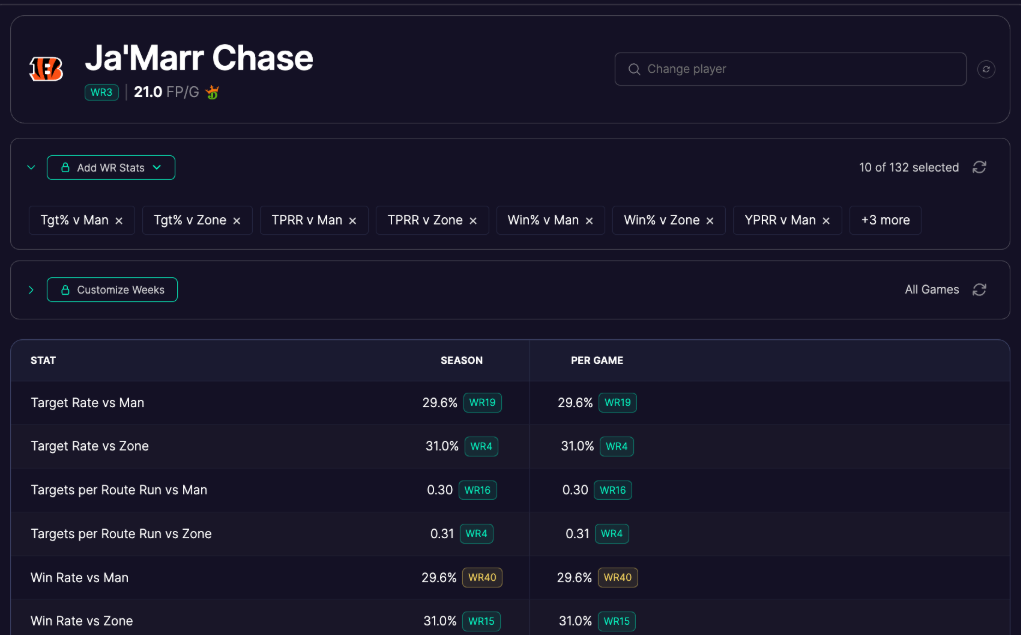
His updates soon descended into useful detail. In October 2025, he described search, player qualification filters and timestamps showing when information had refreshed. By November, the site had more than 2,600 registered users, and the team had completed a speed optimization project. Growth had introduced a familiar complication: the thing people liked had to keep working as more people used it.
In May 2026, Adams described a broader backend rebuild and clickable NFL and NBA player pages. In August, the product added fantasy ranking boards for ten platforms, with average draft position alongside the rankings. A player comparing a recommended selection with the prevailing draft market could make that comparison in the same place. The details had become the business.
September brought downloadable NFL statistics and a connector for using StatRankings data through Claude, ChatGPT and Grok. The archive covered seasons back to 2021, with some newer statistics beginning later. It was another way to reach the information: a file for someone who wants to work directly with the records, or a conversational route for someone arriving with a question.
The working group includes CTO Kyle Johnson, data scientist Steven Patton, DFS strategist Mark Garcia and analyst Sam Choudhury. In his anniversary update, Adams thanked the team, investors and users. The name MagicSportsGuy remains a convenient introduction, but his public work keeps bringing other people into the frame. Kelley’s early encounter with that open inbox belongs to the same history.
Taken together, these projects suggest a recurring interest in the distance between possessing information and being able to use it. Adams has addressed that distance with writers, charting crews, acquisitions, filters and now another interface. There is room for personality in all that precision. The haircut business, the contest finishes and the fantastical handle belong to a founder whose actual product keeps asking a wonderfully ordinary question: what would help the person making the next choice?