Issue №39 — The Operators
Joshua Broggi
The Oxford philosopher who decided that the university itself was the bug, and got out his keyboard.
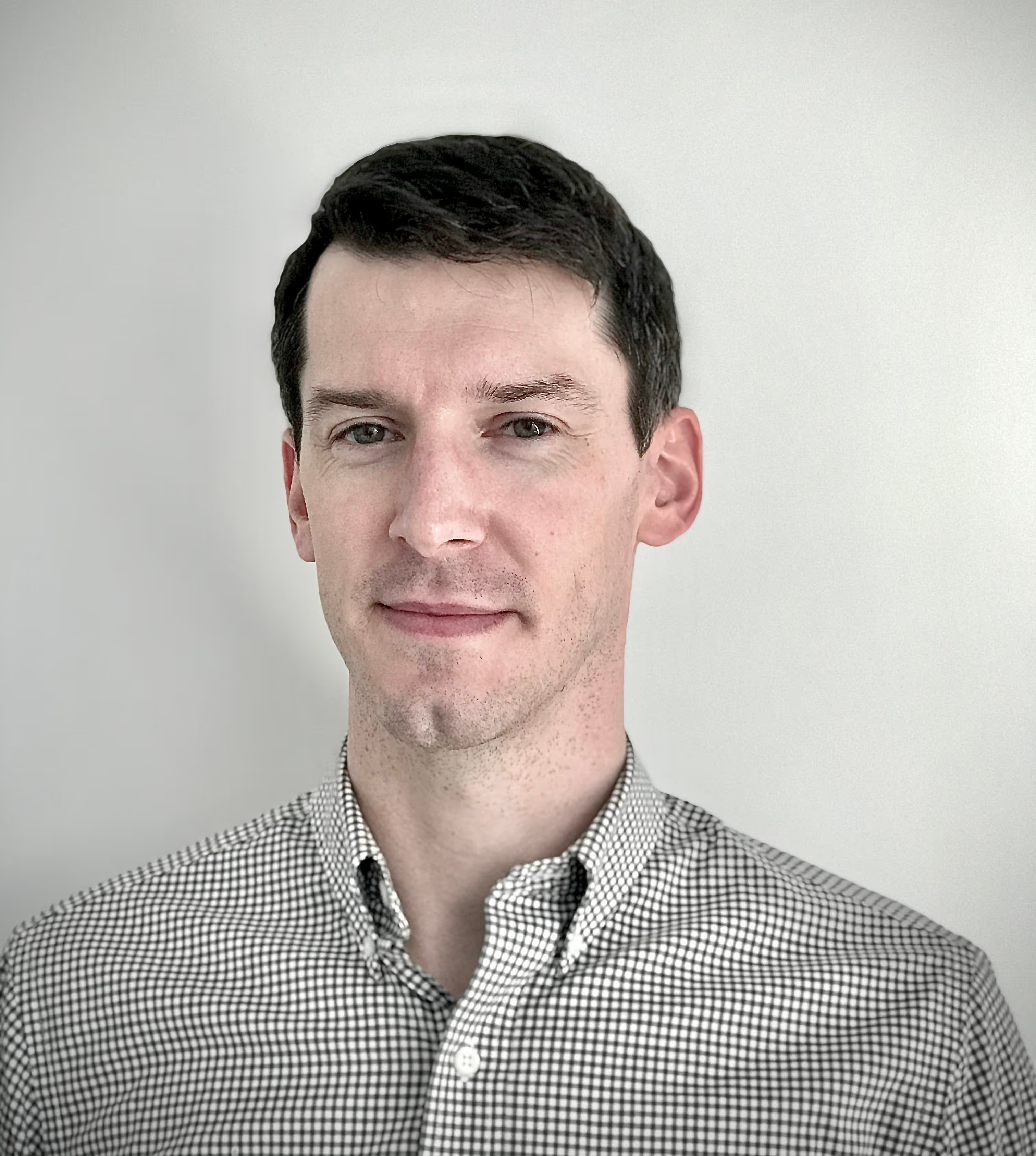
The Oxford philosopher who decided that the university itself was the bug, and got out his keyboard.
Most people who spend a decade inside Oxford's Faculty of Philosophy leave with footnotes. Joshua Broggi left with an architecture diagram. Woolf, the company he founded in 2018, treats accreditation the way Stripe treated payments and Twilio treated phone numbers - a fiddly, regional, paper-soaked thing best handled by an API. Companies, bootcamps, academic groups: they plug in, Woolf does the regulator-facing plumbing, and a real, recognized degree pops out the other side. In weeks. Not years.
It is the sort of idea that could only have come from someone who has stood inside the bureaucracy long enough to know exactly which bricks to lift. He sat on the governing Congregation of the University of Oxford. He held a Humboldt Fellowship in Germany devoted to defining and measuring human progress. He earned a PhD in Theology and Philosophy at Edinburgh, and a book on scriptural hermeneutics sits in the Bloomsbury catalogue. Then he wrote some Next.js.
The result is the first software-powered global collegiate university, currently spinning up new accredited member colleges at a clip of roughly one a month, with degrees recognized in more than sixty countries and an internal tape that read $18 million in member-college revenue across a recent twelve-month stretch. Broggi's stated ambition - delivered with the unhurried calm of a man who reads continental philosophy for fun - is for Woolf to become the largest university on Earth.
Broggi did graduate work at Yale before crossing the Atlantic, taking a PhD at the University of Edinburgh between 2009 and 2012. His thesis examined the way Christian traditions shape rationality - the concepts that quietly decide what counts as normal, good, and true. The 2016 monograph that followed, Sacred Language, Sacred World: The Unity of Scriptural and Philosophical Hermeneutics, is the kind of book whose acknowledgments page reads like a roll call of European chapels and reading rooms.
From Edinburgh he moved to Oxford, where he was a member of the Faculty of Philosophy, a member of Wolfson College (note the one-letter distance from his eventual company name; he insists it is a coincidence) and a member of the governing Congregation that runs the university. A Humboldt Fellowship took him to Germany, where the brief was suspiciously startup-shaped: define and measure human progress, with particular interest in how modern universities were invented in the first place to serve it.
That last sentence is the seed of Woolf. Universities, Broggi noticed, were once a piece of social technology, designed for a particular moment. The current accreditation regime is also a piece of social technology - and a frighteningly expensive one. "The cost of our accreditation and administration system is ultimately paid for by the students it is meant to protect," he has said. He stopped writing about it and started writing software for it.
Role: Founder & CEO, Woolf
Based: San Francisco, CA
PhD: Theology & Philosophy, Edinburgh
Previously: Faculty of Philosophy, Oxford
Past fellowship: Humboldt
Affiliations cited: Yale, Dartmouth, Duke
Has taken trains overland from Scotland to Singapore. A useful preview for someone now stitching together universities across continents.
Picture a Stripe for diplomas. A qualified organization - it could be a coding bootcamp in Lagos, an enterprise training arm in Paris, a small liberal arts cohort in Mexico City - applies to become a member college of Woolf. Once admitted, they teach. Woolf supplies the academic infrastructure, the regulatory wrapping, and the credential rails. The student walks out with a degree that travels, recognized across the Bologna Process, the Lisbon Convention, and the long alphabet of credential evaluators that gatekeep work visas and graduate-school applications.
Member colleges launch their programs in weeks, not the typical years. The accreditation overhead, once a moat for incumbents, becomes a shared utility. The cost curve flattens. Adjuncts get paid better because there are fewer middlemen. The students - the people the whole apparatus claims to protect - stop subsidizing the apparatus.
That is the pitch, and it is doing well enough that Woolf reports creating one new accredited college every month, with member-college revenue in the eight figures and credentials honored in sixty-plus jurisdictions. The stack underneath is the kind of polyglot mix you'd expect: AWS, Next.js, Vercel, Istio in there for service mesh, Salesforce and HubSpot on the GTM side, Zendesk listening to the students.
Figures cited by Broggi and Woolf in 2024–25 press appearances.
The kind of trip that requires both patience and a working theory of borders. Both useful when stitching universities together across them.
His Oxford college was Wolfson. His startup is Woolf. One letter, an entire pivot.
From a Bloomsbury book on scripture to API contracts for degrees. The throughline: how meaning gets transmitted reliably between strangers.
His German fellowship asked how to measure human progress. His company is, in a sense, the production system for that thesis.
Woolf was built distributed before distributed was the only option. Broggi calls the people he found doing it "wonderful."
The plan, stated plainly, is to make Woolf the largest university in the world. No dramatic gestures. Just one new college per month.
Broggi is unusual among edtech founders in that he is uninterested in disrupting the university so much as completing it. The medieval collegiate model - independent colleges federated under shared standards - is, he points out, already a distributed system. Oxford and Cambridge ran on it for centuries before software was a word. The bug is not the model. The bug is that incumbents quietly closed the membership rolls and called it tradition.
Woolf reopens them. If you can demonstrate academic quality, you can join. If you join, your students inherit a credential that crosses borders. If credentials cross borders, students stop being trapped by geography, and faculty stop being trapped by single-employer dependence. The economics of the whole system tilt back toward the people doing the actual learning and the actual teaching.
It is a slow, patient bet, made by someone visibly comfortable with long horizons. The Humboldt research never quite leaves the room. Neither does the philosopher's habit of asking what something is for. The point of a university, on Broggi's view, is to be a useful piece of social technology. If the current implementation isn't useful, ship a new one.
How a Wolfson College fellow ended up rebuilding accreditation from scratch.
Tracing the overland trip that shaped Woolf's globe-spanning collegiate model.
A look at the operating cadence behind the claim to build the world's largest university.
Why Broggi argues bureaucracy is what makes degrees expensive.
Reading scripture, writing APIs - the throughline in Broggi's body of work.
Breaking down the revenue model that distinguishes Woolf from MOOC peers.
The research thread that connects fellowship to startup thesis.
How a small team got their credentials accepted across borders.
How non-traditional learning gets re-papered as accredited credit.
A philosopher-founder on what to read when business books bore you.