For a professional racing driver, the driving is almost the suspiciously easy bit. Jonathan Clues reckons it occupied 30 or 40 days of his year. The balance was a traveling seminar in persuasion: finding sponsors, keeping sponsors, explaining the dream, working a room and making a small logo on a fast car feel like excellent business. The cockpit supplied the photograph. Communication paid for it.
Clues won more than 20 races and two national championships. In 1994, North American results show victories at Indianapolis Raceway Park and Blackhawk Farms, along with starts at Watkins Glen, Lime Rock and Road Atlanta. He had grown up in London and came to the United States to keep racing. The sporting career eventually plateaued, as sporting careers have a ruthless habit of doing. Yet the less photogenic half of the job survived intact.
Sponsors introduced him to small entrepreneurial companies. Those companies needed brands, websites and a way to explain themselves on the young internet. Clues began helping. By the late 1990s, he was putting video online while modems still made that indignant electronic squeal. A driver accustomed to picking a line through traffic had found another new and badly signposted circuit.
The web was dead. He missed the memo.
Back in London around the dot-com crash, Clues started iMedia 8, a web development and application agency that worked on rich media projects, including communications for nongovernmental organizations in Geneva. The fashionable verdict was that the web had expired. Clues looked at the amount of information people could suddenly share and declined to attend the funeral.
A real-estate assignment sharpened the idea. Property pages full of static photographs could display a building, but they struggled to convey location, movement or feeling. In 2002, that problem led to Realview TV. Its premise joined broadcast television's emotional force with the web's interactivity. The company served real estate, hospitality, automotive, health care and education. Clues began sorting those categories by the weight of the decision. A holiday, a house and a university have something in common: you make a consequential choice before fully experiencing what you bought.
“We really believed in the power of video.”Jonathan Clues, on the origins of Realview TV
Education kept pulling the company closer. Colleges had enormous stories, distributed across faculty, students, residence halls, laboratories and rituals. Their prospective customers were often far away, young and trying to imagine a future self. In the middle of the 2010s, Clues narrowed the work to higher education, launched StudentBridge and folded Realview TV into it. The new name was a job description: connect institutions and students.
The question under the question
Admissions language tends to orbit one anxious sentence: Will I get in? Clues focused his company on a quieter and ultimately more expensive question: Will I fit in? An acceptance can be counted in a database. Belonging is harder to render. It lives in the student voice that sounds familiar, the dining hall that seems navigable and the glimpse of a campus organization that makes a stranger think, perhaps, my people are there.
This is where his argument about marketing becomes more interesting than a tour product. Clues links recruitment to retention. If institutions present themselves with candor and prospective students understand the place more fully, the match improves. A better match can raise the chance that a student stays, graduates and carries affection for the institution into later life. Marketing, on this account, has consequences long after the campaign dashboard closes.
His favorite word is authentic, an adjective marketers have nearly polished smooth. In his case it comes with an old technical conviction: video is harder to fake than a page assembled overnight. The medium can show real people doing real things. Of course, cameras can flatter, scripts can stiffen and algorithms can manufacture an aura. Clues's practical standard remains useful: help a student make a better-informed decision.
A company behind the jet skis
Founder stories acquire marble floors in the retelling. Clues has kept one excellent obstacle in his: a jet ski. When his early venture hired its first employee, the office occupied the back of a friend's storage unit. The new colleague navigated filing cabinets, boxes and personal watercraft on the way to work. The founders saw romance in the improvisation. The employee may have seen a hostage situation with stationery.
Clues took away a plain lesson. A presentable office lends credibility and gives employees a place they can plausibly call home. The point fits his broader career. Presentation is part of the experience. The route into a workplace matters. So does the route onto a campus, from parking and wayfinding to the tone of check-in. People begin forming judgments before the official story starts.
Another early relationship changed the map altogether. Clues was trying to win the business of Ardy, chief executive of a sports marketing company called The Championship Group. Ardy proposed becoming a partner instead, helped establish a United States office and persuaded Clues to move to Atlanta. A pitch became an invitation. The former driver returned to America and found the city where StudentBridge would grow.
Joining the top and bottom of the funnel
By 2023, StudentBridge had become strong at the early, exploratory part of recruitment: video stories, virtual tours and other experiences for students who may not yet have raised a hand. Full Measure Education worked farther along the journey with mobile-first messages, personalized content and direct engagement. The companies merged that June and kept the StudentBridge name.
Clues described the fit as highly complementary. The merger broadened the company's reach from attraction through yield and reduced the number of disconnected systems an enrollment team might need to manage. It also brought the combined organization close to 500 partner schools. There is founder pragmatism in the move. If the stated ambition is to serve an entire journey, the product has to travel farther than its original specialty.
StudentBridge now pairs content with analytics. Clues has spoken about engagement scores, content scores and profiles that show what prospective students actually watch. The shift completes a loop familiar from racing: act, measure, adjust. Creative work supplies emotion; data reveals where attention held and where it wandered into the gravel.
“I really believe in better retention through better recruitment.”Jonathan Clues, Filling Seats podcast
Digital as a companion to place
Clues can sound impatient with higher education's pace of digital change. His more durable argument is about continuity rather than replacement. A virtual experience can prepare a family before a campus visit, deepen the physical tour with stories a guide cannot carry, and continue the relationship afterward. Students pass between screen and sidewalk all day. Their decision journey does the same.
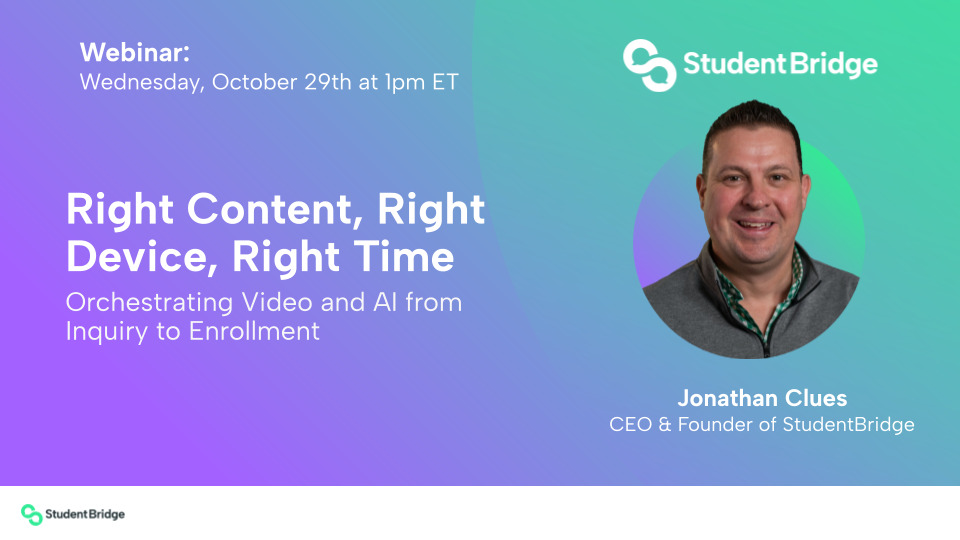
In a 2025 presentation, he framed video strategy around content, device and timing. He reported that StudentBridge delivered more than seven million video stories to students annually and urged institutions to test, distribute, measure and adjust. In 2026, his public conversations moved deeper into the campus visit itself: housing, food, community, wayfinding, arrival and the basic hospitality that shapes a family's mood before anyone begins the official presentation.
The driver in him still reaches for motion. One of his favorite sayings is that nobody ever swam behind a wave and surfed it. You have to get in front and paddle. He also holds airplane and helicopter licenses, which makes his professional fixation on maps, routes and perspective feel almost indecently well branded. Away from the office, he has offered pleasure flights around Atlanta.
There is civic evidence behind that hobby. During his service with the Boys & Girls Clubs of Metro Atlanta, Clues brought together contacts from the aviation community to initiate a $130,000 overhaul of the Brookhaven club. The accomplishment joins several strands of his life: networks built around machines, a talent for sponsorship and an interest in helping young people see a broader horizon.
What the route explains
Clues calls his progress an evolution full of twists, wrong turns, good luck and bad luck. That description is more generous to reality than the standard pivot tale. Racing did not secretly contain an education-technology company. It taught a young driver to sell an idea, honor a sponsor and perform under observation. The early internet did not hand him a market. It let him experiment with how moving images make distant things legible. Realview TV did not begin with colleges. Years of client work revealed which decisions most needed the medium.
The resulting business serves a moment everyone recognizes: standing outside a possible future and trying to picture life inside it. StudentBridge supplies institutions with cameras, maps, messages and measurements. Its founder supplies the recurring question. Does this help the person choosing?
Speed made the first career visible. Attention made the next one possible. Clues's useful trick has been noticing that both depend on the line taken before the decisive corner appears.