In 2015, Joe Nunziata helped buy a company he had already helped sell. The company was FBC Mortgage, the Orlando lender he and his brother Rob had founded a decade earlier. Their fellow buyers included executives, employees and former investors. A business exit had acquired an entrance. For an industry that puts so much care into closing, it was an unusually good opening.
There is a further wrinkle. Between the sale and the return, Nunziata had become president and CEO of Sterne Agee Group, the business that bought FBC. He had occupied both sides of the arrangement. When the brothers and their partners formed Pine Court Holdings to reacquire the lender, he came back with experience of the company and its corporate parent.
Today, Sal A. “Joe” Nunziata has another expanded brief. He is president of Acrisure Real Estate Services and CEO of Acrisure Mortgage, the name FBC adopted in July 2025. His responsibilities now extend across mortgage, title and real estate businesses. The career is still moving outward. Its most revealing episode remains that decision to come back.
A buyer on the other side of the desk
Sterne Agee acquired FBC in 2012. Nunziata subsequently led the acquiring group, based in Birmingham, Alabama. An executive whose work had centered on residential mortgages was now responsible for a broader financial business. The transaction changed his job along with the lender’s ownership.
That experience gives the later buyback its particular interest. A founder selling a company is a familiar business story. A founder running the buyer and then returning as part of the purchasing group requires a little more space on the diagram. The paperwork had been busy.
The return came as Sterne Agee was itself entering a transaction with Stifel Financial. In February 2015, Joe and Rob announced the planned FBC acquisition. Pine Court Holdings completed its purchase on March 31. The lender would retain its name and Orlando headquarters.
“focused solely on residential lending”
Joe Nunziata on the attraction of renewed independence, 2015
That short phrase captures the appeal Nunziata described at the time. Residential lending was the work to which he wanted the company to return its attention. The decision was specific: regain independence for this lender, with these participants, at this moment. The next ownership chapter would eventually be different again.
- 2005Co-found FBCOrlando, Florida
- 2012Sell to Sterne AgeeJoe later leads the group
- 2015Buy FBC backPine Court Holdings
The table came after the apprenticeship
The beginning had been less ceremonious. FBC started on a card table in downtown Orlando in 2005. It is an irresistible detail, partly because finance generally prefers furniture that looks difficult to move. Yet the table tells only half the story. Nunziata had already spent years inside the mortgage business.
From June 1989 to October 2003, he was a vice president and shareholder at American Heritage Mortgage Corp. His father, Salvatore Nunziata Jr., had co-founded that business. First Horizon acquired American Heritage in 2003; Joe then served as a senior vice president at First Horizon Home Loans until November 2005.
The sequence places FBC in a family and professional history. Joe and Rob were opening a new company in a field they knew. The founding date marked a fresh organization after years of work within established lenders. A card table can make a beginning look improvised. The résumé behind this one was considerably more prepared.
The housing downturn followed soon after FBC’s founding. In 2017, looking back on that early period, Nunziata said, “We were resilient and successful during that time.” That year, Joe and Rob received EY’s Florida Entrepreneur Of The Year award in the financial-services category. The recognition belonged to both brothers.
FBC’s own description of its workplace offers a smaller, useful glimpse of the organization they had built. In 2014, it reported broadening its President’s Club trip to include top staff members as well as top producers. The distinction matters in a business where the salesperson is visible and the work required to finish a loan involves many other desks.
The return had more than two signatures
When the company came back under the founders’ purchasing group in 2015, it had about 450 employees and licenses in 45 states. It funded just under $1 billion in residential mortgages in that year’s first quarter. The brothers were recovering a substantial operating business, with a national footprint and daily obligations to borrowers and partners.
The participation of employees and former investors gives the episode a different texture from a solitary founder’s return. People with their own connections to FBC joined the ownership effort. The purchasing vehicle had a name, Pine Court Holdings, and the acquisition had a closing date. Commitment had become a transaction.
It also complicates any easy account of Nunziata as an executive forever chasing the next institution. He had left FBC’s immediate operating world for the buyer’s leadership job, then returned to the mortgage company. Later he would remain through another ownership change. The same business could offer different responsibilities at different stages of his career.
His professional credentials sit alongside those transactions. He earned a bachelor’s degree in business from the University of South Florida and the Certified Mortgage Banker designation through the Mortgage Bankers Association. In 2015, the Orlando Business Journal named him Executive of the Year. The biography contains both the dealmaker and the practitioner.
An Orlando address, a wider map
Nunziata’s institutional connections spread around Central Florida. He is a founder and director of One Florida Bank and of Trident Reciprocal Insurance. His earlier board service includes community banks such as Southern Community Bank and Sunshine Bank. Banking, lending and insurance have given him several vantage points on the region’s business life.
In May 2024, Governor Ron DeSantis appointed him to the Greater Orlando Aviation Authority. An airport authority adds a public responsibility to an executive’s private-sector work. It also puts his name alongside another piece of the infrastructure through which Central Florida grows.
His civic work has included the Seminole and Orange County sheriff foundations and the FBC Mortgage Charitable Foundation. In April 2024, he appeared at the announcement of a new endowed UCF scholarship program as president of the Orlando Police Foundation. The scholarships were intended for criminal justice and legal studies students.
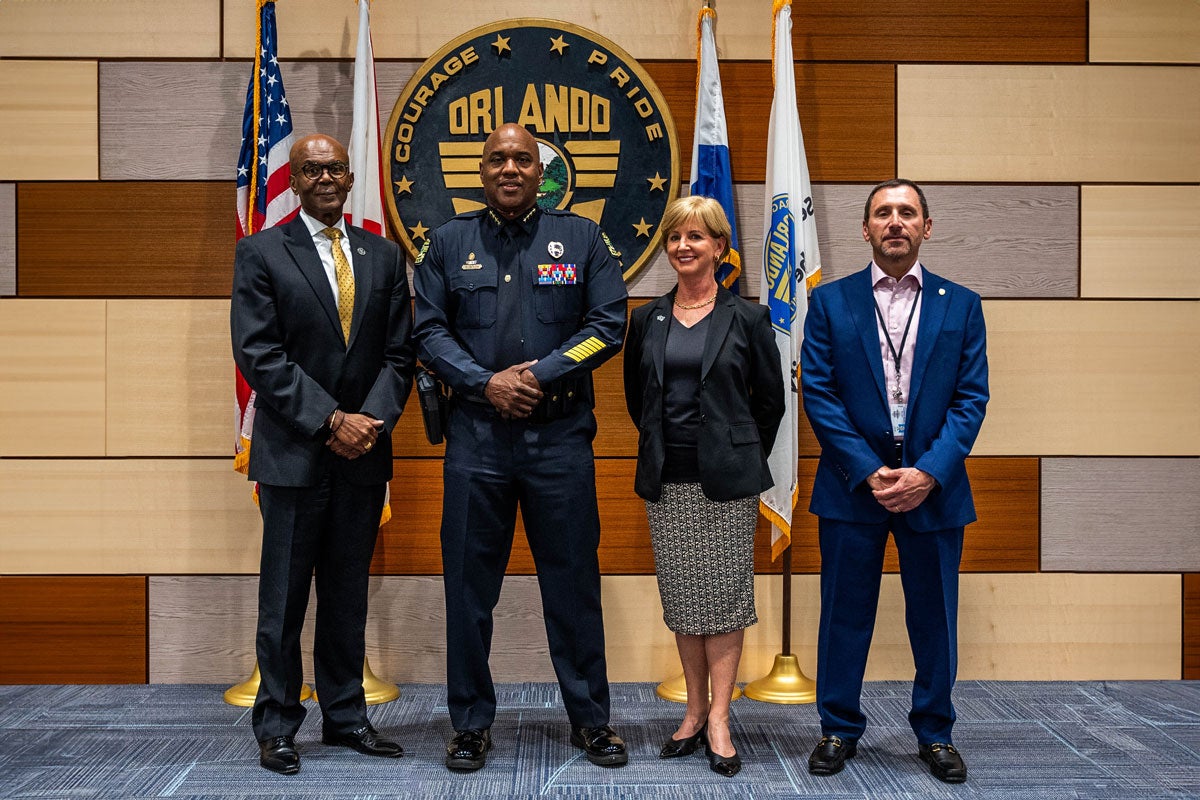
The photograph has the orderly formality of an institutional announcement: four people, flags, a police insignia. Its subject is a future cohort of students. Nunziata’s role puts a mortgage executive into an educational project with a specific purpose and a local partner.
Those connections keep the profile from floating away into a list of corporate transactions. The lender became national. His board memberships and community work still give the story a recognizable local map, running through banks, foundations, a university and an airport authority.
The company name went up on a stadium
FBC’s relationship with UCF became conspicuous in 2022, when the university approved a ten-year, $19.5 million stadium naming agreement. FBC Mortgage Stadium put the lender’s name before football crowds. It was a considerable change of scale from a card table in downtown Orlando.
That same year, FBC joined Acrisure. On July 1, 2025, it became Acrisure Mortgage. The company described the rebrand as a name change with its leadership and team structure remaining in place. The stadium became Acrisure Bounce House. A financial-services brand had inherited a name with rather more spring in it than the sector usually permits.
For Nunziata, this was another form of continuity through changed ownership. A decade earlier, he had welcomed renewed independence. Now he was leading the lender within a larger financial-services organization. Each arrangement belonged to a different stage of the company’s development.
In December 2025, he returned to UCF in another capacity, as a commencement speaker. He had once attended summer courses there; his educational path also included sessions at the London School of Economics. The address brought an experienced local executive to a room of graduates preparing to begin their own careers.
There was enough practical experience behind the invitation: a family mortgage business, a new lender, a sale, a job running the buyer, a group buyback and a second parent company. Few graduation gowns conceal quite so much corporate rearrangement.
Three businesses, one larger assignment
By August 2026, the assignment had widened again. Acrisure Mortgage named Todd Boss president, responsible for daily mortgage operations and reporting to Nunziata. Boss had joined the executive leadership team in 2009. His promotion placed a long-serving colleague in charge of the lender’s daily work while Nunziata oversaw the broader real estate services business.
“Todd is a tremendous team builder, business developer and leader.”
Joe Nunziata, August 2026
The new structure joins mortgage, title and real estate under Nunziata’s responsibility. Each business occupies a different part of a property transaction. Bringing their leadership together gives the former FBC co-founder a problem larger than the original lender.
His previously stated ambitions had already pointed toward expansion. In a 2024 interview, he described entering new markets, adding joint ventures and rebuilding staffing after interest-rate increases. He also set a goal of reaching the top ten among mortgage lenders. These were concrete operating aims, rooted in the company’s position at that time.
The current title extends that work across more of the property business. It leaves him connected to the lender he helped start while adding responsibility for adjacent operations. The 2015 return therefore looks less like a final homecoming than one turn in a continuing career.
Nunziata’s story is full of documents that appear to settle things: acquisition agreements, a buyback closing, a naming contract, a promotion announcement. Each has been followed by more work. For the co-founder who came back, signing at the bottom of a page has repeatedly meant there is another page to turn.