A car shopper can spend an evening choosing a vehicle, comparing payments and considering a trade, then return to a website that behaves as if the two have never met. The computer has forgotten the conversation. The shopper gets to have it again. Joe Gillespie has spent much of his working life on the other side of that small indignity, asking what the dealership could do better.
He came to automotive software carrying a customer’s grievances. As a dealership owner, he had encountered websites that produced too few leads, offered too little room for customization and came with inadequate support. These were practical complaints about a service his business needed. A handsome website was of limited comfort if getting something changed became a second occupation.
A customer with a supplier problem
Dealer eProcess dates that founding story to 2008. Gillespie, now its founder and CEO, turned the problems he had encountered into a business serving other dealers. The origin gives his career a useful point of reference: before asking anyone to buy his technology, he had reasons to be dissatisfied with the technology he bought.
His preferred subjects still have the texture of a working dealership. Can the customer carry their information forward? Can the staff understand what happened online? Can someone answer a request? An industry can acquire a great many new abbreviations while those questions remain stubbornly recognizable.
Before the cars, the property
Gillespie’s professional story begins earlier, at 21, when he became a business owner and real estate investor. During the 1990s, he gained experience in online real estate marketing and sales. Before founding Dealer eProcess, he served as dealer principal for six new car franchises. His route into software passed through businesses where an online inquiry eventually had to become a real conversation about a substantial purchase.
A house and a car invite different anxieties, but both demand decisions that resist being hurried through a little box on a screen. There are preferences to remember, questions to answer and details to carry from one stage to another. That is a useful background for someone whose later work would concentrate on the gaps between stages.
The early internet experience also places him in a particular generation of business owners: people who encountered the web while already thinking about how to market something tangible. In Gillespie’s case, the eventual destination was the dealership website, with its inventory, inquiries and impatient need to turn interest into a visit.
The expensive art of starting again
By January 2024, Gillespie was writing about the inconsistencies that digital retailing had introduced alongside its benefits. He recalled discussing the problem with his friend Brian Pasch. Dealerships had acquired online tools, yet the experience could remain fragmented. Personalization and consistency were missing in precisely the places a shopper might expect them.
His proposed remedies included unified systems, better use of behavioral information, staff training and a way to collect customer feedback. The inclusion of training matters. A customer can complete part of a transaction online, but the advantage evaporates if the people finishing the transaction cannot make use of that work.
There is a modest social principle beneath the software discussion. Asking someone to repeat themselves is a poor way to demonstrate that you have been listening. In a complicated purchase, repeating a detail can also mean losing confidence that the next detail will survive the journey.
A mountain with a memory
On June 10, 2024, Dealer eProcess announced Everest for dealers in the United States and Canada. The platform brought websites, digital marketing, inventory management and digital retailing under a shared framework. Its AI engine, Sherpa, supplied the guiding metaphor. Even the mountain came with customer assistance.
The central mechanism was a Digital ID that stored shopping preferences and visit history. Sherpa would use that information to adjust the website experience, including when a visitor returned or browsed another site within the same dealer group. Gillespie compressed the ambition into an unusually economical pair of promises:
“No log-ins for shoppers. No extra work for the dealers.”
Joe Gillespie, at the Everest launch
Those promises describe the intended experience, rather than a task list for the shopper. A site should do some remembering on its own. In his June 2024 reflections after the Digital Marketing Strategies Conference in Austin, Gillespie connected that capability with changes to navigation, offers and conversion tools. Remembering a visitor was meant to influence what happened next.
The practical distinction is between keeping a record and making the record useful. Brian Pasch’s later discussion of Everest highlighted Gillespie’s commitment to working with different customer data platform providers. A dealer group could have its own preferred system. The website still needed a way to put the information to work.
When three leads are one person
Gillespie’s interest in a connected experience also makes him a critic of convenient counting. In October 2025, he compared a cleaner retail interface with one offering separate buttons for payment calculation, trade valuation and preapproval. The second arrangement could require the same shopper to supply information repeatedly, producing an impressive collection of leads from a rather smaller collection of people.
That is an awkward possibility for a business accustomed to celebrating the total. A sales team needs useful opportunities. A shopper needs a tolerable experience. Neither necessarily improves when a form appears for the third time, however enthusiastic the reporting dashboard becomes.
He also questioned pop-up coupons that claim early credit for a customer who later uses other tools. The issue is attribution: which interaction gets recognized for a sale, and what that recognition encourages a dealer to buy. Counting is consequential when it determines the next investment.
By the end of 2025, his writing was describing a broader change toward websites that adapt to individual behavior. He argued that shoppers increasingly expected that responsiveness because they already encountered it elsewhere. The dealership would be judged against the rest of the customer’s online life.
The account manager is part of the product
For someone selling automation, Gillespie spends a noticeable amount of time discussing the people around it. His October 2025 reflections credited account managers who support dealers during the day, at night and on weekends. Continuity mattered here too. A customer relationship loses something when the person who understands it keeps changing.
His earlier conversation with Brian Pasch offers another view of the same priority. In 2022, following AWA Vanguard recognition, Gillespie discussed investment in development and said he had not built the business simply to sell it a few years later. He also described how talking directly with dealers kept him connected to events on the retail floor.
“So, that’s the part I enjoy the most.”
Joe Gillespie, on speaking directly with dealers
There is a revealing preference in that answer. Running a technology company can put considerable distance between an executive and the person trying to use the technology. Gillespie identified the conversations that reduced that distance as the enjoyable part of the job.
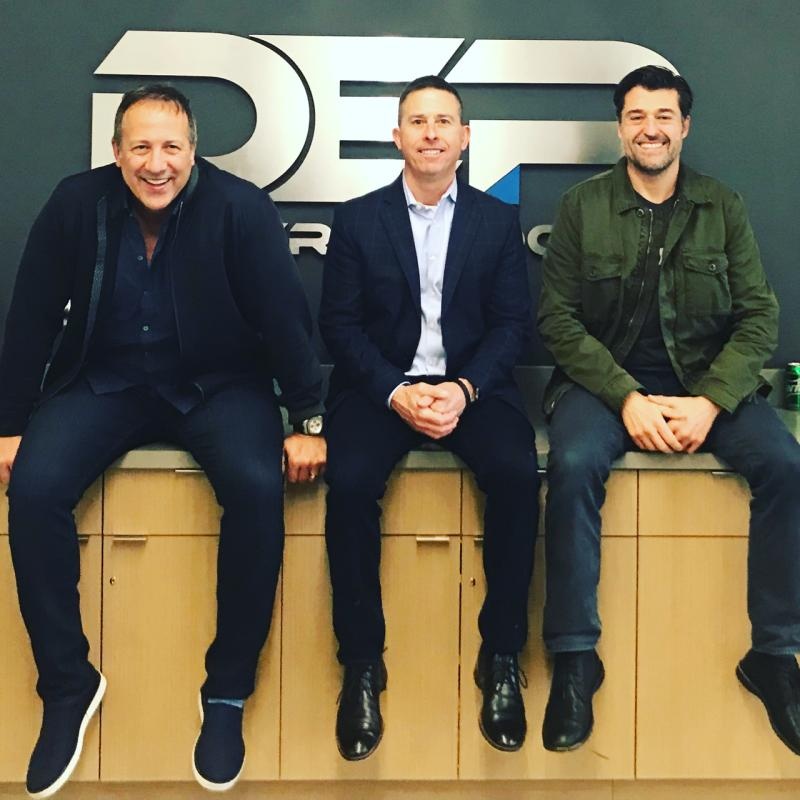
The circle around his work includes dealers, colleagues and industry educators. At NADA 2024 he appeared in a conversation with Yago Paramo. The company’s later Sherpa discussion brought Pasch together with Gino Cipperoni and Sam Vukas to examine how shopping activity could become information a dealership employee could actually read and act on.
A football match, an ad, a promise
His attention has also followed the shopper away from the website. In July 2026, Gillespie used the World Cup as a starting point for discussing streaming television advertising. The change in viewing habits interested him because it altered where dealers could reach potential customers and how specifically they could address them.
He had been explaining Amazon Advertising to dealers at least as far back as 2024, arguing that its streaming audience and targeting capabilities deserved more attention. His recurring challenge was educational: a dealer’s mental picture of Amazon shopping could obscure the separate advertising opportunity.
The more revealing part of his 2026 argument arrived after the advertisement. A relevant vehicle offer still had to lead to a coherent website experience. If the destination was cumbersome, the investment in getting someone there could be squandered. The ad made a promise that the website would have to keep.
The arithmetic still has to work
Gillespie’s appetite for newer technology comes with some decidedly ordinary tests. Writing after NADA 2025, he argued that AI counted for little when payment calculations were unreliable or inventory feeds were troubled. The mundane machinery had to function before the elaborate machinery could earn its place.
At NADA 2026, his advice again emphasized focus. Use AI to handle business more efficiently and make complicated website activity understandable. Avoid becoming distracted by each new attraction. For a founder whose company sells technological change, that is a useful constraint to put on the conversation.
His ambitions have grown from fixing dealership websites to connecting more of the work around them. The point of contact remains familiar: a person considering a car, with questions already asked and decisions partly made. Gillespie keeps asking the website to respect the effort that person has put in. The next visit should begin with some memory of the last.