Jeremy Hitchcock had found a way to spend less time outside in Worcester, Massachusetts. As a student at Worcester Polytechnic Institute, he could use remote-access technology to arrange the printing of a paper without making an extra journey through the cold. It was a modest convenience. The weather had supplied a reasonably persuasive product brief.
He and his collaborators were working on an open-source project. It helped people reach computers remotely, at a time when home broadband was opening up new possibilities. There was useful software, a growing collection of users, and the considerable task of keeping everything going. A career running internet infrastructure was still some distance from the immediate problem of a college assignment.
Hitchcock would co-found Dyn in 2001. Before the company had hundreds of employees, outside investors or an acquisition agreement with Oracle, it had people who wanted the service to survive. Those people were about to make the students’ next decision rather more complicated.
The users declined to say goodbye
There were about 25,000 users when the team asked for donations. The proposition was simple: contribute a dollar each so the project could keep running. The students were considering whether to continue; users were being given a chance to answer.
The money exceeded the request. Hitchcock later recalled a total of $40,000. The team had asked whether a useful project deserved more of their time and received an answer that could purchase computers. People who had relied on a free service were willing to help pay for its future.
“We ended up with $40,000 and realized that we were on the hook!”
Jeremy Hitchcock, recalling the donation drive
A vote of confidence can be inconvenient. Now there was equipment to buy, a service to maintain and an obligation to the people who had contributed. Dyn’s beginnings contained a bargain more concrete than an enthusiastic response to a pitch: keep this working, and we will help you do it.
Eleven years before the outside money
Dyn worked in a part of the internet most people encounter only when something goes wrong. The domain name system translates familiar names into the addresses computers use. It helps a person asking for a website find the infrastructure that can deliver it. Making that process dependable is a business with an awkward publicity problem: successful work generally leaves the customer thinking about something else.
The company’s remit expanded into managing internet performance. By the time Oracle announced its acquisition agreement in November 2016, Dyn served more than 3,500 enterprise customers. Netflix, Twitter and CNBC were among them. Oracle described a global network making 40 billion traffic optimization decisions each day.
Getting there took years. Dyn waited until 2012 to raise its first institutional round, $38 million from North Bridge Venture Partners. That was more than a decade after Hitchcock helped establish the company. Its earliest financial backing had come from users; growth capital arrived after a substantial business was already operating.
The eventual figures give the journey its scale: 500 employees, $100 million in annual recurring revenue and roughly $100 million in growth capital. Those numbers describe a company with departments, managers and customers whose own businesses depended on it. The students’ maintenance problem had acquired an organizational chart.
The interview that work could improve
One revealing account of Hitchcock as an employer concerns an intern named Brian. Given a technical problem by his mentor, Brian went away and returned a few days later with a way to run a process across multiple machines while checking for errors and inconsistencies. His work made an impression that Hitchcock thought an interview alone would have missed.
Brian had arrived alongside a more outgoing peer. In Hitchcock’s telling, the more sociable candidate initially looked like the obvious person everyone would want to hire. Actual work changed that assessment. A useful solution had supplied evidence that personality in an interview could not.
Hitchcock used the example in a 2014 argument for paying interns. About a tenth of Dyn’s workforce consisted of interns on any given day, he wrote. They contributed to software, marketing and customer work. He also challenged a system in which only students who could afford unpaid work would have access to certain opportunities.
His education work extended beyond that essay. Dyn supported student projects and internships at WPI, hired graduates and helped fund its User Experience and Decision Making Laboratory. Hitchcock helped create Dyn Hackademy, a four-day program for young people interested in technology entrepreneurship. The university named him its 2015 Innovator of the Year.
A founder makes room
In May 2016, after Dyn announced another $50 million investment, Hitchcock stepped down as CEO. Executive chairman Jim Baum assumed daily operations. Hitchcock remained involved as a board member and full-time employee with the title of founder.
He was direct about the distinction between building the business to that point and running the larger organization it had become. He publicly acknowledged that the mechanics of leading it at its new scale did not match his skills. The company had grown; his role could change with it.
The timing matters. Hitchcock’s departure from the CEO position preceded both the October attack that would make Dyn a news story around the world and Oracle’s November acquisition announcement. The transaction closed in January 2017. Compressing those events into a single exit story loses the decision he had already made about leadership.
It also leaves out the people who kept working together afterward. Dyn had assembled a group with shared experience in infrastructure, sales and operations. Several members of that group would take those relationships into new businesses in New Hampshire.
The trouble came from the living room
On October 21, 2016, Dyn was hit by a distributed denial-of-service attack. The Mirai botnet used compromised connected devices to overwhelm internet infrastructure. Ordinary devices, including insecure cameras, had become tools for disrupting services far beyond the places where their owners had installed them.
For a person trying to reach an affected website, the distinction between the website and the service directing traffic to it could be invisible. The result was an interruption. The episode exposed how the security of consumer devices could become a problem for companies operating elsewhere on the network.
Hitchcock co-founded Minim in 2017 in response. The company focused on Wi-Fi management and security for connected devices. The work brought him from the infrastructure behind internet services toward the networks inside homes. Both involved keeping connections useful and dependable, but the customers, equipment and day-to-day problems differed.
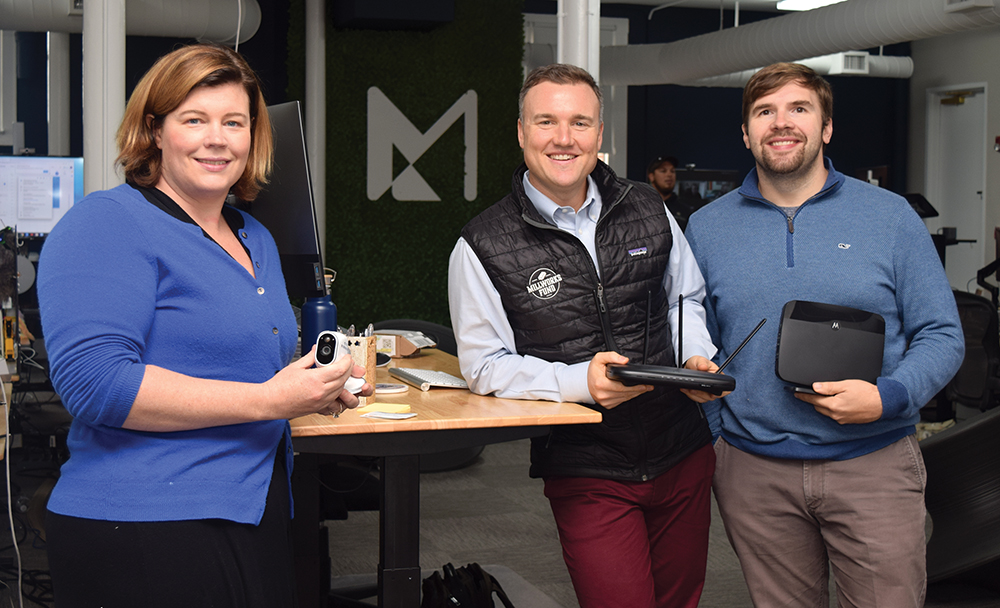
By early 2020, Minim had grown from five engineers to 32 people. Seven former Dyn colleagues had joined Hitchcock, including Gray Chynoweth, Dyn’s former chief operating officer, who became Minim’s CEO. The next venture carried some familiar names into a different corner of the network.
A different sort of network on Elm Street
Meanwhile, Jeremy and his wife, Liz, had helped create somewhere to put down a screen. Bookery Manchester opened in 2018, combining an independent bookstore with a cafe and events. Its preparations included plans for a children’s room, live music and a carefully chosen selection of books.
Liz and collaborator Liz Cipriano took prominent roles in developing the store. It had been an idea of Jeremy and Liz’s for some time. Giving both women their place in its beginnings matters: the bookstore was a shared local enterprise, with its own work and ambitions, rather than a decorative footnote to a technology exit.
The Hitchcocks’ other Manchester projects included support for the reopening of the Rex Theatre and the development of a former shoe factory into space for artists and entrepreneurs. Through Orbit Group, their interests encompassed technology, property and the practical question of what makes a city somewhere people want to work and stay.
They also established the Hitchcock Family Fund through the New Hampshire Charitable Foundation. Their children took part in learning about local needs and discussing grants. One question about children who lacked beds led the family to recommend support for Families in Transition.
It was a small, specific way to make giving part of family life. Jeremy described the aim as helping the children understand their wider community and the effect they could have on it. At the meeting point of entrepreneurship and nonprofit work, he saw a place “where the dreamers hang out.”
The next customer might be a government
Hitchcock’s investing work brought a different partnership. With Brett Davis, whose background was in government intelligence, he co-founded New North Ventures. They met while trying to establish a corporate venture platform and decided to start an early-stage fund themselves.
The firm backs technology with commercial and national-security uses. That means considering both a product’s business prospects and its relevance to government needs. The two founders brought different experience to those questions: Hitchcock from building companies, Davis from intelligence and operations.
New North closed its first fund at $25 million in July 2024. Hitchcock continues as co-founder and general partner. His October 7, 2026 newsletter examined governments taking equity stakes in strategic companies, and argued for the role of investors who support regional startups before those companies attract larger institutional attention.
Beyond the investment work, there are interests that a list of companies misses. He plays trombone, performed in several WPI ensembles and has listed coffee roasting and hiking among his pursuits. He also holds commercial airplane and remote-pilot credentials. A career spent connecting computers has left room for instruments with slides and machines with wings.
Still, the early donation drive provides a useful place to leave him. Before the workforce, the financing and the later ventures, a group of users had been asked whether they wanted a service to continue. They answered with more money than the students had requested. Hitchcock and his colleagues had something to keep running. The next task was to make it last.
Keep the conversation going
WORK & PUBLIC PROFILES
READ, WATCH & LISTEN