The gray horse came late. Halfway through the 2025 Elkhorn Stakes at Keeneland, Limited Liability had made an early move and opened what looked like a decisive advantage. Utah Beach, wearing a green cap, waited in the pack. Then he began to close. Two grays met at the front, stride for stride, and Utah Beach put his head down at the right instant. The winning margin was a head.
Utah Beach was an 11-1 homebred for Jeffrey Amling and Merriebelle Stable. The result belonged to racing, but the shape of it fits Amling's other career: long preparation, selective commitment, a late decision, and a small margin that changes the record forever.
At FTI Consulting, Amling is Head of Corporate Business Development, leader of the firm's M&A function, and a member of its Executive Committee. Before that he spent decades in media investment banking. His work has lived around combinations - which companies should join, which teams will stay, which price is real, and which opportunity deserves a firm no.
A category was becoming a market
Amling arrived at Alex. Brown in 1983, two years after earning a law degree from the University of Maryland, where he served on the Law Review. His undergraduate training was economics at the University of Virginia, completed with High Honors in 1976. Law supplied structure. Economics supplied incentives. Investment banking gave both disciplines a live arena.
In 1990, he founded Alex. Brown's media investment-banking practice. The timing placed him inside a period when radio stations, television groups, outdoor advertising companies, and entertainment businesses were being bundled into larger systems. By 1997, the media and communications division he co-led at BT Alex. Brown had handled $12 billion in media-related deals that year.
Its client list reads like a map of the era: Clear Channel, Radio One, Entercom, Lamar Outdoor, Infinity, CBS, Viacom, Cumulus Media, Emmis, Warner Music, Sinclair Broadcast Group, Hispanic Broadcasting, and Univision. Amling's job sat behind the visible brands, arranging the capital and combinations that changed who owned the microphone, tower, billboard, and distribution channel.
“The content side is very important, and we'll see broadcasters paying more to protect content as well as the pipeline.”Jeffrey Amling, 1997
That sentence has aged well because it catches an old media argument before streaming gave it new clothes. Distribution has leverage. Content gives the distribution something worth carrying. Owners want both, and capital follows the attempt to secure them.
By 2004, Amling was leading media investment banking at Deutsche Bank and was promoted to a Vice Chairman role. When Comcast made its unsolicited approach to Disney that year, he observed that the bid had forced other management teams to reconsider their own alliances. One public move could reorganize the private thinking of an entire industry.
The useful memory of a bad deal
Amling joined FTI Consulting in 2008. The move kept him close to transactions while changing his position in them. He was now helping an operating company decide how to deploy its own capital. FTI sells expertise across restructuring, economics, investigations, technology, and strategic communications. In a professional-services acquisition, most of the value leaves the office every evening.
That fact turns retention from a line in a model into the center of the deal. Contracts matter. So do incentives. Yet neither can fully explain whether a group of specialists wants to build its next chapter inside the buyer's culture.
FTI chief executive Steven Gunby later recalled that Amling had been vocal about acquisitions that failed to meet the standard of the firm's earlier deals and destroyed value. Gunby asked him to take over M&A and convert institutional memory into criteria everyone could use. The assignment rewarded an uncommon corporate reflex: the person who openly identifies old mistakes gets responsibility for preventing their return.
Amling's acquisition lens
Four questions before the spreadsheet gets persuasive
At FTI's 2017 Investor Day, Amling described eight acquisition criteria and lingered on the human ones. Does FTI know the target's professionals? Is the deal a rushed auction or a conversation among people with history? Does the team want to stay? Can its younger professionals grow inside FTI?
Then he attacked a familiar bit of deal cosmetics. Sellers of professional-services firms often present adjusted EBITDA after removing costs for finance, human resources, information technology, and bonuses. The pitch says the buyer already has those functions, so the costs can disappear. Amling's answer was blunt: those savings often fail to arrive.
“You do have to be disciplined.”Jeffrey Amling, FTI Investor Day, 2017
He preferred revenue per professional and revenue relative to enterprise value. The metrics are not glamorous, which is part of their appeal. They direct attention toward the people producing the work and the price paid for that productive capacity.
The framework also saves time. Segment leaders can reject a poor fit early. When a rare opportunity satisfies the criteria, the company can move quickly. Selectivity and speed become partners rather than opposites.
The distinction matters because inactivity can resemble restraint from a distance. Amling made clear that FTI remained interested in acquisitions and had capital available. The firm simply expected fewer opportunities to fit its model. Discipline, in his telling, was an active process: mapping candidates against history, aligning executives around shared standards, and spending real energy when a target met them. A smaller deal count could therefore reflect a more demanding search rather than a lack of ambition.
A deal has to live after it closes
Amling used FTI's 2017 acquisition of CDG Group to make the process tangible. FTI executive Mike Eisenband had known restructuring adviser Robert Del Genio for 14 years. They had worked together, competed across the table, won some mandates, and shared others. FTI understood the business because its own people had seen it operate.
The central conversation was about desire. Would Del Genio and his colleagues genuinely want to become part of FTI and its culture? The firm listened, believed the answer, and completed the transaction. Amling noted a small post-deal detail with large symbolic weight: Del Genio and Eisenband had offices beside each other. Integration had a physical address.
This is the quiet operating insight beneath his M&A framework. A transaction is announced once. A working relationship is renewed daily. The closing photo captures signatures, but the real combination happens through shared client calls, career decisions, compensation meetings, and the willingness to ask a new colleague for help.
The other long game
Racing gives Amling another institution to steward and another form of judgment to practice. He serves as Treasurer and a Trustee of the National Museum of Racing and Hall of Fame in Saratoga Springs. He has also served on the Town of Palm Beach Retirement System Board, a civic role centered on a different long-duration obligation.
His thoroughbred record goes deeper than appearing in an owner's line. Amling has bred and co-owned stakes winners. My Afleet took the 2014 Dueling Grounds Derby by a nose after surrendering the lead in deep stretch and fighting back. Real Story won the Grade 3 American Derby in 2018. Utah Beach added the Grade 2 Elkhorn in 2025.
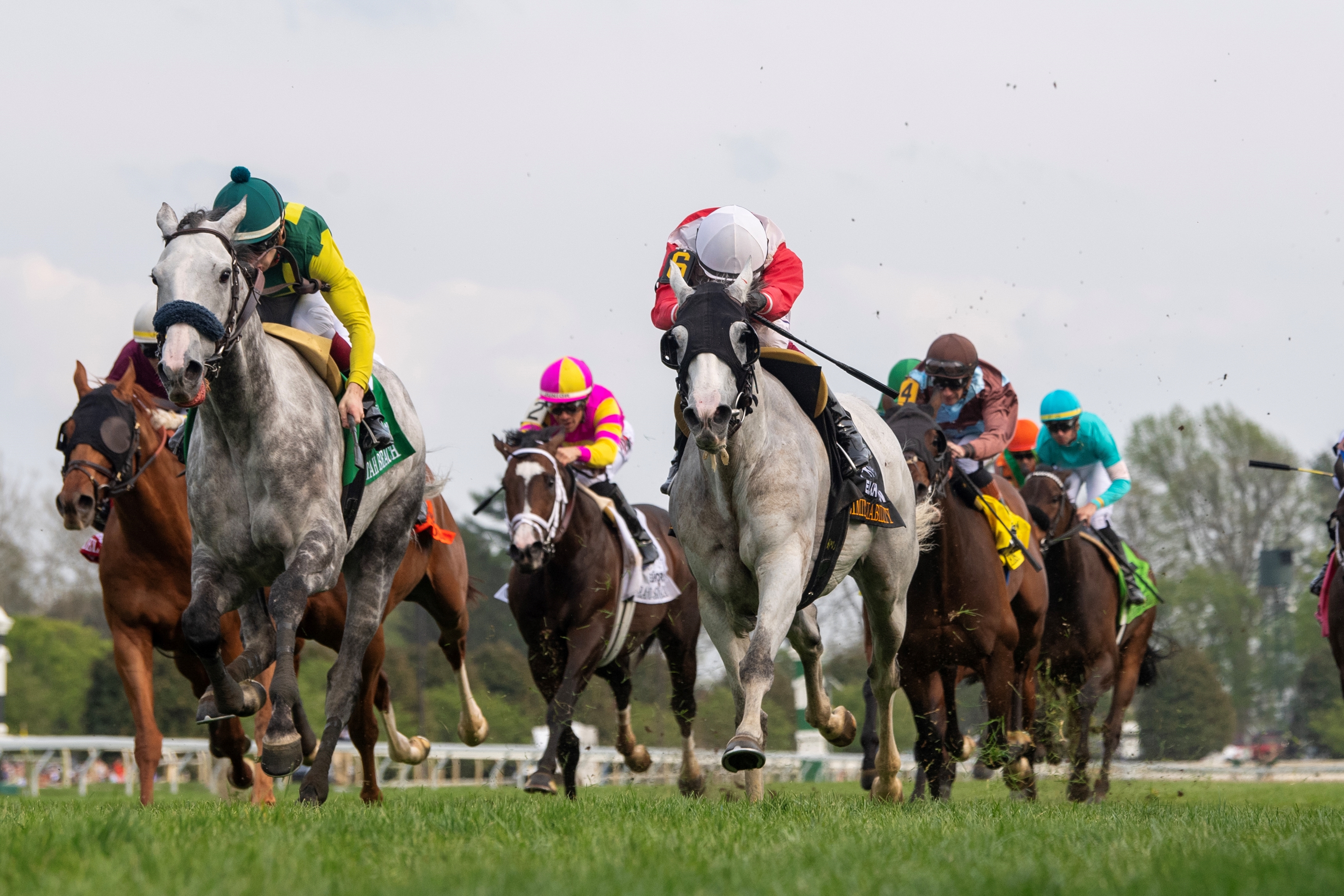
The connecting thread is their dam, My Own Story. Purchased for $10,500 as a yearling, she produced three black-type stakes winners: My Afleet, Real Story, and Utah Beach. Racing often turns pedigree into a language of certainty. Her record is a reminder that pedigree still requires patient observation, repeated decisions, training, sound placement, and time.
2025 Elkhorn Stakes
1½ miles on turf
Final time 2:29.78
The sport supplies a neat metaphor, but Amling's public record does not need one forced upon it. The corporate and racing sides of his life share a temperament already visible in his own words: know the participants, understand the underlying economics, respect longevity, and reserve conviction for the moments when the fit is clear.
Judgment leaves a trail
Careers in dealmaking are easy to summarize with transaction values and titles. Amling's more useful legacy is procedural. In 1997, he could see broadcasters paying to secure both content and distribution. In 2004, he could see one public bid changing private calculations across media. At FTI, he helped turn observations about people and price into a repeatable gate for capital.
His example offers a compact lesson for anyone allocating money, attention, or reputation. Study the history before the opportunity becomes urgent. Treat relationships as operating evidence. Refuse invented economics. Say no early enough to preserve energy. When the rare fit appears, move.
The finish at Keeneland lasted seconds. The bloodline behind it took years. That ratio feels about right.