The first day of Maven Clinic's iPhone app was meant to be noisy. The team had built the product, recruited a network of professionals, arranged press coverage, and heard enough encouraging noises from Apple to imagine an App Store feature. Schedules were cleared for the rush. The rush amounted to one appointment. It was a wonderfully impolite number. One refuses to flatter a forecast. One cannot be rounded up into momentum. One is simply a person using the thing that had, until that morning, been an argument about the future.
Jason Garrett had a close view of that future. He was Maven's first iOS hire and a founding engineer, arriving when the company was still an early New York venture and an app was its front door. His own account of the job is almost comically economical: “I was the first iOS hire at Maven. I'm still trying to make things better.” Two sentences, no fireworks. The first establishes his place in the chronology. The second explains why the chronology kept going.
Founding engineers are usually photographed at the exciting end of the story, near a whiteboard, a launch button, or a check with an extravagant number of zeroes. Their real work occurs after the photograph. The first release acquires users, old decisions, new regulations, feature requests, weak network connections, forgotten passwords, and devices that did not exist when the architecture was chosen. A product does not mature so much as accumulate weather. Someone has to keep the roof sound.
“I was the first iOS hire at Maven. I'm still trying to make things better.”Jason Garrett
A language with wet paint
The early Maven app was written in Swift. This sounds ordinary now. It was not ordinary in 2014 and 2015, when Apple's new programming language was still arriving in installments. Swift had been announced in June 2014. By the time Maven launched publicly in April 2015, developers were learning a language whose conventions, tools, and rough edges were being discovered in real time. The codebase and the language were growing up together, an arrangement with all the calm domesticity of two puppies sharing a kitchen.
The choice fit the company. Maven was betting that an important service could be delivered through a computer people carried in a pocket. The iPhone was not merely a smaller browser. Its camera, notifications, identity systems, and App Store distribution shaped what the product could become. Garrett's job sat at the narrow bridge between a large promise and a small screen. Every tap had to carry its share of the weight.
There was also a more basic problem. In 2015, using a phone for a live professional consultation still seemed novel to many people. The technical task was not only to make video and messaging function. It was to make the whole exchange feel unsurprising. Good interface work often disappears in precisely this way. The user should not admire the bridge while crossing it. The user should reach the other side.
April 2015
to the 2026 reunion
at the anniversary
The one appointment was therefore not nothing. It was evidence. A stranger had found the app, trusted it enough to book, and completed the path the team had drawn. That lonely transaction contained the product in miniature: discovery, decision, scheduling, connection. Launch-day traffic would have been pleasant. A completed loop was useful.
The great pivot was persistence
Maven's public story after launch is full of strategic movement. The company began with a consumer product, then found a larger route through employers and plans. Its service expanded, its customer base changed, and its geographic reach eventually crossed more than 175 countries. The iOS app remained, but the system around it became far more complicated: enrollment, eligibility, localization, communications, support, and the quiet machinery that makes a digital platform feel coherent.
This is where a long-serving engineer becomes more than the sum of shipped features. Garrett carried knowledge of the original constraints into each new era. He knew which decisions were deliberate, which were temporary, and which had merely survived long enough to look deliberate. That distinction has practical value. A code comment can explain what a function does. It rarely remembers the meeting in which three plausible alternatives were discarded.
Persistence should not be mistaken for stillness. Eleven years in mobile software contains several technological lifetimes. Screen shapes change. Apple changes its frameworks, privacy rules, review procedures, and interface fashions. Teams change their release rituals. Companies add layers of management and specialization. The founding engineer who stays must repeatedly become new enough for the current problem without becoming contemptuous of the old one.
Garrett's education offers one small clue to that temperament. At the University of Missouri-Columbia, where he earned a computer-science degree between 2000 and 2004, he was also part of the men's track and field team. It is unwise to turn every athletic line on a résumé into a parable, but this one permits a modest observation: training is repetition with a purpose. Nobody becomes faster by delivering a stirring keynote about the first lap.
The engineer on the screen
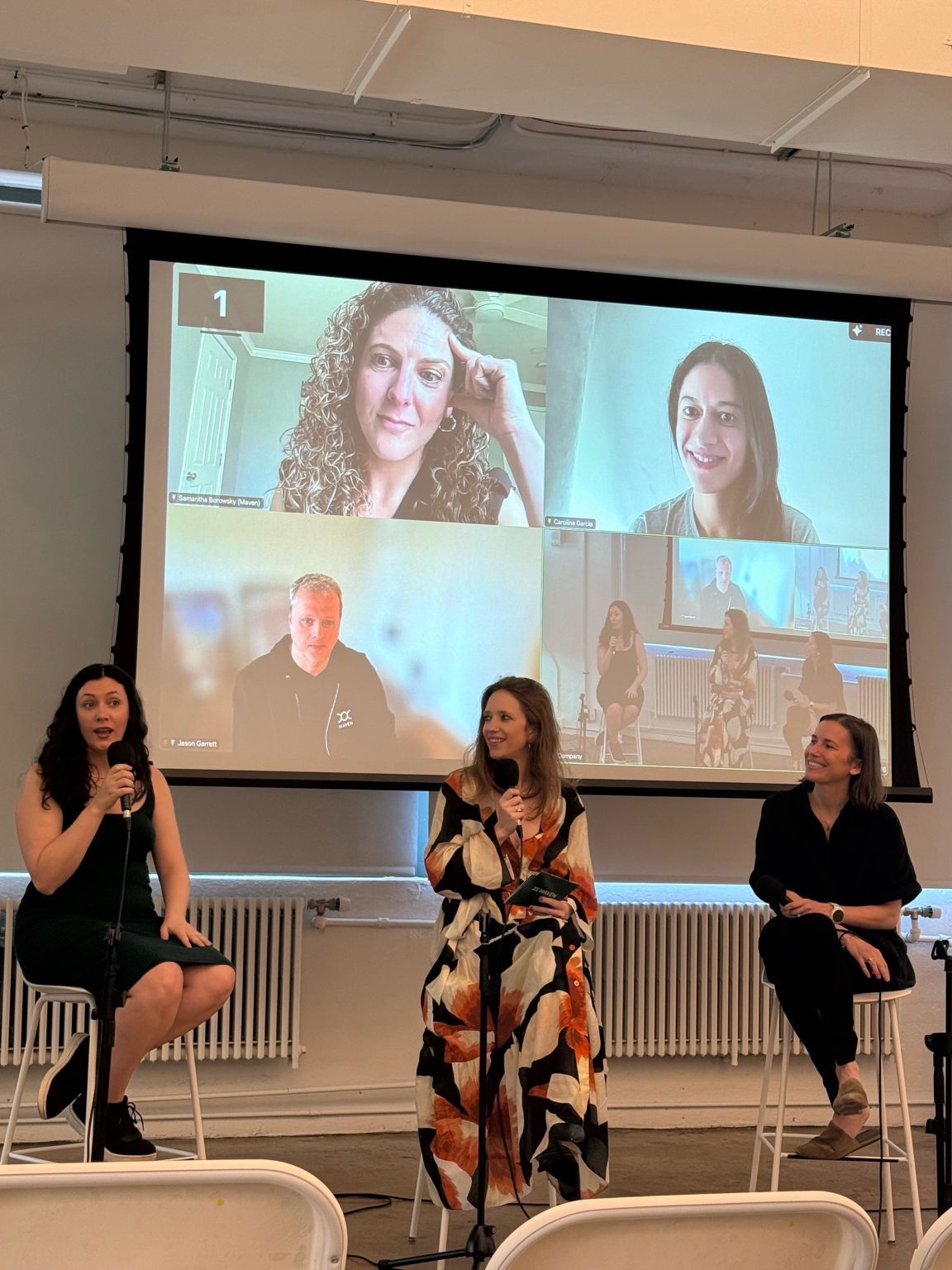
In spring 2026, Maven gathered its New York staff for the app's eleventh anniversary. A photograph from the day captures three speakers seated beneath a projection screen. On that screen are four remote participants. Garrett occupies the lower-left square, his name visible beneath him. It is an apt portrait of an engineer: present, useful, and slightly mediated by the system.
The anniversary program brought together several people who had been building Maven from the beginning. The company remembered the one-appointment launch and paired it with its current figure of 28 million covered lives. Those numbers are not directly comparable, and that is exactly why they work. One describes an event. The other describes a footprint. Between them lie years of releases, migrations, incident reviews, redesigns, hiring, and the countless small choices that never appear in a financing announcement.
By then Maven had become financially conspicuous. Its 2024 Series F brought in $125 million and produced a reported valuation of $1.7 billion. Funding is an easy metric to print in large type, but it is not the same thing as a product working. Money purchases time and options. Engineering converts those options into behavior. Garrett's tenure links the humble beginning to the expensive present without pretending that either one guarantees the next.
Garrett's public profile lists more than 500 professional connections, one programming language, one current company, and a two-sentence biography. The compression feels intentional: first iOS hire; still improving.
There is restraint in that biography. Garrett does not call himself a visionary, disruptor, evangelist, ninja, or any of the other costumes technology has rented from religion and martial arts. He names the concrete thing he did, then uses the present tense. “I'm still trying” admits that improvement is unfinished and that trying is not identical to succeeding. The honesty is bracing.
What staying builds
A founder can point to the company. A designer can point to the screen. An engineer's contribution is harder to isolate after eleven years because it has become structural. It may live in conventions other engineers follow, release processes nobody thinks to question, and decisions that prevent a bad day rather than create a celebrated one. The mature product conceals its scaffolding. This is good for users and inconvenient for biographers.
So Garrett's story must be read in intervals. A computer-science graduate moves to New York. He joins a small company as its first iOS engineer. He works in a language with wet paint. The launch makes one booking. The company changes its model, expands its reach, raises successive rounds, and returns eleven years later to ask the early builders what they remember. Garrett appears on the screen. He is still trying to make things better.
The moral is not that every one-user launch becomes a global company. Most do not. Nor is longevity automatically noble. Staying matters when the work continues to demand judgment and the person continues to supply it. The useful lesson is narrower: the first number does not know the final number, and the first version does not deserve the last word.
That may be why the single appointment has survived in Maven's institutional memory. A launch-day flood would have made a fine press release and a poor fable. One appointment is funny, specific, and human-sized. It reminds a company now described in millions that the product still arrives one person, one screen, and one completed interaction at a time. Garrett's career has occupied the distance between those scales.
The launch was an event. The product became a practice.
There are louder ways to spend a career. There are certainly louder ways to describe one. Garrett has chosen neither. His record is the patient conversion of a first into a still: first iOS hire, still building; first app, still releasing; first appointment, still serving the next one. Software loves novelty, but people live in what endures. Somewhere behind the current screen is an old decision that held, an old decision that was wisely replaced, and an engineer who knew the difference.