Janos
Perczel.
He spent a decade learning how to make things invisible. Now he spends it making students impossible to overlook.
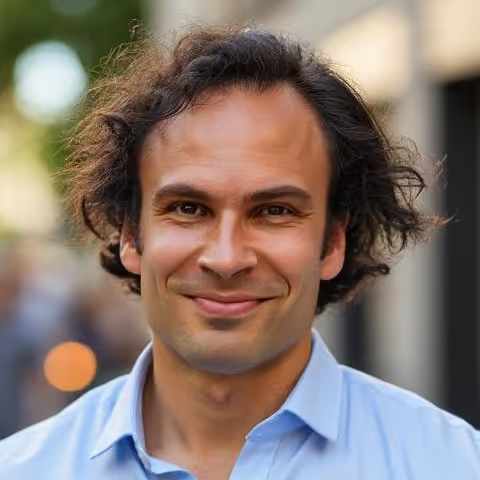
The face of a man who once solved equations for cold atoms and now solves for teenagers. Same energy, warmer subject.
A physicist who found teenagers more interesting than atoms
Janos Perczel builds a company on a simple heresy: the best part of getting a physics PhD was not the physics. It was the teaching. Somewhere between the equations and the office hours, he noticed that explaining a hard idea to a curious student lit him up more than cracking the idea himself. Most academics bury that feeling. He quit and built a company around it.
That company is Polygence. It does one thing with obsessive focus: it takes a high school student with a spark and hands them a PhD mentor and a real research project. Not a worksheet. Not a summer camp with a certificate. A project of their own, shaped over months, mentored one-on-one by someone who actually did the doctoral work. Since 2019 it has reached tens of thousands of students worldwide and signed up thousands of academic mentors.
To understand why he built it, rewind to a classroom in Hungary. A physics teacher named Botond Molnar noticed that a teenage Perczel was hungry, and did the thing great teachers do: he set aside extra time. He fed him Einstein's relativity and the strangeness of quantum mechanics, well past the syllabus. That one relationship pointed a curious kid toward a decade of science. Perczel has never stopped crediting him. Polygence is, in a real sense, an attempt to manufacture more Botond Molnars and hand them to students who would otherwise never meet one.
The academic road he traveled after that classroom was steep. A bachelor's at the University of St Andrews in logic, philosophy of science, and physics. There, under Professor Ulf Leonhardt, his undergraduate research was on the optical theory of invisibility, the real science behind cloaking light around an object. Then Cambridge, where he completed Part III of the Mathematical Tripos, the notoriously brutal one-year master's in applied mathematics, in 2012. Then MIT, for a PhD in theoretical quantum physics, finished in 2018, with much of the work done under Professor Mikhail Lukin at Harvard.
His research was not gentle reading. Metamaterial invisibility cloaks. Robust nanoscale systems for quantum information processing. Cold-atom quantum systems. If you want proof of how he thinks about openness, his MIT physics dissertation sits on a public GitHub repository, free for anyone to read. A founder who open-sources his own thesis tells you something about the company he will build.
It was teaching and connecting with students that made the PhD experience truly memorable.
The pivot happened fast, and it happened at dinner. In January 2019, back at Stanford, Perczel reconnected with Jin Chow, a fellow academic with a talent for mentoring. Over one conversation about giving high schoolers the freedom to chase passions outside the standard curriculum, he saw the shape of a company: a tech-enabled marketplace matching students to mentors. He did not spend a year writing a business plan. Over the next three months he built the platform's MVP himself while Chow recruited mentors out of their university networks. The first student enrolled on May 20, 2019. By the end of that summer, a dozen more had joined.
The founding insight was almost political. Perczel and Chow agreed that education policy could, in theory, fix the attention problem by hiring more teachers and shrinking class sizes. But that reform moves at the speed of legislatures. A company could move at the speed of a startup. So they built the faster path, and let the lobbyists keep working on the slower one.
Then AI arrived, and Perczel did what a physicist does: he looked at the data. His conclusion was contrarian. The large language models everyone was cramming into classrooms had a fatal gap. The public internet, the thing they were trained on, simply does not contain enough high-quality teaching. Forum answers and textbook PDFs are not the same as watching a great tutor patiently coax a student toward an insight over months.
Polygence, it turned out, was sitting on exactly the thing the internet lacked. Years of real, longitudinal, one-on-one student-tutor interactions. In 2025 the company released TeachLM, a language model post-trained on roughly 100,000 hours of that authentic tutoring data, using parameter-efficient fine-tuning. The bet is that a model taught by real teaching will teach better than one that scraped the web. It is the invisibility problem inverted. He spent his youth hiding objects from light. Now he is dragging good teaching into it.
What holds the whole arc together is a single conviction, worn smooth by repetition: give a young person agency, a mentor, and a project worth caring about, and the curiosity takes care of itself. He knows because it happened to him, in a Hungarian classroom, before he knew what to call it.
Look closely at the model and you notice how much of it is borrowed from graduate school and handed to sixteen-year-olds. In academia, the real education does not happen in lectures. It happens in the mentor relationship, the weekly meeting where a more experienced researcher looks at your half-formed idea and asks the one question that reorganizes it. Perczel took that mechanism, the single most valuable and least scalable thing in higher education, and decided high schoolers should not have to wait a decade to get it. A Polygence project is a compressed version of the apprenticeship that turned him into a physicist.
The outcomes are deliberately concrete. Students do not just explore. They produce. A research paper, a white paper, a submission to a journal or competition, an app, a piece of writing, a showcase they can point to. The company's own vocabulary is telling: it talks about outcomes-driven learning, research project publishing, research showcases. For a student staring down college admissions, a finished, mentored project is worth more than a stack of extracurriculars, and Perczel knows the admissions calculus as well as anyone. But the deeper argument he keeps making is that the project is worth doing even if no admissions officer ever sees it, because the act of finishing something hard is where the real growth hides.
His move into AI is not a founder chasing a trend. It is a physicist noticing that everyone else measured the wrong thing. The industry raced to stuff chatbots into classrooms on the assumption that a model good at answering questions must be good at teaching. Perczel's counter is that answering and teaching are different skills, and the data proves it. A model trained on the open web has read a billion answers and almost no genuine teaching, because genuine teaching is a private, longitudinal, one-on-one act that never gets posted. TeachLM is his attempt to correct the training set: feed the model the thing it never saw, the actual back-and-forth of a patient tutor and a real student over months, and see if it learns to teach instead of merely to answer.
There is a neat symmetry to the whole career, and he seems aware of it. As a young researcher he worked on cloaking, the science of bending light so an object cannot be seen. The entire premise of Polygence is the reverse. Every year, talented students go unseen because no mentor ever noticed the spark, the way Botond Molnar once noticed his. He spent his twenties learning to make things disappear. He is spending the rest of it making sure the right students do not.