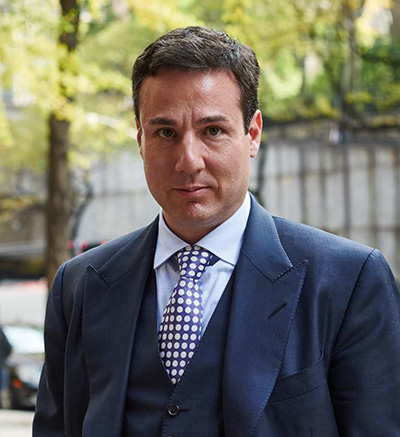
Jamie Diaferia once wanted to become Floyd Abrams. The ambition was understandable: a young person interested in language and law could do worse than admire a lawyer whose work made both matter in public. Diaferia went to law school with that future in mind. Within his first week, he began looking for another one.
Years later, Abrams became a client of the communications agency Diaferia had founded. It is a pleasing rearrangement of an early ambition. The student never became his hero. He found work that allowed him to help his hero be heard.
Today Diaferia leads Infinite, the communications and reputation-management firm he started in New York in 2001. Its business involves professional services, financial services and the public consequences of complicated problems. His own career supplies a relatively cheerful example of a complicated problem: what to do when the profession you chose turns out to fit less comfortably than expected.
The useful detour
At Bucknell, Diaferia studied English and sociology, with a concentration in legal studies. He graduated in 1994. Writing and research were the subjects that drew him in. At the University of Connecticut School of Law, he encountered classmates whose aptitude for legal practice made him reconsider his own destination.
He continued his education, passed the bar, and pursued work outside legal practice. A campus newspaper and then a national magazine for law students gave his interests somewhere to go. The magazine, j.d., the law student’s survival guide, considered the practical business of becoming a lawyer.
That editorial premise has a certain charm. Law school could teach a student to analyze an argument. Someone still had to explain the working life waiting after graduation. The questions of a novice can be useful questions, especially in a profession accustomed to sounding as though it has already answered everything.
The magazine ran out of money. In 1998, Nick Gaffney helped bring Diaferia into Richard Levick’s PR startup. In 2001, Diaferia left to establish Infinite PR. Allan Ripp, who ran his own legal PR business, joined him on early pitches. Independence arrived with assistance.
“Being my own boss suits my personality.”
Jamie Diaferia
A business built beside the lawyers
Infinite’s work puts Diaferia close to the profession he elected to approach from another direction. He advises professional services firms on media, litigation and crisis communications. A lawyer may have a sophisticated account of a dispute. The people reading about it may have ten seconds, little background and a quite different set of concerns.
That gap gives communications counsel something substantial to do. The facts must survive explanation. An argument that satisfies its author can still leave its audience puzzled. Writing for people outside the room requires the writer to imagine their questions before admiring his own answers.
Independent assessments point to the usefulness of Diaferia’s combination of skills. Chambers’ 2023 guide described client feedback praising his legal background, collaboration and composure under pressure. Its 2026 US rankings place him in Band 2 for both crisis and litigation PR and communications.
His other recognition includes PRNEWS’s Crisis Managers category in its 2024 and 2025 People of the Year awards, and its 2017 list of 50 Game-Changers of PR. These are professional distinctions in a career whose daily work often concerns somebody else’s name. Public relations is an unusual occupation for a writer: a good outcome may mean the attention goes elsewhere.
The Atlantic gets smaller
Infinite PR merged with London’s Spada in 2014. Spada had been founded by Gavin Ingham Brooke in 1994. The combination joined businesses with a professional-services focus on opposite sides of the Atlantic.
In April 2016, a management team led by Diaferia acquired Ingham Brooke’s majority shareholding. Diaferia became global CEO and majority owner. Zach Olsen became global president. The London leadership included Isabel Podda, Scott Addison, Ryan McSharry and Bruce Wraight.
For a founder, this was another change in the nature of the job. Starting a company gives a person control over his work. Running a company in two markets requires people who can exercise judgment without sharing a desk. The organizational question becomes how to make colleagues dependable to one another across the distance.
The dates also resist the idea of a single decisive breakthrough. There were thirteen years between founding Infinite PR and merging with Spada, then another two before the buyout. A career can look tidy on a timeline while taking a considerable amount of ordinary Tuesday work to get there.
- 1997A national magazine for law students
- 2001Infinite PR opens in New York
- 2014The merger with London’s Spada
- 2016Management buyout; global CEO
- 2025ParkSouth investment partnership
- 2026DLPR and Greentarget UK acquisitions
Attention, with a purpose
Diaferia’s writing about law-firm marketing makes a useful distinction between being mentioned and being understood. In a 2025 article with Infinite’s head writer, Andrew Longstreth, he examined the limitations of share of voice, the measure that compares an organization’s media mentions with those of competitors.
A mention can be negative. It can concern a practice that leadership has little interest in growing. It can say something that does not advance the firm’s position. The arithmetic may be correct while the conclusion is unhelpful. A room full of people saying your name is only encouraging once you know what they are saying.
Their argument asks leaders to establish the firm’s identity, desired clients and priorities before pursuing publicity. That takes internal discussion and feedback from clients. It also gives communicators a basis for deciding which opportunities deserve attention. Availability alone is a flimsy strategy.
A conceptual sequence, not a scorecard: clarity gives publicity a purpose.
A 2021 article Diaferia co-wrote with Longstreth applied similar care to leadership succession. Employees should hear about a transition first, clients next, and journalists after clients have been informed. The order acknowledges that a firm’s people have a relationship to the news beyond reading it.
It is easy to think of an announcement as a piece of text. Their advice treats it as a sequence of conversations. Roles need to be clear, the transition needs planning, and clients should hear directly about changes that affect them. A polished statement cannot compensate for making a valued client learn something important secondhand.
The company changes scale
On August 13, 2025, Infinite announced investment from ParkSouth Ventures. Diaferia, Olsen and Podda continued as its executive leadership team. Agency operator Michael Koziol would advise on operations, growth, acquisitions and integration.
The arrangement gave an established founder-led business an investment partner for another period of expansion. It also made the operating work explicit: integrating acquisitions, organizing growth and supporting the people expected to deliver it. Those tasks are less photogenic than a deal announcement and occupy rather more of the calendar.
On May 6, 2026, Infinite announced its acquisition of Dukas Linden Public Relations in New York. DLPR brought financial-services experience across asset and wealth management, capital markets, fintech and other areas. Seth Linden took a leadership role within the Infinite platform; Richard Dukas became a senior advisor.
Then, on June 23, Infinite announced the acquisition of Greentarget UK, a London agency founded in 2006. Managing director Jeff Watt joined the management team to lead European operations. The combined business reported more than 120 consultants across seven cities.
The combined business after the Greentarget UK acquisition, spanning London and six US cities.
Growth also brings decisions about the organization inside the organization. Infinite created a Head of Talent position and appointed Eric Wiedeke in 2026. His remit covered global talent strategy and operations, connecting the needs of the business with its people. In 2025, Sophie Mellish had joined in London to oversee global digital marketing and creative services.
These appointments give the expansion a more concrete meaning than a larger number on a company description. New capabilities need leaders. More colleagues need attention to how they work and develop. An agency advising clients on their messages has its own internal messages to get right.
Still a writer’s problem
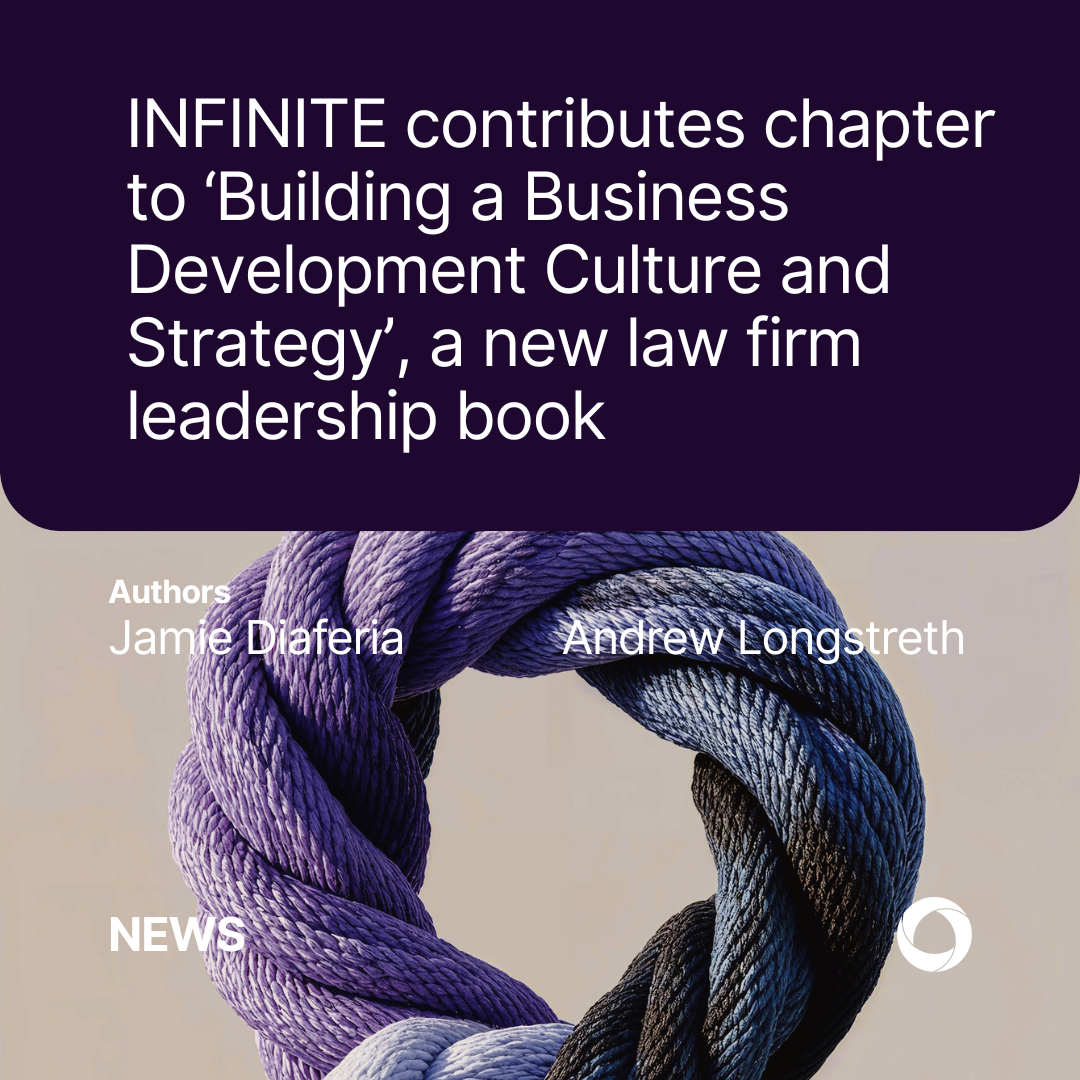
Amid the acquisitions, Diaferia and Longstreth contributed a chapter to Building a Business Development Culture and Strategy: A Management Guide for Law Firm Leadership. Announced in July 2026, their chapter examines content differentiation in an age of information abundance.
It considers how law firms can distinguish themselves when legal excellence is assumed, and how interpretation, synthesis and strategic insight can demonstrate expertise. The subject returns Diaferia to familiar ground: a knowledgeable person has something to say, and somebody else needs a reason to read it.
In September 2026, Diaferia and Linden wrote together about expanding with care. They emphasized specialist knowledge, senior service and compatible culture. Technology and more systematic management were part of their account, too. The ambition was international; the tests remained close to the client relationship.
There is room for less imposing concerns. Asked about his working day in 2020, Diaferia described repeatedly giving up coffee and returning to it, with an awareness that his running commentary might interest nobody else. Even a communications advisor can find himself with an audience problem before breakfast.
His connection to Bucknell has continued: the university’s report lists a scholarship bearing his name. And the early question about career fit has remained part of his public work, including a 2022 podcast conversation with Ken Gary about applying legal and journalistic training to a different profession.
The law-school plan changed. The interest in law and writing endured. Diaferia’s career suggests how much can follow from keeping the parts of an ambition that are useful, then giving them a different job.