Breaking
175M+ people have sent or received a Paperless Post 20M+ events powered $55M+ raised, still privately held Started in a Harvard dorm in 2008 Pandemic cut revenue 85% — then it broke records 175M+ people have sent or received a Paperless Post 20M+ events powered $55M+ raised, still privately held Started in a Harvard dorm in 2008 Pandemic cut revenue 85% — then it broke records
Co-founder & CEO / Paperless Post

James
Hirschfeld

He could not decide between expensive paper and a lifeless email for his 21st birthday. So he refused to choose, and built a design company that lives inside an invitation.

FounderDesignerOperator New YorkHarvard '09
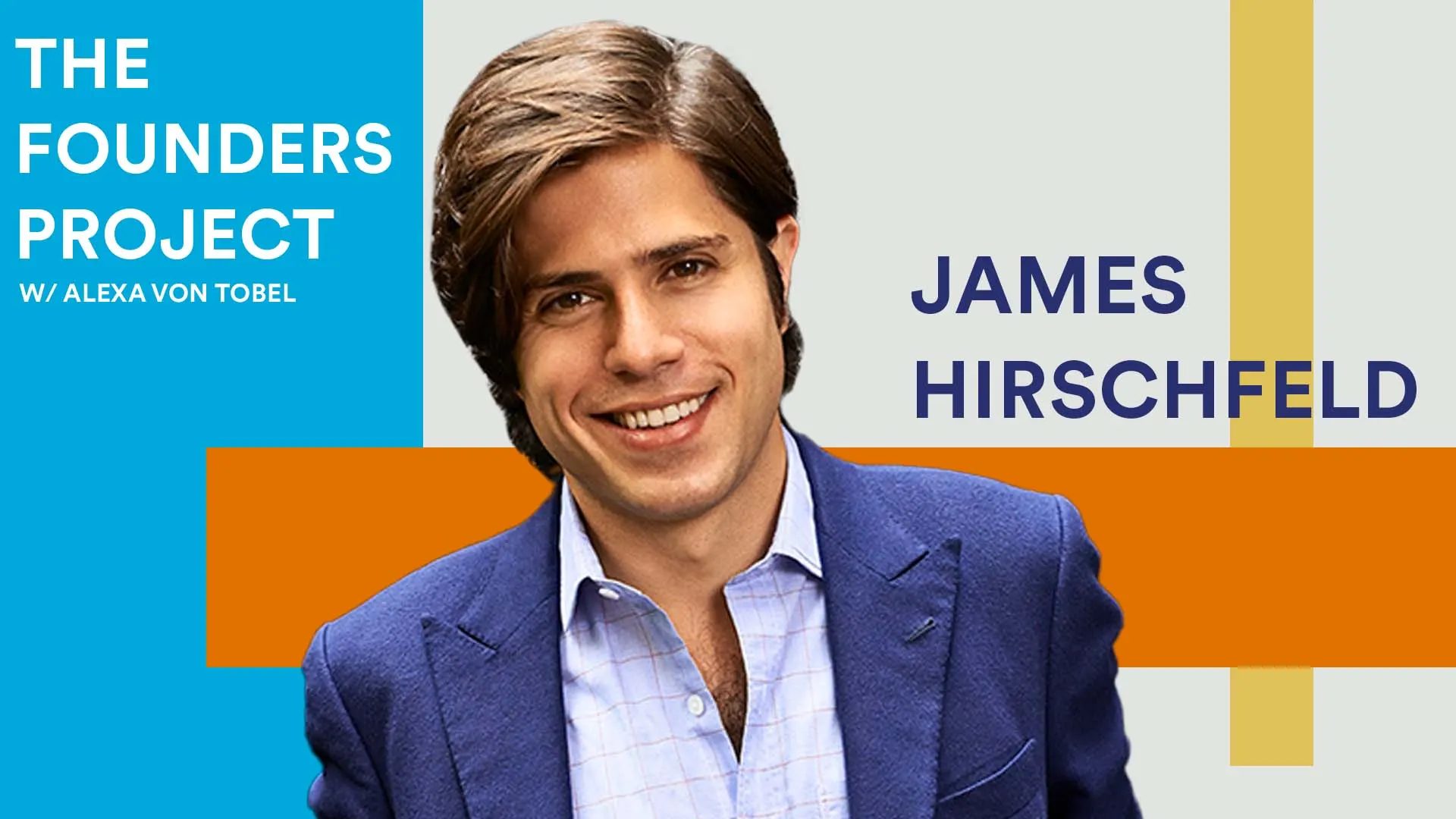
James Hirschfeld, co-founder and CEO of Paperless Post
The calm in the room where the party gets planned.

A phone call about a beach party in the dead of a Boston winter

In 2007 a Harvard undergrad wanted to throw a winter-defying, beach-themed bash for his 21st birthday. Paper was too slow and too pricey. Email was too dry. He picked up the phone and called his older sister.

That call is the whole company. James Hirschfeld phoned Alexa, who was working in New York, and said there had to be a way to send invitations as efficient as email but with the customization and beauty of printed ones. They did not write a market-sizing deck. They noticed that the moment of inviting someone mattered, and that the internet had quietly decided beauty was somebody else's department.

Hirschfeld disagreed. As a kid he collected coins and stamps, drawn less to the value than to the illustrations, the line work, the small encoded culture of a designed object. He looked at the early web and saw a place that had forgotten all of that. Paperless Post, launched in 2009, was his argument that an envelope could feel like something even when it arrived as pixels.

The argument landed fast. Within a month of launch, the president of Harvard was using the platform to organize alumni events. The product gave ordinary people powerful tools and very good defaults — the rare combination that lets a non-designer make something they feel proud of. That, more than any growth hack, is the trick the company has run for fifteen years.

Today the numbers are large enough to lose their texture: more than 175 million people have sent or received a Paperless Post, across roughly 20 million events. The company has raised over $55 million, reached a Series E, and stayed private and profitable. Hirschfeld still describes it the same way he did in the dorm: at its core, it is a design company that happens to live in a browser.
175M+
People reached
20M+
Events powered
$55M+
Raised to date
15 yrs
Privately held
"The web was not a place for beauty."
— James Hirschfeld, on why he started

When the parties stopped, he asked who the company wanted to be

In early 2020 a business built entirely on people gathering watched gathering become illegal. Revenue fell roughly 85%. For a consumer company priced on events, that is not a dip, it is a question about whether you still exist.

Hirschfeld's instinct was not to chase the trend of the week. "We could chase pandemic trends," he put it, "or focus on who we wanted to be on the other side." The company leaned into the second. It treated the worst stretch in its history as its biggest period of innovation — building out a Party Shop marketplace for physical party supplies and decor, and embracing the migration of invitations to text rather than fighting it.

That texting shift is telling. A lot of founders would have read SMS as a threat to a card business. He read it as distribution. Today around 40% of invitations go out by text, and the company treats the channel as an opportunity it chose to ride. By Halloween 2022, revenue was up roughly 70% over 2019. The party business, it turns out, is very much alive.

2019 baseline
100
2020 trough
~15 (−85%)
Halloween '22
170 (+70%)

Indexed illustration of revenue trajectory described publicly by Hirschfeld. Not audited figures.

Fifteen years, one idea

2007
A beach-themed 21st birthday party runs into the paper-versus-email problem.
2008
Co-founds Paperless Post with sister Alexa, still an undergrad at Harvard.
2009
Launch. Within a month, Harvard's president is using it for alumni events.
2017
Fresh funding; the pitch stays the same — get people face-to-face.
2018
Series E, the last major raise. Company stays private.
2020
Pandemic cuts revenue ~85%. The biggest innovation push begins.
2022
Party Shop and SMS invitations launch; Halloween revenue up ~70% vs 2019.
2024
Paperless Post turns fifteen.

A collector's eye, scaled to 175 million people

Defaults are a design

Give people powerful tools and helpful defaults so a non-professional ends up with something they feel proud of. The defaults do the heavy lifting nobody notices.

The thick envelope

He built print-style, skeuomorphic cues on purpose, so opening a digital card carries the tactile thrill of a quality envelope sliding out of a mailbox.

Design company first

The technology is the delivery truck. The product is the design. He refuses to let anyone reverse that order, fifteen years and a Series E later.

The small stuff that explains the big stuff

The coins and stamps came first. A childhood spent cataloguing tiny illustrated objects is hard to separate from a career spent making invitations feel like keepsakes.

He found Lisa Corti's hand block-printed textiles at a friend's house and never quite recovered. Kate and Andy Spade's whimsical stationery sits on the same shelf in his head.

It is a sibling company. James and Alexa, brother and sister, Harvard and New York, building what one writer called the prettiest invites on the internet.

His origin myth is almost too neat: the product exists because email felt too cold for a beach party thrown in the middle of a Boston winter.

"There needs to be a way of creating invitations as efficient as email — with the customization and beauty of printed ones."
— The phone call that became Paperless Post

Beauty, now with a copilot

The forward bet keeps the same center of gravity. Hirschfeld wants to push Paperless Post's tools into business and organizational events — gatherings that still need to feel designed inside a brand's guidelines — and to use AI to widen personal creative expression rather than flatten it. The framing is consistent with everything else he says: technology in service of the host's vision, not a replacement for it.

"They come to us as design authorities," he has said of his users. "I've always wanted to help hosts bring their vision to life." Fifteen years in, the dorm-room thesis has not moved an inch. How you invite people still matters. He is still building the proof.