An electronic component could arrive at your desk the next day. An academic book might take months. James Gray’s father thought this was a peculiar arrangement. The object designed to help you understand the world appeared to be travelling through it at the speed of a leisurely apology. Gray and his younger brother built a business around closing that gap.
Coutts Information Services began in 1991, with its limited-company formation following in 1992. Its proposition had the elegance of a useful household invention: get the book to the person who needs it sooner. Years later, Gray recalled buying a Birmingham business where rows of typewriters produced invoices. His own operation used a computer. The machinery behind the book mattered almost as much as the book itself.
That is a useful place to meet the founder of Kortext. The company now works across digital content, university data and artificial intelligence. Gray’s working life began with the rather more tangible business of supplying readers. His career has repeatedly returned to the distance between having information and being able to use it.
Nashville, then home
Ingram acquired Coutts in 2006. Gray moved to Nashville with his wife to establish Ingram Digital, putting him inside the book industry’s shift towards screens. His work involved helping Amazon and Apple with digital book stores. For someone who had recognised the implications of academic journals moving online, this was a chance to work on the systems through which other kinds of reading would follow.
The move also gave his career a different scale. The 2026 account of his work describes digital-content workflows involving Apple, Sony, Google, Microsoft and publishers around the world. Before Kortext, there had been years of negotiating the practical business of turning published material into something people could discover and consume digitally. A book file still needs a route to its reader.
Gray spent six years working in the United States. His earlier university supply business had offices across several countries, including Canada, the Netherlands and Southern Africa. By the time he returned to Britain, he had seen academic content as a physical delivery, a library service and a digital distribution problem. Each view revealed a different place where the process could snag.
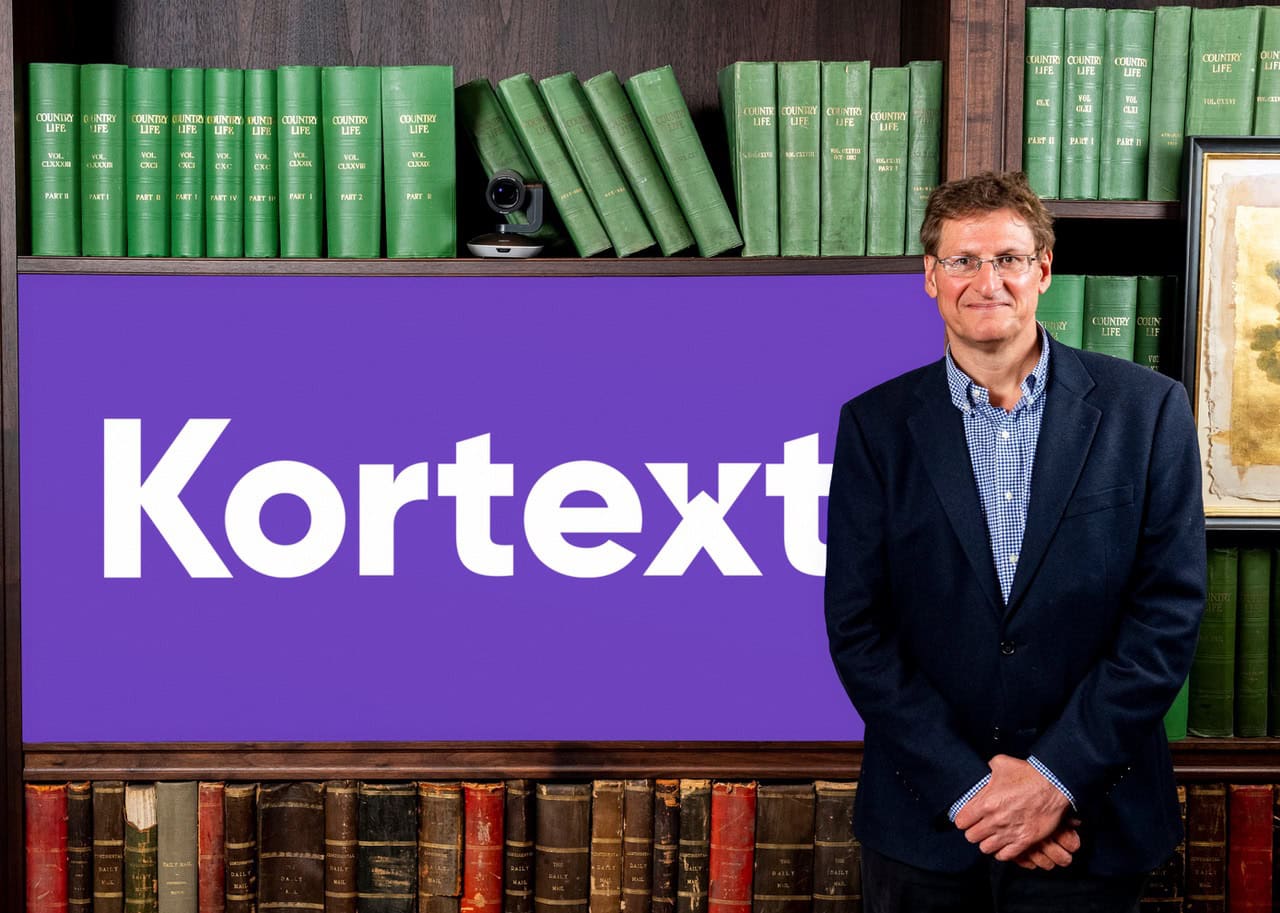
The opportunity at home was refreshingly specific. People he knew had children at university and were still buying their course textbooks in print in 2012. After his years in digital books, Gray found the pace of change surprising. He also worried that, without a British challenger, an American technology business would eventually define the UK market.
Kortext was established in 2013. There is a family resemblance between the two ventures. Coutts had addressed the wait for a book. Kortext addressed access to learning material in a world where delivery could happen through an account rather than a parcel. The commercial proposition had changed; the impatience with an unnecessarily awkward process was familiar.
“My overriding passion is to see technology make something better, easier, faster, more efficient.”
James Gray, 2016
Three people on the other side of the screen
Gray’s explanation of Kortext’s work divides attention among three groups: students, academics and librarians. It is a telling choice. The reader might be the most visible customer, but the book reaches that reader through decisions made by other people. A university platform has to make sense in a lecture, in a library office and during the quiet business of studying alone.
For students, he has described in-book searches, shared notes, collaboration and exported references. These are small actions, repeated many times across a course. For academics, the platform can show how learning content is being used. For librarians, it supplies tools to acquire resources and examine their use. The same material passes through three different kinds of working day.
That arrangement requires relationships as well as software. In 2019, dmg ventures led a further investment round in Kortext, following its participation in the company’s seed round the previous year. Gray spoke about using the investor’s experience to reach new audiences. Money was part of the announcement; so was the prospect of bringing other people’s knowledge into the business.
The investor’s interest also reflected the market’s unusual timing. Education still depended heavily on printed materials while other forms of media consumption had shifted. Gray was operating in a sector with established institutions, established purchasing habits and established reasons for caution. Selling a different way of working meant dealing with those habits one university relationship at a time.
- 1991 / 92CouttsAcademic book supply
- 2006Ingram DigitalDigital distribution
- 2013KortextUniversity learning
The reading list gets a longer job description
By its tenth anniversary in 2023, Kortext’s remit had expanded. Solutionpath had joined the group in 2022, bringing its StREAM student engagement platform. That added a broader view of university activity to a business already working with learning resources. The company’s anniversary review also described citation tools, translation and educational video alongside its books.
The figures from that review belong to their moment: two million students and more than 5,000 institutions globally. The current company overview reports more than three million users at over 5,000 institutions. These are measures of the business Gray leads, rather than a verdict on every student’s experience. They do show how far the operation has travelled from its original supply brief.
In October 2025, Kortext acquired Talis from Sage. Talis connects library resources with academic curricula, making it a logical extension of the company’s library work. The announcement promised investment in its products, compatibility with library systems and further development involving AI. A textbook business was acquiring more of the apparatus that determines how a textbook gets chosen and found.
In June 2026, the practical theme returned in another form. Kortext announced that its perpetual-access eBook catalogue could be discovered within EBSCO’s GOBI ordering environment. The catalogue covered more than 3.5 million titles from over 10,500 publishers. Gray’s accompanying emphasis was on giving libraries choice and allowing them to work through systems that suited them. The useful improvement was partly the absence of an extra detour.
AI enters through the reading list
Gray’s public argument for generative AI begins with educational material. In October 2023, he described tools designed to produce summaries, study notes and revision questions from sections of books. The purpose was bounded by the task. Students already had a body of material to study; software could offer another way of working through it.
He also acknowledged an awkward question: note-taking can itself be part of learning, so what happens when a tool assists with it? His answer included the value of checking generated material against the original text. That leaves work for the student. It also makes the educational proposition more interesting than a promise to remove every effort from studying.
By July 2025, Kortext’s chief product officer, Andrew Bates, was describing fusion, developed with Microsoft. It brings content, data and AI into an institutional platform. Bates explained its architecture through Lego: a foundation with different products added as needed. It is a suitably practical image for a business whose founder keeps coming back to how the pieces fit.
That November, Kortext announced a collaboration with Saïd Business School at the University of Oxford, Microsoft and Instructure on AI-powered personalised learning. The work embeds an AI assistant in Canvas, the learning environment students and academics already use. The location matters. Another clever tool becomes more useful if people can reach it during the work they are already doing.
There is a human requirement behind these developments. Gray has joined Wonkhe discussions about universities building the capabilities needed for digital change, alongside institutional leaders and editor Debbie McVitty. Those conversations deal with working practices, culture and the boundaries between teams. A university can purchase technology more quickly than it can change the routines around it. His brief now includes both.
The coast, and a cooler head
Gray’s own relationship with universities has acquired another dimension: Arts University Bournemouth lists him as a governor. Its biography places him in Poole with his family, still enjoying time on the water when the weather permits. It also describes his investment and board work with other technology businesses. The supply relationship has become one of several connections to the region’s institutional life.
His attachment to sailing predates the business career. At 18, he postponed university for two years of travelling, mostly by boat. During an Atlantic passage, he went overboard while the other crew members were asleep. He later recalled the captain stopping, calculating their position with paper charts and returning to find him. Gray has said that calm response still informs how he thinks about decisions.
There are less dramatic glimpses of the person at work. In 2016, he described mornings beginning with his three-year-old jumping on him and nights ending with an iPad falling onto him. He enjoyed meeting people such as astronaut Tim Peake and land-speed record holder Andy Green. The flights involved in meeting interesting people had less appeal, particularly when they required a four o’clock start.
These details give the technology career its ordinary dimensions: family, departures, screens used too late, a place to come home to. Gray has built businesses around making information easier to reach. The next assignment is more complicated than next-day delivery, but the standard he set himself remains wonderfully testable. Somewhere, someone is trying to learn something. Does the machinery help them get on with it?
Keep reading and listening
- Kortext
- James Gray on LinkedIn
- Arts University Bournemouth biography
- The Nashville years and university learning
- A working day with James Gray
- Extrology: listen to James Gray
- His Dorset background and sailing story
- James Gray on AI and studying
- Watch: Kortext LIVE 2026 sessions
- Watch: James Gray’s Kortext LIVE invitation
- Talis joins Kortext
- Oxford Saïd AI collaboration
- Fusion explained by Andrew Bates
- Library catalogue joins GOBI
- People and digital change
- Kortext’s current company overview
- Kortext’s tenth-anniversary review
- The 2019 investment round
- 2026 HEPI speaker biography