A good coat can outlive the shop that sold it. Jaeger has put that proposition through an unusually demanding test. The British clothing name passed through administration in 2017, entered it again in 2020, and was bought by Marks & Spencer in January 2021. The price was £6 million. The old chain’s remaining stores were outside the deal.
Today the label sits inside M&S, selling womenswear, menswear and accessories through its website and selected shops. Its familiar interests remain: wool, cashmere, silk, tailoring and clothes intended to earn repeat appearances. Yet the useful part of the story is the rearrangement behind the rail. M&S kept a recognisable fashion identity and gave it access to an established retail machine.
That makes Jaeger an instructive company to watch. Its history contains both the appeal of a long-lived brand and the limits of treating age as a business plan. A label sewn into a coat cannot pay the rent. Somebody still has to persuade a customer to buy the coat.
01 / THE TRANSACTIONA rescue with the shops left out
The distinction between buying a brand and rescuing its former business matters here. When the 2021 deal was completed, the remaining 63 stores and concessions were excluded. Retail Gazette reported 233 redundancies, comprising 211 store employees and 22 head-office staff. The Jaeger name continued; the people who had sold its clothes faced a very different outcome.
Earlier attempts had required considerably more capital. Better Capital’s regulatory reporting records an initial £40 million investment in 2012, including £19.5 million to acquire Jaeger and money reserved for restructuring. Private Equity News later reported total investment of £69 million and a £7 million disposal in March 2017. Those figures describe that investor’s involvement, not the later M&S transaction.
So what failed first? The chronology rules out a story that begins with lockdown. Jaeger was already in administration in April 2017, after a buyer could not be found. Pandemic disruption subsequently surrounded the second collapse under Philip Day’s ownership in November 2020. The brand’s difficulties had a history before the high street’s extraordinary shutdown.
M&S’s price for the Jaeger brand and assets.
M&S approached the opportunity with something previous owners could not simply buy off a shelf: its own website, delivery network and stores. It appointed Fiona Lambert to lead the relaunch and set Jaeger up with a dedicated team. The commercial proposition was to broaden the M&S clothing offer with a name that already meant something to shoppers.
02 / THE UNLIKELY BEGINNINGBefore the coat, the underpants
Jaeger’s origin is considerably stranger than the usual tale of a gifted tailor opening a small shop. In 1884, London businessman Lewis Tomalin established a clothing business inspired by Gustav Jaeger, a German scientist who promoted wearing animal fibres next to the skin. The original company’s name was Dr Jaeger’s Sanitary Woollen System Company.
Woollen underwear was central to the early offer. This was clothing attached to a theory about how people should live, with a scientist’s name doing valuable commercial work. The theory belongs to its period; it is not a modern medical recommendation. What endured was the emphasis on material, a more durable selling point than Victorian ideas about bodily health.
Over time, Jaeger moved into fashion. Its history encompasses explorers’ woollens, tailored clothing and a Regent Street flagship opened in the 1930s. Natural fibres supplied continuity as the wardrobe changed. For a customer meeting the label today, that history is most useful when it explains a fabric choice or a cut, rather than decorating a swing tag.
The archive gave the relaunch team specific things to work with. Lambert told TheIndustry.fashion that garments and photography were housed in Leeds and at the University of Westminster. Three launch coats drew on vintage pieces. A later trench and print dress also had archive origins. An old garment could become a design brief, with its proportions reconsidered for a new wearer.
“It’s a mix of science and art.”
Fiona Lambert · Jaeger relaunch blog, 2021
03 / THE REBUILDA fitting room inside a bigger business
The new collection launched on M&S.com in October 2021, followed by physical trials. These tested different ways of selling: customers could browse samples and order online at Cribbs Causeway, while Edinburgh offered a fuller shop-within-a-shop experience with its own entrance. The experiment was about the selling format as well as the clothes.
Spring Studios helped develop the brand identity; Task PR supported the launch. Inside the business, Lambert described design judgement working alongside data. Her team’s account emphasised listening to customers and improving the range. These were management’s stated working principles, and they explain the sequence: establish a collection, observe the response, then decide how far to expand.
The business earns its money in the conventional way: selling garments and accessories to consumers. Its organisational advantage is that the brand can concentrate on an identifiable collection while the parent supplies much of the route to market. For M&S, Jaeger provides another reason for shoppers to visit its clothing offer. For Jaeger, the arrangement makes the existing M&S shopping journey part of the proposition, from browsing through to delivery or collection.
The early response gave M&S grounds to extend the store offer. In March 2022 it announced 14 additional locations, taking the stated footprint to 26 across the UK and Ireland. Dedicated spaces included changing rooms, seating and staff able to advise on Jaeger. Customers could feel the fabrics and assess the fit before choosing.
In October 2023, M&S announced another 20 locations, targeting 46 by early 2024. It reported autumn/winter sales up 25% against the previous year and knitwear up 43%. Those are seasonal sales comparisons, not annual profit figures. They nevertheless provide a concrete reason for the retailer’s decision to give Jaeger more space.
04 / THE CLOTHESFor the wardrobe that has a diary
Jaeger serves people dressing for work, weddings, dinners, weekends and holidays. Womenswear includes coats, dresses, blazers, trousers, shirts and knitwear. Menswear covers tailoring and more relaxed pieces. Accessories complete the offer. The underlying problem is familiar: finding clothes that look considered without requiring the wearer to become a full-time student of fashion.
Its market position is premium ready-to-wear. The pitch rests on fabric and cut, with an archive behind it and M&S handling the purchase. Shoppers can buy a single useful layer or build a coordinated outfit. That flexibility matters when a jacket must work separately from its matching trousers, or a dress needs to survive more than one invitation.
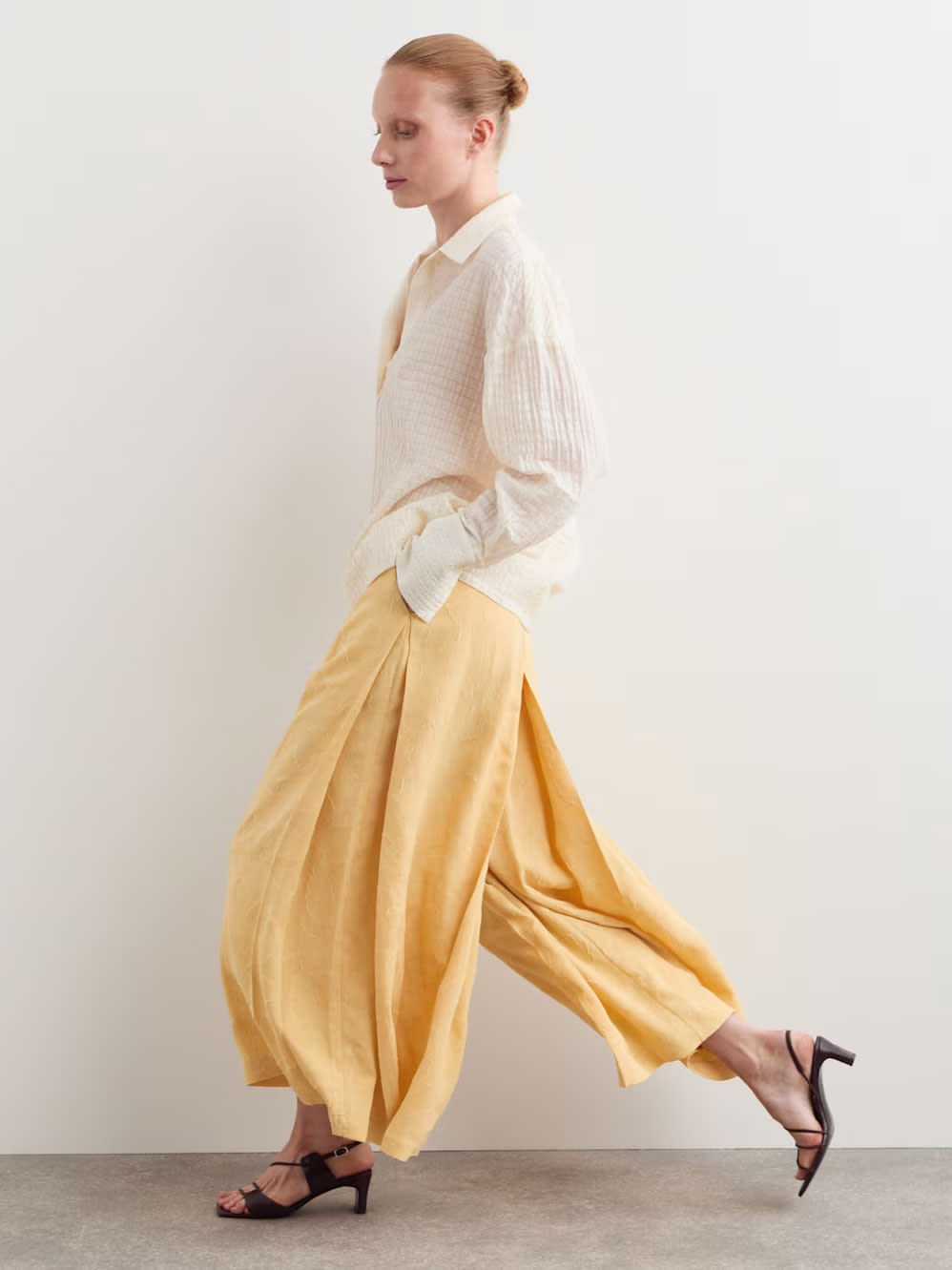
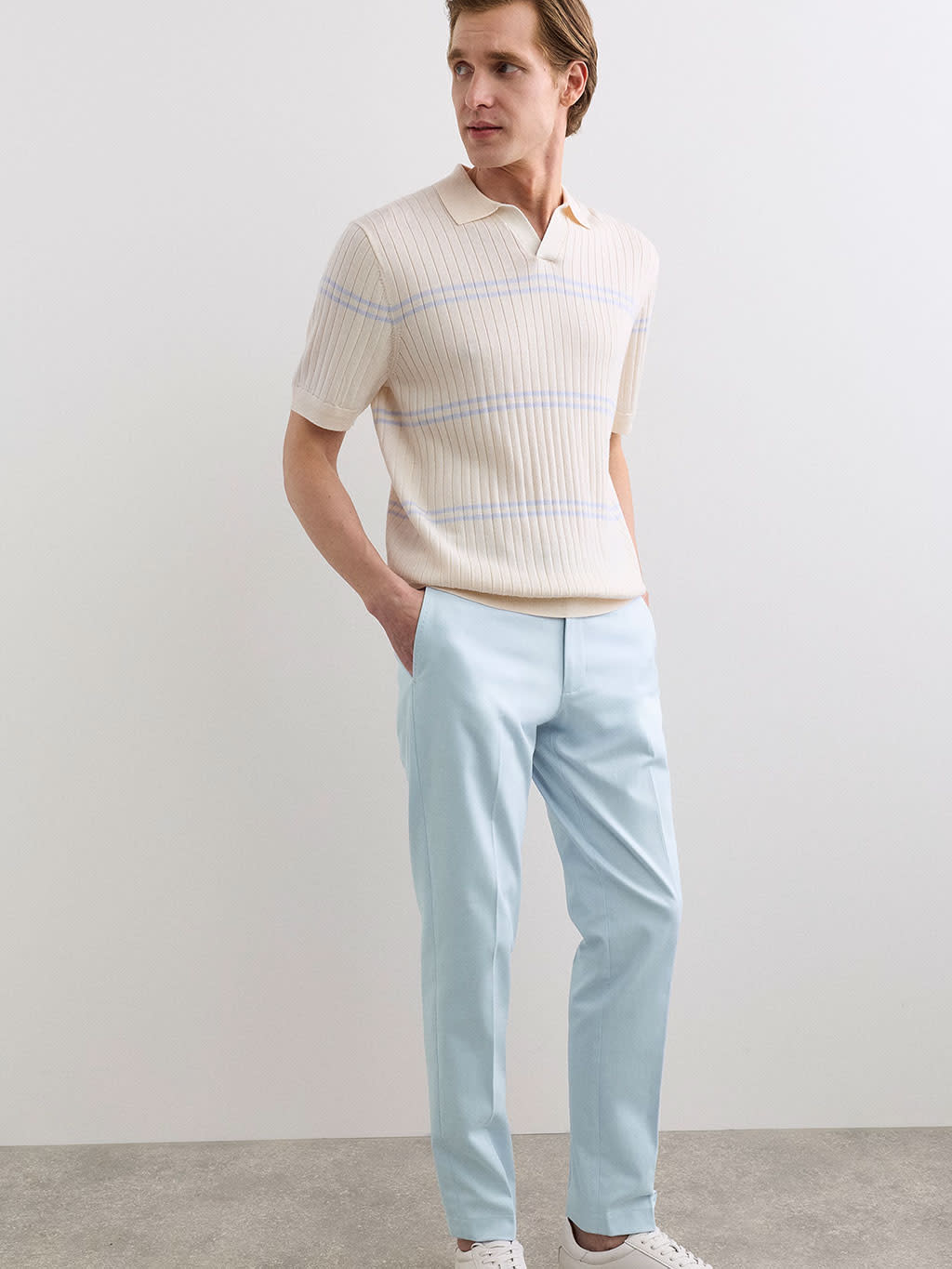
The summer 2026 edit illustrates the breadth. Alongside colourful womenswear and silk pieces, the menswear offer includes linen-and-silk tailoring, merino wool enriched with silk, and cotton trousers with a touch of cashmere. Fabric remains part of the sales argument, even when the styling is relaxed enough for a seaside lunch.
Prices place limits on the audience. M&S’s July 2026 editorial selection included £69 knitwear, £79 trousers and a £115 pure-silk piece. These are examples from that published edit, not permanent prices. They indicate a customer willing to spend beyond the cheapest basics, while still considering individual garments rather than buying a designer wardrobe wholesale.
A useful comparison set includes Hobbs for women’s occasionwear, Reiss for contemporary tailoring and M&S’s own Autograph range, which also promotes fabrics such as linen and silk. This is an editorial shopping comparison, not a market-share ranking. Jaeger’s combination is a particular British clothing archive, a continuing natural-fibre emphasis and access through M&S. None of those removes the need to compare the actual garment with the alternatives.
For that shopper, Jaeger’s distinctiveness has to be visible. A familiar name can get a jacket into the fitting room; the shoulders, lining, handle and comfort must finish the job. The practical comparison is garment by garment. Check composition, movement and care requirements, then ask how many existing clothes the new purchase will work with.
05 / THE NEXT RAILEven a wool specialist needs a holiday
In April 2026, M&S announced Jaeger’s first swimwear collection. The launch arrived within a broader summer range that included silk-cotton shirts, sandals, bright tailoring and woven leather details. For a label associated with a substantial winter coat, beachwear is a cheerful stretch of the imagination.
It also asks a commercial question. Can customers recognise Jaeger’s design preferences when the product no longer relies on the fabrics most associated with its history? Swimwear can make sense alongside a holiday wardrobe, but the name alone does not establish expertise in every new category. Fit and use will provide the answer at the product level.
There is a lesson here for other businesses, though it needs careful boundaries. Jaeger’s relaunch suggests starting with the qualities customers recognise, turning the archive into saleable products, and testing distribution before expanding it. In this case the parent already had the infrastructure. An independent label would have to secure or pay for that access.
Nor does an archive guarantee repeat demand. If customers dislike the fit, reject the price or see little distinction from neighbouring rails, history offers limited protection. The operating arrangement needs a brand worth preserving and a retail partner able to sell it effectively. Jaeger had the first; M&S brought the second.
The remaining test happens in ordinary wardrobes. A coat gets worn to work, a suit appears at another wedding, a summer shirt comes out again next year. Jaeger’s relaunch ambition was to create “tomorrow’s vintage”. The phrase gives the designer a direction. The customer, deciding what to keep wearing, gets the last word.