BREAKING   i3 launches 3-French NIRF-IVUS coronary imaging catheter Tested in ex-vivo human coronary arteries Series A financing opened July 2022 Born from Mass General / Harvard & TU Munich Tagline: Looking Beyond Anatomy Coronary artery disease is the #1 cause of death worldwide HQ: Wilton, Connecticut
Company Profile · MedTech

Intravascular Imaging
Incorporated (i3)

"Looking Beyond Anatomy."

A coronary catheter thin as a millimeter that does something ultrasound alone never could: show a cardiologist the biology inside an artery, not just its shape.

Founded 2018 Wilton, CT NIRF-IVUS Series A
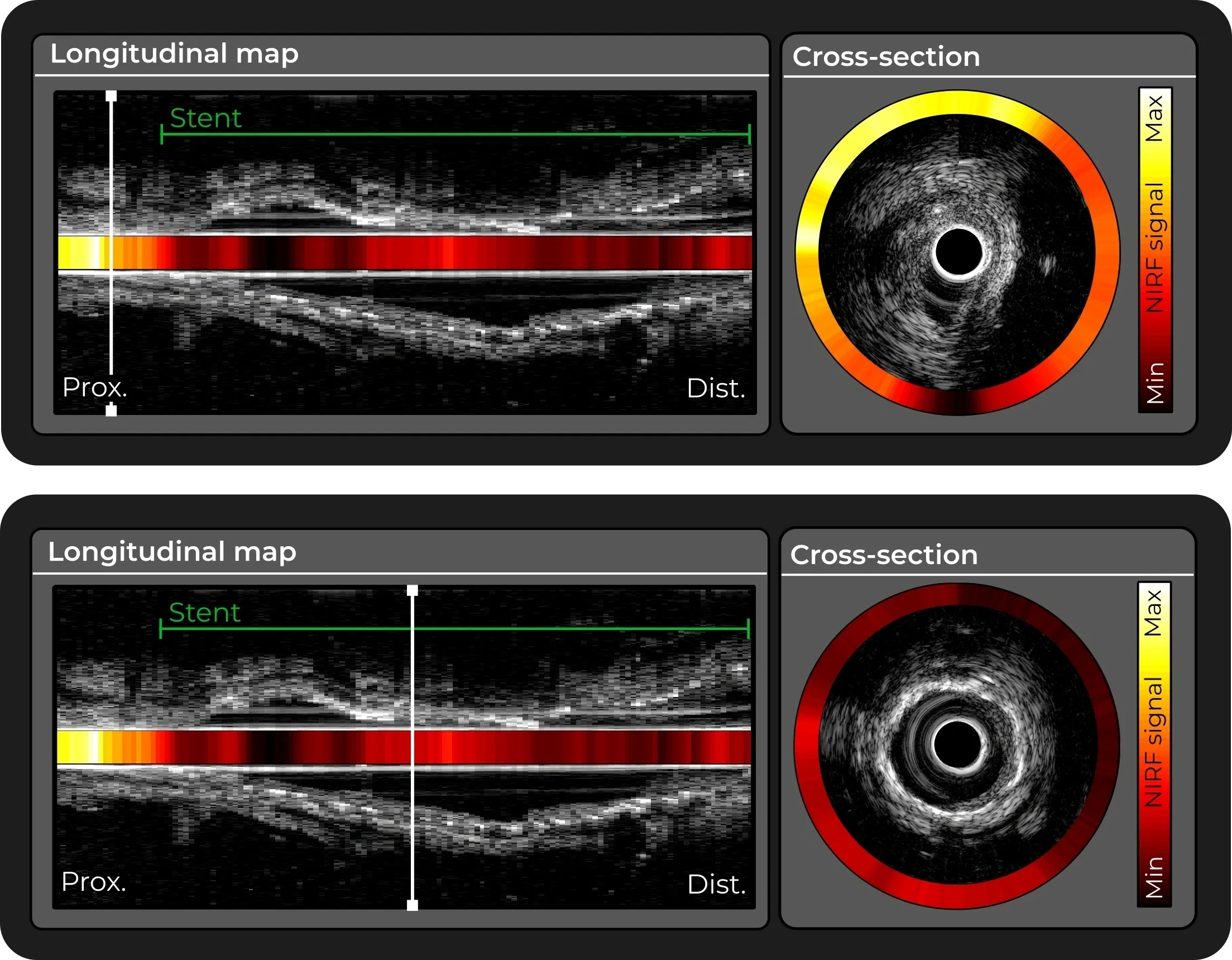
i3 NIRF-IVUS imaging display showing longitudinal maps and cross-sections of a coronary artery with a near-infrared fluorescence signal overlay
EXHIBIT A: What a heart artery looks like when you stop pretending biology is invisible. The fiery ring is the NIRF signal - "hot" tissue, literally glowing.
Who they are now

A small company with a large idea about the human heart

Picture a cardiac cath lab at the decisive moment. A stent is going in. The cardiologist is watching a grayscale ultrasound image of the artery, reading its walls the way a geologist reads rock. The picture is good. It shows the plumbing. It does not show whether that plumbing is on fire.

That gap - between what the artery looks like and what it is actually doing - is the whole reason Intravascular Imaging Incorporated exists. The company, known to almost everyone as i3, is headquartered in Wilton, Connecticut, and is small by any honest measure. It is not small in ambition. Its single product is a catheter that fits inside a coronary artery and reports back on two things at once: structure and biology.

Most heart-imaging tools show you the shape of the problem. i3 wants to show you the problem.

— The pitch, compressed

The technical name is NIRF-IVUS. It fuses intravascular ultrasound - the current clinical standard for guiding stent placement during percutaneous coronary intervention, or PCI - with near-infrared fluorescence imaging, which lights up molecular activity like inflammation. One catheter. One pullback. Two kinds of truth.

The problem they saw

Anatomy is necessary. It has never been sufficient.

Coronary artery disease is the leading cause of death on the planet. Cardiologists fight it largely by opening blocked arteries and propping them open with stents. To do that well, they need to see inside. Intravascular ultrasound has been the workhorse for decades, and it is genuinely good at what it does, which is measure walls, lumens, and the fit of a stent.

Here is the inconvenient part. A great deal of what actually kills people - inflamed plaque, unhealed stent struts laced with fibrin, quiet arterial dissections, the slow vasculopathy that creeps into transplanted hearts - is biological. It is happening at the molecular and cellular level. And a grayscale picture of anatomy, however crisp, mostly shrugs at biology.

You can build a perfectly shaped stent inside a perfectly inflamed artery and call it a success. The artery may disagree later.

— The tension i3 is built around

So the field has spent years asking an awkward question: what if you could see both at the same time, in the same place, in a living patient? Plenty of imaging modalities can see molecular signals in a lab. Threading that capability down a one-millimeter wire into a beating human coronary artery is a different sport entirely.
The founders' bet

Two professors, one operator, and a shared hunch

i3 was incorporated in 2018 to commercialize technology developed across two of the more serious addresses in medical imaging: Massachusetts General Hospital and Harvard Medical School in Boston, and the Technical University of Munich. The founding trio reads like a deliberately balanced bet - clinical credibility, imaging physics, and someone who has actually run a business.

Farouc A. Jaffer
Co-Founder · MD, PhD
Interventional cardiologist, Professor of Medicine and Director of Coronary Intervention at MGH / Harvard Medical School. He works at the intersection of the cath lab and the imaging bench - the person who has both placed the stents and studied why they fail.
Vasilis Ntziachristos
Co-Founder · PhD
An acclaimed biological and molecular imaging researcher, professor at the Technical University of Munich. His work is the reason a fluorescence signal can be coaxed out of tissue and turned into a usable picture.
R. Scott Jones
Chairman & CEO
A medical device veteran with 25+ years in the sector, including leadership at GE's cardiovascular business, and a track record running startups that have scaled to thousands of employees. The one who has to turn a beautiful catheter into a sold catheter.

The science was elegant in a journal. The bet was that it could survive a cath lab, a factory, and a regulator.

— On founding a device company

The supporting cast matters too. Philipp Rauschendorfer, PhD, a biomedical R&D engineer who did intravascular imaging research at both TUM and MGH/Harvard, serves as Chief Scientific Officer - the connective tissue between the two founding labs.

The product

A 3-French catheter that refuses to pick a side

"3-French" means roughly one millimeter across. Into that span, i3's engineers packed both an ultrasound transducer and an optical fiber, so the device captures structure and molecular signal in a single pass. The system then renders them together: a longitudinal map of the vessel, a cross-section, and a near-infrared fluorescence overlay drawn as a ring of color where "hot," biologically active tissue glows.

NIRF-IVUS Catheter

The miniaturized, integrated 3-French device. Co-registers plaque anatomy with molecular signals in one pullback - lesion progression, dissections, transplant vasculopathy, plaque inflammation, and fibrin in unhealed stents, all in the same view.

NIRF-IVUS System

The console and software that drive the catheter and render the co-registered images. Positioned not as a rival to ultrasound but as an upgrade to the worldwide installed base of IVUS systems already sitting in cath labs.

The clever commercial move isn't replacing the machine the hospital already bought. It's making that machine see more.

— On i3's go-to-market

There is a useful accelerant in the chemistry. Near-infrared fluorescence imaging can lean on indocyanine green, or ICG - a dye already approved by the FDA - which pools in the lipid-rich, macrophage-heavy zones of permeable plaque. In other words, some of the hard regulatory groundwork for the contrast agent already exists.

Milestones

How a lab idea started becoming a device

2018
i3 is incorporated
Founded to commercialize NIRF-IVUS technology developed at MGH/Harvard and the Technical University of Munich.
~2018–2021
Federal grants and the science
Backed by federal grants (including NIH SBIR/STTR work), foundational support, and industry sponsorship. Peer-reviewed research demonstrates a miniaturized integrated NIRF-ultrasound catheter.
JUL 2022
3-French catheter launch + Series A
i3 announces its 3-French NIRF-IVUS catheter with favorable results in ex-vivo human coronaries and in vivo preclinical studies, and opens its first equity round to fund GMP manufacturing.
NEXT
Toward human pivotal studies
Stated path: advance GMP manufacturing, run pivotal human studies, and pursue FDA submission. The hard, expensive, unglamorous part.
The proof

Where the numbers do the arguing

A pre-commercial device company lives and dies on validation, not revenue. i3's strongest evidence so far is that the catheter has performed in the settings closest to a real patient: ex-vivo human coronary arteries and in vivo preclinical studies. The technology also rests on published research showing that an integrated NIRF-ultrasound catheter can actually be built small enough to work.

One catheter, more visible information

Illustrative comparison of what each modality reveals · structural vs. molecular
IVUS alone
structure
anatomy only
NIRF alone
biology
molecular only
NIRF-IVUS
i3
structure + biology
Conceptual illustration, not measured performance data. The point isn't a benchmark score - it's that combining the two modalities adds the molecular layer that anatomy-only imaging leaves out.

The device is one millimeter wide and carries an ultrasound transducer and an optical fiber. Restraint was not an option.

— On engineering at 3-French

Credibility also comes from company i3 keeps. The catheter was designed in collaboration with Massachusetts General Hospital. The founders carry MGH/Harvard and TU Munich appointments. And i3 has appeared in the portfolio of Broadview Ventures, a backer focused on cardiovascular innovation. None of this is FDA clearance - the company is candid that pivotal human studies and a submission still lie ahead - but it is the right kind of scaffolding for a device this early.

The mission

"Looking beyond anatomy" is a thesis, not a slogan

i3 frames its work around a single, blunt fact: coronary artery disease is the number one cause of death worldwide. The mission follows from it. If inflammation and unhealed stents are major drivers of cardiac events, then giving the cardiologist a way to see those processes during the procedure - not months later, on a follow-up scan, after something has already gone wrong - changes what a "successful" stent even means.

Through molecular and pathophysiologic imaging we can visualize plaque inflammation in living subjects, simultaneously with IVUS-detected plaque anatomy.

— Dr. Farouc Jaffer, Co-Founder (paraphrased)

It is worth being skeptical here, and the company more or less invites it. Plenty of imaging technologies look brilliant in ex-vivo arteries and never clear the gauntlet of human trials, manufacturing, reimbursement, and the conservative habits of a busy cath lab. i3's answer is its structure: a clinician who knows the failure modes, a physicist who knows the signal, and an operator who has shipped devices before.

Why it matters tomorrow

Back to that moment in the cath lab

The bet i3 is making is that intravascular imaging is mid-transition - from describing arteries to interpreting them. If that's right, hybrid molecular-structural imaging stops being a research curiosity and becomes part of the standard checklist before a stent gets locked into place. The company's plan to upgrade the existing IVUS installed base, rather than rip it out, is a quietly pragmatic way to ride that shift.

Return to that decisive moment. The stent is going in. In the world i3 is building, the cardiologist is no longer reading the artery like rock - guessing at what's underneath. The fire is on the screen. The inflammation has a color. The unhealed strut is visible before it becomes a problem.

The artery still looks like plumbing. The difference is that now, finally, you can tell whether it's on fire. That is the whole point of i3.

Share this profile

// SPREAD THE SIGNAL