Who they are now
A clinic with no waiting room.
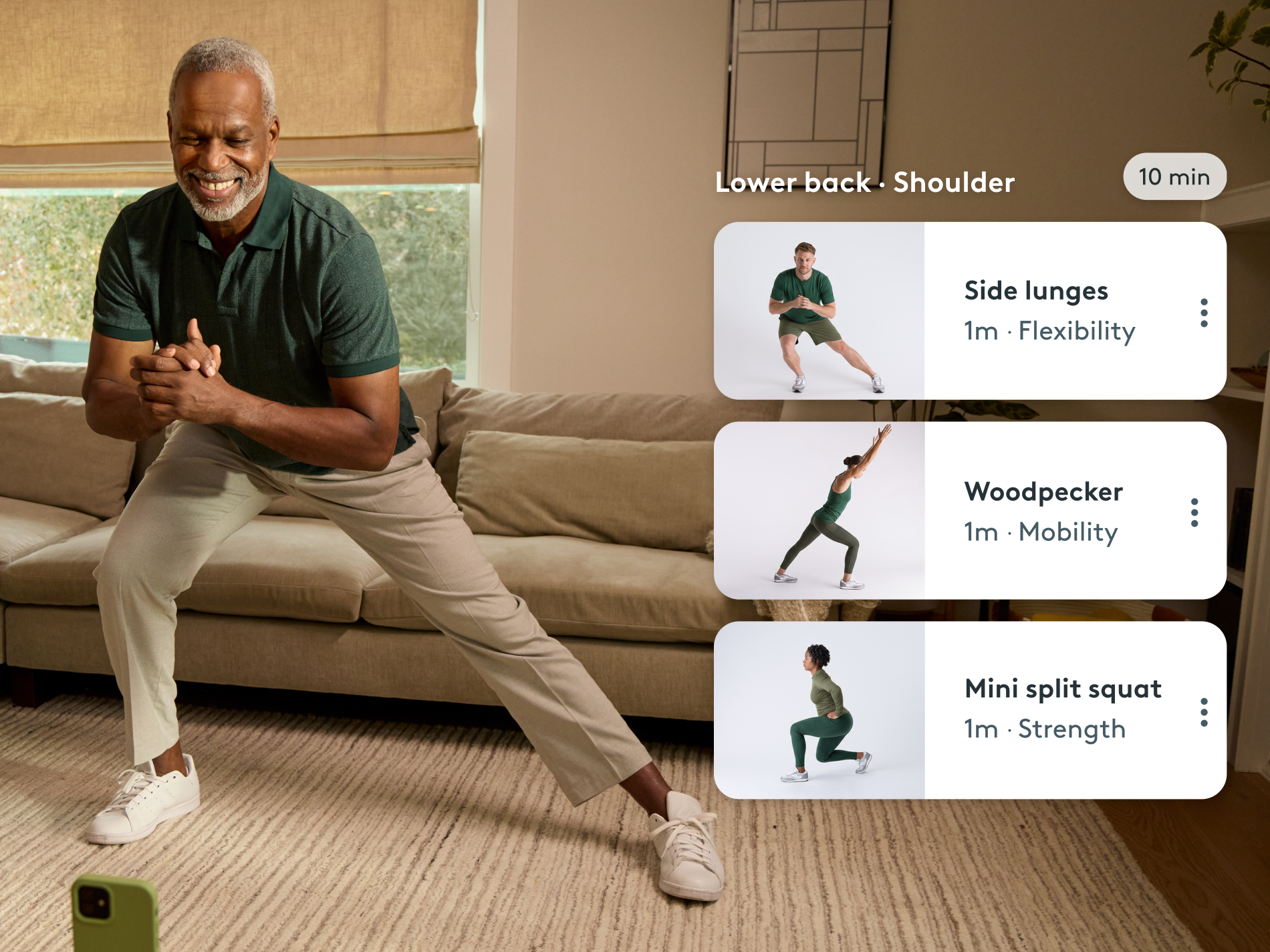
Somewhere right now, a warehouse worker is doing knee exercises in a break room while a phone camera counts the reps. A new mother is rebuilding her pelvic floor from a couch in Ohio. Neither booked an appointment. Neither sat in a fluorescent-lit lobby reading a six-month-old magazine. Both are patients of Hinge Health, a company that decided the most broken thing in musculoskeletal care was the building you had to drive to.
Hinge Health treats the body's hinges - backs, knees, hips, shoulders, and pelvic floors - the parts that ache, click, and eventually send people to surgeons. It does this through software, a small wearable, and a remote team of physical therapists and health coaches. It sells the whole thing not to patients but to the employers and health plans who foot their medical bills. By mid-2025 it had more than 1.5 million lifetime members, roughly 2,250 enterprise clients, and a freshly minted ticker on the New York Stock Exchange.
"Pain relief for every body."
- Hinge Health's stubbornly literal mission statement
The problem they saw
Musculoskeletal pain is everywhere, and the care for it is somehow nowhere.
Back and joint pain is the kind of problem that hides in plain sight. It is one of the largest categories of medical spending in the United States, and it has a habit of escalating: a sore back becomes an imaging bill, becomes an injection, becomes a surgery, becomes an opioid prescription. The traditional path is expensive, slow, and - this is the awkward part - frequently no better than diligent exercise therapy.
Physical therapy works. The trouble is logistics. Appointments are scarce, clinics are far, copays add up, and the average person abandons their home-exercise plan roughly the moment they leave the parking lot. The result is a strange market: a treatment that is proven, cheap, and almost impossible to get people to finish.
Surgery is dramatic. Exercise is boring. Guess which one people skip.
- The central inconvenience Hinge Health was built around
The founders had a personal stake in this. Daniel Perez had shattered bones in a bike accident. Gabriel Mecklenburg had torn his ACL in a judo match. Both went through the disjointed, surgery-and-opioid-heavy machine and came out the other side thinking the same uncharitable thought: this could be done better, and most of it could be done from home.
The founders' bet
Two scientists, three startups, one torn ligament.
Perez and Mecklenburg met in the United Kingdom while pursuing PhDs in the orbit of Oxford and Cambridge - one in biomedical engineering, the other in materials science and bioengineering. They were, by their own account, serial collaborators. Hinge Health was their third venture together; the first two involved bridging academia and industry, and a crowdsourced product-development platform for healthcare. Neither made them famous.
Founded in 2014, Hinge Health was not an overnight success. The early years were lean enough that the founders reportedly collected a startup "Cockroach Award" - the kind of honor you only win by refusing to die. Their bet was specific and a little contrarian: that a camera, a wearable, and a remote care team could deliver physical therapy that people would actually finish, and that employers would pay for it because the math worked.
Daniel Perez
Co-founder & CEO. Biomedical engineering background; high-energy, vision-forward operator who rang the NYSE bell.
Gabriel Mecklenburg
Co-founder & Executive Chairman. Materials science and tissue-engineering roots; the operational counterweight.
You do not build a clinic for back pain because it is glamorous. You build it because your own back made the case.
- On founders treating their own injuries as the product spec
The product
Hollywood motion capture, pointed at your knee.
The flagship is the Digital MSK Clinic, but the magic trick is a piece of computer vision called TrueMotion. It uses an ordinary device camera - no straps, no sensors - to read the angles your joints make, measure symmetry and endurance, and turn them into a score the care team can track over time. The lineage traces back to the same motion-capture ideas used to animate movie characters. Here it animates nothing; it just makes sure you are not cheating your squats.
TrueMotion
AI computer vision that turns your phone camera into a physical therapist's trained eye.
Enso
An FDA-cleared, non-invasive, non-addictive wearable delivering electrical nerve stimulation for drug-free pain relief.
Care Team
Licensed physical therapists, physician oversight, and health coaches, 1-on-1 and remote.
Pelvic Health
A national women's program spanning postpartum, bladder control, pelvic pain, and strength - with a connected trainer for biofeedback.
The company says its AI-enabled model cut the human therapy hours each patient needs by about 95%.
- Which is either efficiency or witchcraft, depending on your camera angle
That 95% figure is the whole business in one number. Software does the watching and the nudging; humans step in where judgment matters. The model is what lets one care team look after a population the size of a small city - and it is why employers can offer the benefit without their costs spiraling.
The proof
The numbers do the arguing.
Skeptics of digital health have a fair complaint: plenty of apps promise outcomes and deliver downloads. Hinge Health's answer has been clinical studies and claims data. In a randomized controlled study, Enso participants cut pain 54.7% versus 25.3% in the control group, with multiples-better gains in walking speed and mobility. A 10,000-member cohort reported large drops in pain, depression, and anxiety. And in a claims analysis spanning 136 employer groups, the company pointed to roughly $2,387 in savings per participant.
1.5M+Lifetime members
~2,250Enterprise clients
$390M2024 revenue
73%Avg. engagement
Enso vs. control: reported pain reduction
Randomized controlled study, self-reported pain // higher is better
Bars scaled for the eye, labels scaled for the truth. Engagement of 73% is cited as roughly 3x the industry benchmark - the rare health app people actually keep opening.
Then there is distribution, which is its own kind of proof. The customer roster includes Salesforce, Verizon, US Foods, Land O'Lakes, L.L. Bean, Southern Company, and the State of New Jersey. Partnerships with health-plan and benefits players - Meritain Health (an Aetna company), Sun Life, Carrum Health, HealthComp - extended its reach further still. Four in five large employers that offer a digital MSK benefit reportedly chose Hinge Health.
A claims study across 136 employer groups put the savings at about $2,387 per participant.
- The line that gets a benefits director to sign
The mission
Make good MSK care boringly available.
The stated mission is to make high-quality musculoskeletal care accessible to everyone. Stripped of the gloss, it means taking a treatment that already works - movement, coaching, the occasional drug-free nerve buzz - and removing every excuse not to do it. No drive. No copay surprise. No waiting room. The pelvic health expansion, with a 53% reported pain reduction at 12 weeks and a connected Perifit trainer, is the same idea aimed at a population that medicine has historically under-served.
It is worth keeping the skepticism handy. The 2025 IPO priced at roughly $2.6 billion - a notable down round from the $6.2 billion private peak of 2021, a reminder that public markets and venture exuberance grade on different curves. Digital health is littered with companies that confused growth with health. Hinge Health's bet is that clinical evidence and cost savings, not vibes, are what survive contact with a CFO.
The opposite of revolutionary care is care so ordinary that finishing it stops being remarkable.
- The quiet ambition under the technology
Why it matters tomorrow
The waiting room was never the point.
Aging workforces, rising medical costs, and a shortage of physical therapists all push in the same direction: care has to scale without a proportional army of clinicians. A model where software handles the watching and humans handle the judgment is, whatever you think of any single company, where this is going. Hinge Health is one of the larger bets that the model works at population scale - and now it has to prove it quarter after quarter, in public, with everyone watching.
Go back to that warehouse worker in the break room, the new mother on the couch in Ohio. A decade ago their options were an appointment they would not keep or a surgery they might not need. Now the clinic comes to them, watches them move, and tells them, gently, to straighten that knee. The building they used to dread is still standing. They just do not have to go in.
The future of physical therapy looks a lot like your living room. The waiting room can keep the magazines.
- Hinge Health, in one sentence