The first mayor to proclaim GivingTuesday was supposed to be New York’s. Henry Timms and his colleagues had an announcement lined up, with the publicity machinery ready to go. Then Batesville, Arkansas, got there first. A small city had borrowed the idea and acted on it before the large institution that helped create it had finished arranging the occasion.
For an executive accustomed to managing a launch, this could be an irritating development. For Timms, it became a useful example of what he was trying to build. GivingTuesday needed people who would make it their own. Batesville had done exactly that. The carefully planned announcement had acquired an uninvited rehearsal, hundreds of miles away.
There is a particular kind of managerial discomfort in this story. You want an idea to spread, but would quite like everyone to use the approved version. You want participation, but prefer a little advance notice. Timms’s career has repeatedly brought him to that uncomfortable spot: how much control should an institution surrender if it wants more people to care?
A historian learns to share the stage
Timms grew up in Exeter, England, and studied history at Durham University, graduating in 1998. His path into leadership has passed through places where people gather to hear, watch and discuss things. The arts were already part of his university life. At Durham, he formed a friendship and creative partnership in music and theatre with Jon Boden, who would become known for his work in folk music.
That early connection supplies a more human beginning than a list of executive appointments. Before the budgets and boards, there were people making things together. A theatre production gives you an immediate education in dependence: somebody else has to remember the cue. It is a fitting starting point for a career concerned with what an individual can accomplish by getting other people involved.
He joined New York’s 92nd Street Y in 2008 and became its executive director in 2014. The Y already had a long history as a cultural and community institution. Its familiar model was easy to understand: offer a program, publish it, invite people through the door. A lecture or concert could be excellent and still leave the audience with essentially one job: attend.
Timms began exploring what happened when that invitation extended beyond the building. The Social Good Summit brought people into conversations around global issues, while related events took place elsewhere. The institutional address remained in Manhattan. The conversation no longer had to remain there with it. For an organization built around convening, that was a consequential change in the meaning of a room.
The day with no proprietor’s name
GivingTuesday began at the Y in 2012, offering a philanthropic counterpoint to Black Friday and Cyber Monday. After the shopping came an invitation to give. The calendar supplied a memorable sequence, with a mildly corrective sense of humour. Humanity had devoted several days to acquiring things; surely it could spare a Tuesday for somebody else.
The consequential decision concerned the name. Timms and his colleagues did not make it the Y’s branded day of generosity. They left room for other organizations and individuals to adapt it. A community could choose its own cause and its own way of participating. The name offered a shared occasion without demanding that every participant advertise the founding institution.
This was a bet on other people’s initiative. A locally useful version of the idea might be quite different from the original plan. Accepting those differences meant giving up the comforting sight of identical messages marching in formation. It also meant that the movement could carry local meaning, rather than a set of instructions arriving from New York.
The movement subsequently became an independent organization, with Asha Curran as CEO. Its 2025 estimates put US participation at 38.1 million people and donations at $4 billion. These are collective results, belonging to countless donors, volunteers, organizers and causes. The distinction matters in a profile of a founder whose central decision was to make space for precisely those people.
There is an appealing restraint in that outcome. An executive can spend years building something that succeeds partly because his institution’s name disappears from the front of it. The absence becomes productive. People can attach their own communities to the idea without feeling that they are borrowing another organization’s publicity campaign.
The crowd gets a vocabulary
With Jeremy Heimans, the movement builder and co-founder of Purpose, Timms developed a way of describing these changes. Their book New Power appeared in 2018 and was shortlisted for the FT/McKinsey Business Book of the Year Award. It brought together two different working perspectives: an activist’s experience of organizing people and an executive’s experience of running an established institution.
Their distinction turns on how power operates. Established models depend on what a person or organization controls. Participatory models depend on the activity of a connected crowd. An audience that shares, adapts or helps create something is doing more than receiving it. The leader’s task changes accordingly. The work includes designing opportunities for others to act.
An editorial schematic of the participation question running through Timms’s work.
The distinction also makes an ordinary leadership problem harder to evade. If people are helping an idea succeed, what say do they have in its future? Asking someone to share a message is easy. Allowing that person to alter the message requires a different appetite for uncertainty. The benefits of participation arrive with opinions attached.
Timms and Heimans have been clear that crowd energy can serve very different purposes. Their analysis includes political movements and commercial platforms alongside philanthropic work. That keeps the argument from becoming a cheerful theory that everything connected must be good. A powerful method still needs judgment about its ends, its rules and the people affected by it.
At a 2019 Ford Foundation appearance, Timms extended the question to philanthropy itself. He asked how institutions could make more room for distributed participation, on terms shaped by the people taking part. It is a demanding question for an executive. Generosity is easier to endorse when the conversation concerns money; it becomes less comfortable when the resource under discussion is authority.
A concert hall needs more than an invitation
In May 2019, Timms became president and CEO of Lincoln Center for the Performing Arts. The setting changed from a community institution on the Upper East Side to a campus whose name was already inseparable from New York’s cultural life. Here, a theory about participation had to coexist with performance spaces, resident organizations and the practical business of keeping a complex institution working.
The $550 million redevelopment of David Geffen Hall offered a substantial test. The project was undertaken with the New York Philharmonic and a group of institutional, artistic and financial partners. Board chair Katherine Farley and Philharmonic leader Deborah Borda were part of the leadership around it. A profile of Timms should leave room for their names. Cooperation was part of the accomplishment.
The hall reopened in October 2022, two years early and on budget. Those phrases are wonderfully unromantic. They describe the portion of leadership that cannot be carried off by a promising hashtag. Buildings require decisions, money, coordination and people who know what they are doing. An inviting institution still needs a ceiling that stays where it belongs.
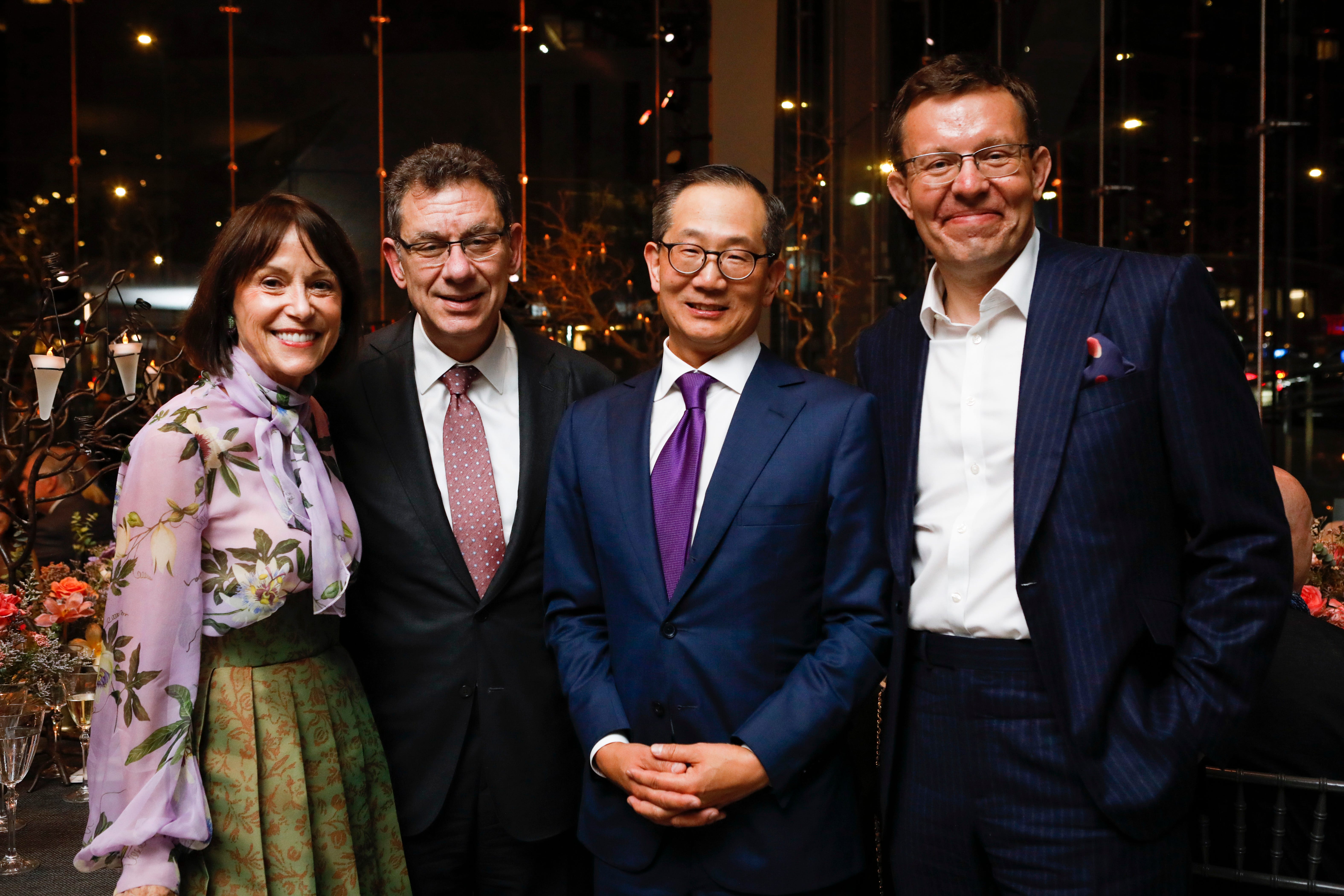
The opening also carried a different kind of invitation. The inaugural public program included San Juan Hill: A New York Story, a commission by composer Etienne Charles. Tickets were Choose-What-You-Pay. Later that month, a free open-house weekend offered performances and participatory activities. A rebuilt hall could be introduced through the people entering it, as well as through its architecture.
Elsewhere on campus, the first Summer for the City season in 2022 brought more than 300 events and over 1,000 artists to ten outdoor stages. Shanta Thake, Lincoln Center’s chief artistic officer, shaped the artistic vision. The program treated the campus as somewhere New Yorkers could gather and take part. The institution’s public space became part of the invitation.
These details give the word access something tangible to mean. Price changes what a person can try. Outdoor programming changes the formality of arriving. A varied program changes who recognizes themselves in the offer. None guarantees belonging by itself, but each gives a visitor an actual choice. An institution can write a warm welcome indefinitely; eventually somebody has to decide how much the ticket costs.
The next room is the boardroom
Timms became Brunswick Group’s CEO on August 1, 2024, succeeding Neal Wolin, who moved to vice chairman. He remained based in New York and became Lincoln Center’s president emeritus. Corporate advisory brought a different set of responsibilities. Clients facing consequential decisions need advice about the people whose trust, cooperation or opposition will shape what happens next.
The move is interesting because Timms had already spent years working on influence from the inside of institutions. His ideas had met donors, audiences, boards and collaborators. At Brunswick, he works alongside chief operating officer Tom Burns. The executive who has written about sharing power continues to occupy a job that carries a considerable amount of it.
“Thought leadership is my side hustle.”Henry Timms, 2024
That line, delivered while he was preparing for Brunswick, gives a useful measure of his self-presentation. He places the commentary beside the operating job. He also finds room for a dry joke. On joining the firm, he wrote that his heart was as full as his Britishness allowed. Even gratitude, apparently, had to pass through a small customs inspection.
His recent public thinking has also turned to artificial intelligence and the need for businesses to prioritize people as they deploy it. The underlying concern fits the earlier work: technological change alters who can act, who makes decisions and where responsibility sits. The tools change faster than the human questions attached to them.
GivingTuesday, Lincoln Center and Brunswick serve different purposes. What links Timms’s work across them is an attention to the invitation: who receives it, what they can do with it, and how much room the institution leaves for their response. Batesville supplied an early answer. Someone else had taken the idea seriously enough to act. The founder’s next task was to let that count as success.
Keep the conversation going
Read Timms’s Brunswick profile, follow him on LinkedIn or visit his X profile.