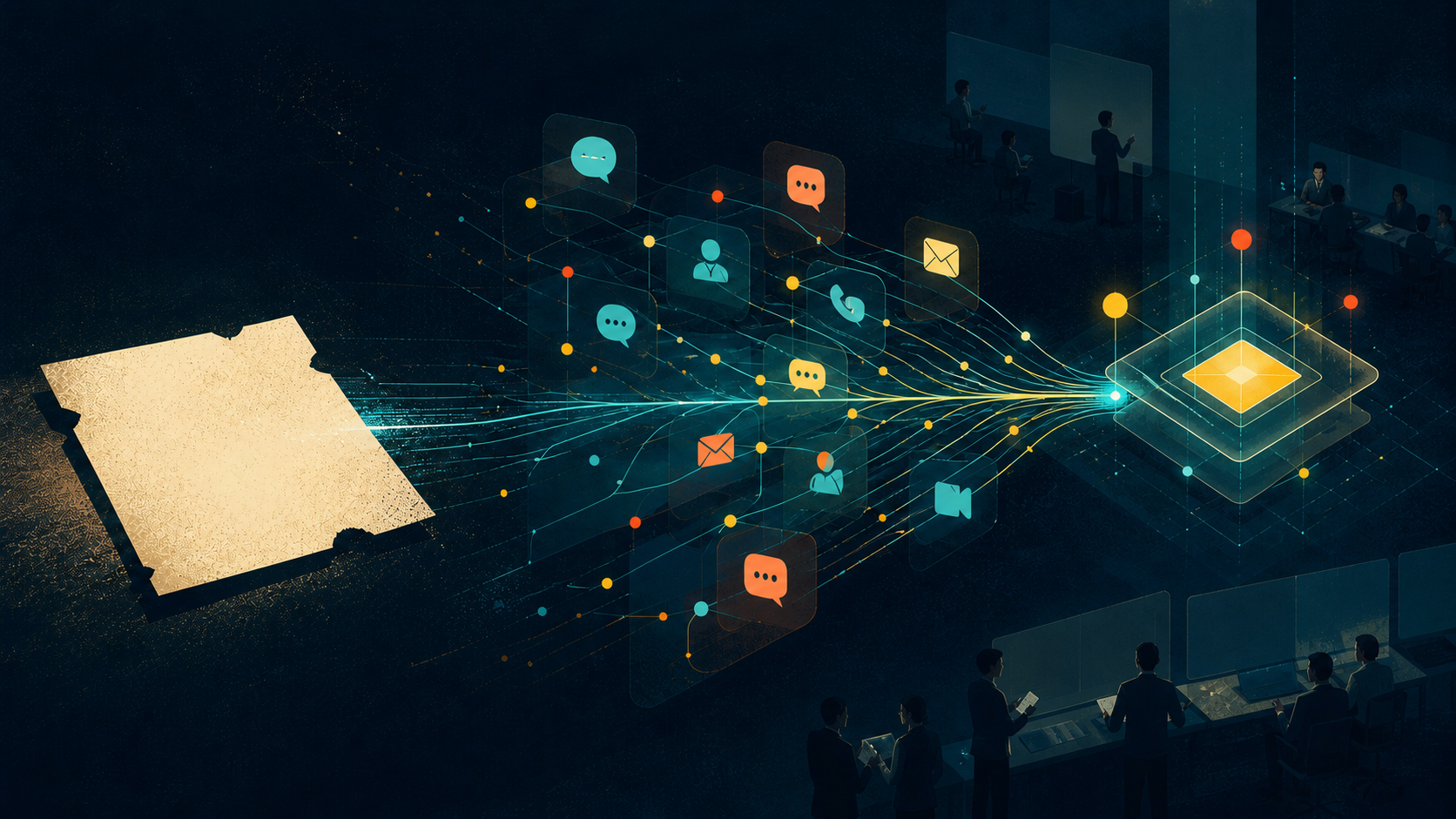
A customer writes, “Why did our renewal fail?” The sentence is short. The work hiding behind it is not. Support needs the account history. Finance needs to inspect the invoice. Sales owns the commercial promise. An engineer may need to check an integration. Someone must decide what the customer should hear, and someone must make the underlying problem disappear.
The old help desk was built to hold the sentence. The new contest is about coordinating everything that follows.
That explains why eight very different companies - Zendesk, Kayako, Halo Service Solutions, ProProfs, ServiceNow, Pylon, Thena and SAP - now sound oddly similar on first encounter. Their sites speak of unified workspaces, knowledge, omnichannel service, automation and AI agents. The vocabulary has converged because the ambition has expanded. A ticket repository is no longer enough. Each vendor wants to become the layer that senses customer trouble and routes a response through the business.
The ticket is only the receipt
For years, support software improved the queue. It made messages assignable, searchable and measurable. Then customers began appearing everywhere: email, web chat, WhatsApp, social networks, voice calls and, for B2B companies, shared Slack and Microsoft Teams channels. The queue became a collection of doors.
The first response was omnichannel service: pull those doors into a common agent workspace and preserve the customer’s history. That remains the center of gravity for Zendesk Messaging, which describes a workspace spanning voice, email, web, mobile and social messaging. Kayako frames the same problem with the clean language of the shared inbox, adding signals such as intent, urgency, complexity and customer value. ProProfs Help Desk brings shared inboxes together with live chat, knowledge and surveys, pitched toward teams that want a more approachable operating bundle.
These are not interchangeable products, but they share a practical idea: the agent should not reconstruct a customer from loose threads before writing a useful answer. Centralize the conversation, surface the history, route the work and make routine replies cheaper.
A fast reply is cheap now. A completed resolution is still expensive.
AI raises the bar. Summarizing a long exchange or drafting a polite email is useful, yet those tricks are quickly becoming standard. The more consequential promise is action. Zendesk says its AI agents can reason through multi-step requests and work across connected systems. ProProfs describes AI that can prioritize and resolve routine tickets. Kayako emphasizes contextual routing and responses. Once the software is allowed to change a subscription, approve a return or trigger a workflow, the help desk is no longer merely recording work. It is participating in it.
Three ways to build the nerve center
The market becomes easier to read when the products are grouped by the place from which they expand.
A map for the shortlist
The conversation-first group is the natural starting point when channel coverage, agent productivity and service operations are the main problem. Zendesk has the broadest recognizable CX posture in this set. Kayako’s message is narrower and pointed: a shared inbox should share context, not just access. ProProfs connects ticketing with its adjacent chat, knowledge-base and survey tools. A buyer can ask a concrete question here: how quickly can a support team gain one reliable view without rebuilding the rest of the company?
The workflow-first group begins farther inside the organization. ServiceNow Customer Service Management emphasizes cases that move across departments on a common data and workflow platform. Its public materials describe AI agents handling tasks from case triage to more complex processes, with enterprise controls wrapped around them. Halo spans IT service management, enterprise service management and customer service on one platform. Its site says customer interactions can be consolidated in a single workspace while workflows extend into departments such as HR, finance and facilities. SAP Service Cloud grounds service in SAP’s enterprise data and processes, with case management, omnichannel service and Business AI.
That breadth is attractive when the complaint is only the visible tip of an operational process. It can also mean a more involved implementation. A platform that can coordinate half the enterprise needs clean data, clear ownership and serious governance. Software does not remove those decisions. It makes their absence visible.
A necessary caveat
Product capabilities described here come from current vendor pages and documentation. Claims about speed, automation or savings should be tested with your own cases, integrations, controls and service volumes.
Slack changed the shape of B2B support
The relationship-first group starts from a newer observation: many B2B customers do not want to visit a support portal at all. They already share a channel with the vendor. They expect to ask a question there, in the same conversational space where implementation plans, product feedback and renewal anxiety already live.
Pylon’s documentation calls it a support platform built for B2B, spanning Slack Connect, email, Microsoft Teams, chat widgets and forms. Thena likewise turns Slack, email, chat and Teams conversations into trackable work, with account context, routing, service-level policies and broadcasts. Both products treat business messaging as a first-class front door rather than a notification pipe attached to an email-era system.
This changes the unit of service. A consumer-support ticket often belongs to an individual and a transaction. A B2B issue may involve several people at one account, a contract, an implementation milestone and a running relationship with customer success. The technically correct answer can still be commercially clumsy. Account context matters because urgency is not contained in the latest message.
The attraction is proximity. Customers can speak where they already work, while the support team gains structure behind the scenes. The risk is sprawl. A chat channel feels informal until an outage, promise or escalation disappears inside it. The value of Pylon and Thena is not that they make Slack busier. It is that they try to give conversational support the ownership and measurement once reserved for tickets.
Choose the system that understands your messiest handoff, not the one that aces the cleanest demo.
What buyers can steal from the market
The first useful move costs nothing: draw one difficult customer issue from first message to final fix. Mark every queue, tab, spreadsheet, database and human judgment it crosses. Then mark every point where the customer repeats context. This sketch is a better requirements document than a list assembled from vendor menus.
Use the sketch to run a live test. Give each finalist the same anonymized escalation and watch what happens after the first answer. Can the platform identify the account? Can it find the policy? Can it invoke the right system? Can it bring in the correct person without shedding context? Can a manager audit why an automated action occurred?
Then measure the unglamorous things. Time to a correct resolution matters more than time to a confident draft. Reopen rates expose shallow automation. Escalation quality reveals whether context travels. Agent effort shows whether the “unified” workspace has merely arranged several silos on one screen.
The nervous system needs judgment
The metaphor has a warning built into it. A nervous system must transmit signals quickly, but it must also distinguish pain from noise. AI trained on yesterday’s tickets can repeat yesterday’s policy mistakes at machine speed. A workflow that reaches deeper into billing, identity or logistics creates more leverage and a larger blast radius.
That is why governance belongs in the product comparison, not in a security review parked at the end. Buyers should demand boundaries on what an agent may read and change, visible approval steps for high-impact actions, versioned knowledge, evaluation against real cases and a clean route to a human. The most mature automation may be the one that knows when it lacks enough evidence.
There is also a human question. Support agents accumulate unusual knowledge: how customers describe problems before a dashboard detects them, which workaround actually works and which small confusion predicts a cancellation. If automation merely removes people from conversations, that learning can thin out. If it removes clerical work and captures their judgment, the entire company gets sharper.
The help desk is becoming the company’s nervous system because customer trouble is rarely owned by one department. The platform that wins inside a particular organization will be the one that matches its anatomy. Sometimes that is a broad customer-experience suite. Sometimes it is an enterprise workflow backbone. Sometimes it is a B2B layer living quietly inside Slack.
The choice becomes clearer once the buyer stops asking who has the most AI. They all have AI. Ask instead where the signal begins, what context follows it and whether the system can help finish the work. A ticket closed by software is a metric. A problem removed for a customer is the point.