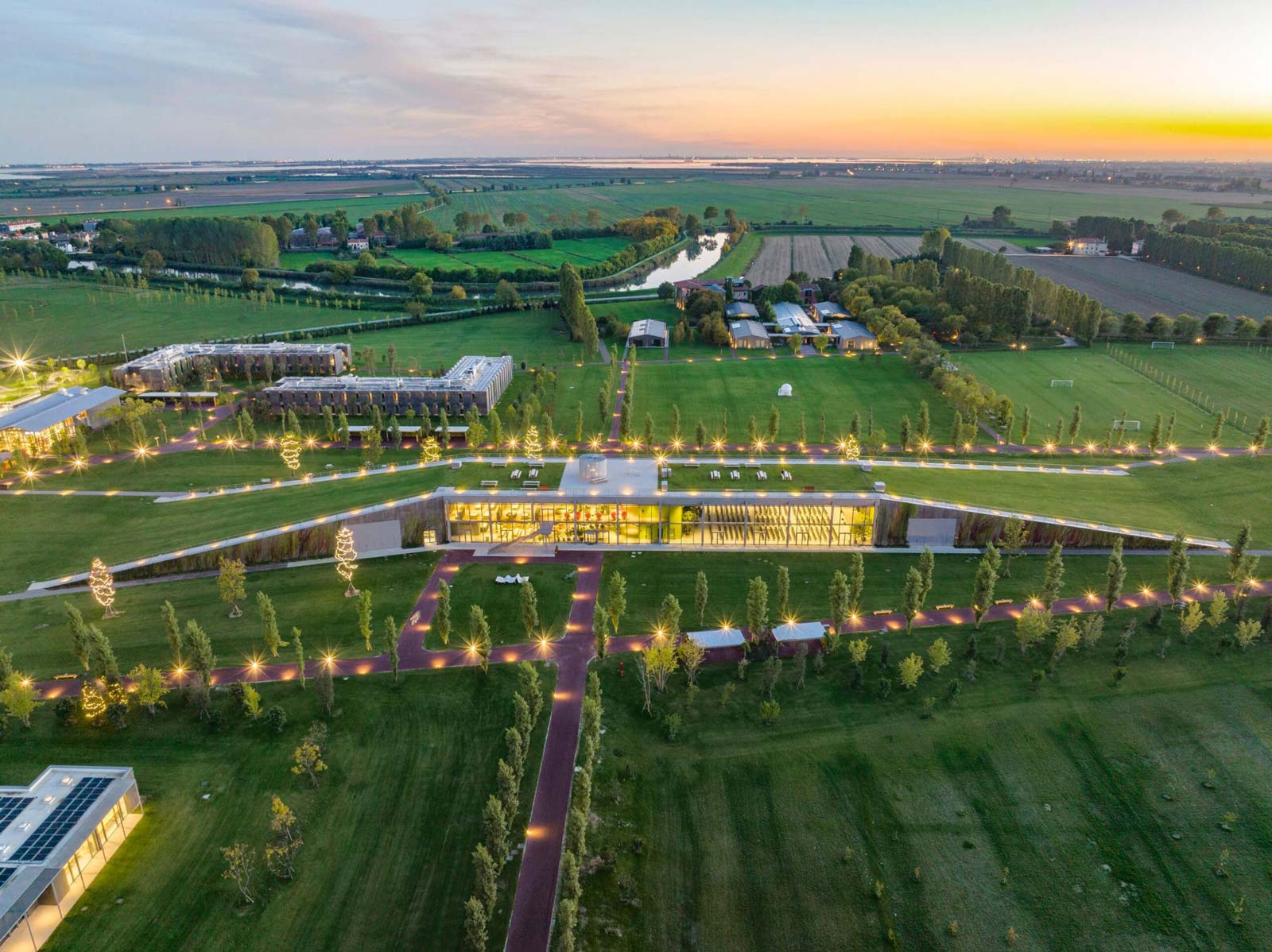
The farm is real. That is the first useful thing to know about H-FARM. Before the degree programs, the corporate workshops and the artificial intelligence fellowships, there were rural buildings at Ca’ Tron, near the Venice Lagoon. In January 2005, Riccardo Donadon and Maurizio Rossi put a technology business there. The setting supplied an unusually good question: must ambitious people leave their region to build something ambitious?
- H-FARM builds ventures and connects students with entrepreneurs.
- A €101 million property fund backed its campus expansion.
- Consultancy and international schools were sold to larger operators.
- The college continues, alongside new AI and deep-tech initiatives.
Donadon had already built and sold E-Tree, an internet services company. Rossi brought a background in luxury goods. Their experiment placed startup capital, practical help and other founders within reach of young businesses. The tractor became a fitting emblem: an enterprise about cultivation, with very little interest in crops.
The advantage was already outside the window
There was a temptation to describe the place as an Italian Silicon Valley. Rossi offered a more interesting argument. “The world is not Silicon Valley,” he told WIRED in 2014. Veneto already possessed expertise in fashion, design and manufacturing. Technology could work with those traditions. Copying California’s address book would miss the resources next door.
That observation explains H-FARM’s position in the market. A conventional investor can supply money. An accelerator can offer a program. A university can teach a subject. H-FARM tries to put those experiences close together, making introductions and experimentation part of the surroundings. Proximity is the wager; a pleasant lawn alone cannot produce it.
Its startup record supplies a reason to pay attention. H-FARM says it has invested about €40 million in more than 150 startups over 21 years. Depop emerged from its ecosystem and was acquired by Etsy in 2021 for $1.6 billion. That figure belongs to the acquisition of Depop. It should never be mistaken for H-FARM’s own return.
A school became the next venture
The educational expansion made the original question more demanding. Helping an entrepreneur who arrives with an idea is one task. Preparing someone to recognize an opportunity is another. H-FARM invested in education, developing international schools and university-level learning beside the entrepreneurial activity. Students could encounter company creation before it became an abstract career choice.
H-FARM College offers undergraduate and postgraduate programs; its Business School serves companies and professionals. BigRock supplies vocational education in graphics and coding. These are different products for different customers: families choosing schooling, students choosing careers, employers updating skills and founders seeking advice. Their common problem is how to learn while technology keeps changing the syllabus.
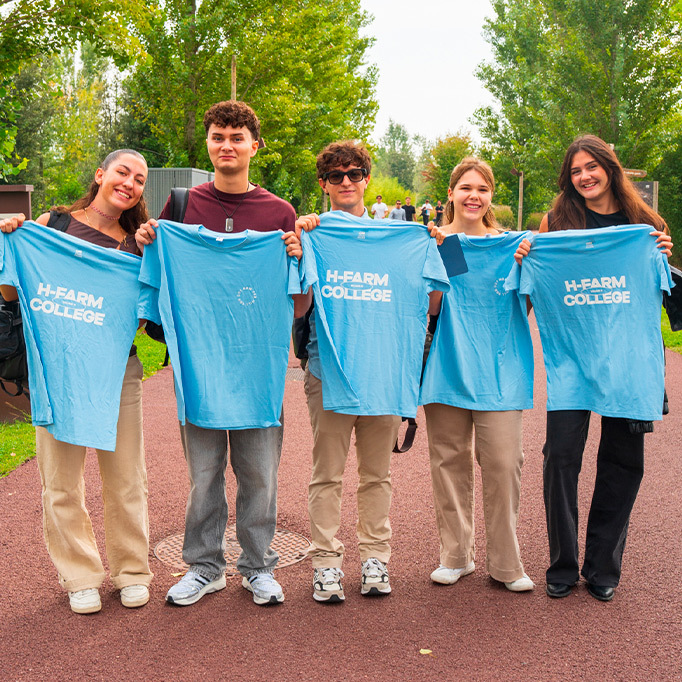
The offer has a price. The College’s MSc in AI for Business Transformation, delivered with the University of Chichester, lists 2026/27 tuition at €15,500 for EU or Schengen students and €26,350 for non-EU students. The roughly year-long program combines technical and managerial work. Anyone considering it should compare the curriculum, degree-awarding partner and total living costs with their alternatives.
Beautiful surroundings come with a rent bill
The expanded campus opened on September 7, 2020, occupying 51 hectares with ten new structures. Its financing deserves attention. A €101 million real-estate fund was backed by Cattolica Assicurazioni, CDP Investimenti SGR and Ca’ Tron Real Estate. The 2017 investor presentation described H-FARM as the tenant under a 30-year lease. Property capital and startup investment were separate pots.
That distinction matters because classrooms require students and buildings require payment. In its February 2025 half-year report, H-FARM said lease costs were weighing on improvements in its businesses. The grounds made a convincing photograph; the operating economics still needed work.
Cattolica 56% · CDP Investimenti 40% · Ca’ Tron Real Estate 4%
The revealing decisions were the sales
In 2022, H-FARM sold its Innovation, Digital Marketing and Enabling Solutions consultancy divisions to JAKALA. The announced closing valuation was €38 million, with €5 million to be reinvested in JAKALA Holding and an additional possible earn-out. H-FARM publicly framed the decision as a way to concentrate on education. The old three-pillar description became historical shorthand.
Then education itself produced a sale. In August 2025, the three international schools in Venice, Vicenza and Rosà formally joined Nord Anglia. Together they educated more than 1,150 students. The schools retained their place in the wider campus story, but their ownership changed. H-FARM College continued separately. The company increasingly described its method as venture building: develop an initiative, find its next owner or partner, reinvest.
“The world is not Silicon Valley.”Maurizio Rossi, speaking to WIRED, 2014
The syllabus needed rewriting too
A more awkward lesson came from BigRock. Enrollment in its six-month master declined across the September 2024 and March 2025 editions. H-FARM’s annual report linked a subsequent redesign to AI’s acceleration in graphics and coding and changing market requirements. From September 2025, the course became ten months long. The lesson was practical: enthusiasm for technology does not exempt a technology school from disruption.
By February 2026, the College had reached its first positive EBITDA after nine years: €0.1 million. The group still reported a €2.2 million net loss for that half-year. One improving business and a profitable group are different achievements. Meanwhile, new experiments included ELEVO, a deep-tech technology-transfer platform, and nAItive, a fully funded fellowship for 20 AI-native founders per cohort, scheduled to begin in October 2026 without taking equity.
What can another organization copy? Put learners near practitioners, give projects real feedback and revise the offer when demand changes. Reproducing the entire campus requires patient capital, sustained enrollment and partners willing to participate. Without those conditions, buildings become an expensive substitute for useful encounters. H-FARM’s transferable idea is to organize the encounters first.