At a chip-design seminar in Austin in June 2016, Grant Pierce reached for Miles Davis. The useful thing to consider, he suggested, was the music left unplayed. His audience had come to hear about semiconductor power management. Jazz was an agreeable way into a discussion that would soon involve controllers, switching and the brief intervals when a circuit could stop consuming unnecessary energy.
Pierce was introducing a product direction for Sonics, the company he had co-founded two decades earlier. Its new Energy Processing Unit would attend to idle moments inside a chip. There was something nicely economical about the presentation: a pause in a musical phrase became a way to understand a pause in computation. A technical seminar briefly acquired a soundtrack.
For Pierce, whose career began in accounting, this was familiar territory in an unfamiliar form. Resources cost money. Waiting has consequences. And an organization built around very capable specialists still needs someone to consider how the parts fit together.
Before the circuits, the accounts
Pierce studied business administration and accounting at California State University, Hayward. He became a certified public accountant and began his career at Arthur Andersen. His early experience also included ITT Qume and Convergent Technologies. The route into semiconductor entrepreneurship ran through the working machinery of technology companies: their finances, their operations and the arrangements that allowed engineering to become a business.
From 1984 to 1988, he was corporate controller at MIPS Computer Systems. He then became chief financial officer at ParcPlace Systems, which sold object-oriented software development environments. Before Sonics, he worked at MicroUnity Systems Engineering as chief financial officer, vice president and general manager. Hardware, software and management were already neighbors on his résumé.
In September 1996, he co-founded Sonics with Drew Wingard. Pierce became chairman in February 1997 and president and chief executive the following month. Wingard was the technical co-founder. The partnership put a business executive alongside a chip architect, selling technology whose value depended on helping other people’s designs function as a whole.
Even the company name was matter-of-fact: Sonics stood for Systems On ICs. The ambition was packed into an abbreviation. Integrated circuits were becoming systems in their own right, and assembling their internal components created work that a specialist supplier could take on.
- 1984-88MIPS
Corporate controller - 1988-90ParcPlace
Chief financial officer - 1996Sonics
Co-founder - 1997Sonics
President & CEO
A website for trying a chip before building it
In May 2001, Sonics launched SOCworks, a web-based environment for exploring chip architectures. A designer could evaluate semiconductor intellectual property within a simulated system. The initial platform, developed with TSMC, modeled small-office and home-office networking equipment, including routers and gateways. It brought together components from several suppliers around Sonics’ SiliconBackplane communications fabric.
The attraction was practical. Evaluating a component meant finding out whether it behaved usefully alongside the other components a design needed. SOCworks offered access to vendor IP and full-chip simulations without first requiring nondisclosure agreements. Sonics presented it as a way to compress an evaluation process that otherwise could occupy weeks.
For a company led by a former finance executive, the proposition had a pleasing directness: reduce the time people spend discovering that their chosen parts will not cooperate. A simulated chip could reveal awkward conversations before those conversations became expensive silicon. Pierce was selling a connection, but also a better-informed decision about what to connect.
Growing a company of specialists
By January 2005, Sonics was expanding its engineering organization. Pierce appointed Raymond Brinks vice president of engineering as demand for its interconnect technology increased. At the time, he described customers integrating 50 or more cores into a system-on-chip. More components brought more opportunities for communication to become the problem.
That same month, Sonics opened an engineering design center in Armenia for product development and infrastructure support. Pierce linked the expansion to the company’s transition beyond its startup phase, access to engineering talent and the cost of development. Growth required an organization that could deliver the promised technology.
Years later, his recruiting language was wonderfully less corporate. Finding engineers with the breadth Sonics needed was “like searching for unicorns,” he said in 2014. They had to understand individual blocks and the system those blocks formed. His pitch to candidates emphasized varied designs and the immediate impact available inside a small company. The recruiting problem resembled the product problem: the connections mattered.
“It’s the team.”
Grant Pierce, on Sonics’ core value, 2014
The public offering that stayed on paper
On August 24, 2007, Sonics filed a registration statement for an initial public offering. Pierce appeared as president and chief executive. By March 2008, an amended filing carried his signature as CEO and chairman. The prospect of a public company had become a formal process, with the paperwork and scrutiny that accompany it.
The offering did not become Sonics’ exit. In his 2014 interview, Pierce recalled how the market downturn had disrupted the plan. His account of the decision was measured in the terms a finance executive would recognize: eligible company size, revenue expectations and the continuing expense of participating in public markets.
This episode gives the career its useful interruption. Building a technology company does not let its chief executive choose the weather in capital markets. Pierce had to keep running Sonics after the anticipated route changed. The record then moves through new products and partnerships rather than a triumphant day at an exchange. A prospectus, however carefully prepared, cannot reserve favorable conditions.
What the chip does between jobs
In May 2015, Sonics introduced its ICE-Grain Power Architecture. By January 2016, it announced its first customer agreement for that technology, intended for a high-volume mobile application. The customer was unnamed. The same announcement reported five additional SonicsGN network licensees in the final quarter of 2015. Pierce was broadening the business while continuing to sell the interconnect products already associated with Sonics.
The distinction between communication and energy was commercially useful. A chip needs its components to exchange data; it also needs decisions about which circuits should remain active. Sonics was moving into another part of the system designer’s job. Its knowledge of integration offered a nearby problem to address.
In May 2016 came ICE-G1, an Energy Processing Unit based on ICE-Grain. The design used configurable hardware to manage circuit idle time. It could work with third-party IP, and combining it with a Sonics network was an option. Customers could consider the energy subsystem across a wider range of designs.
The engineering idea rewards ordinary language. A circuit with work to do should be available. A circuit between jobs may offer an opportunity to save energy, provided it can return when needed. Managing that timing is part of the product. A chip does not earn extra credit for keeping every participant awake throughout the meeting.
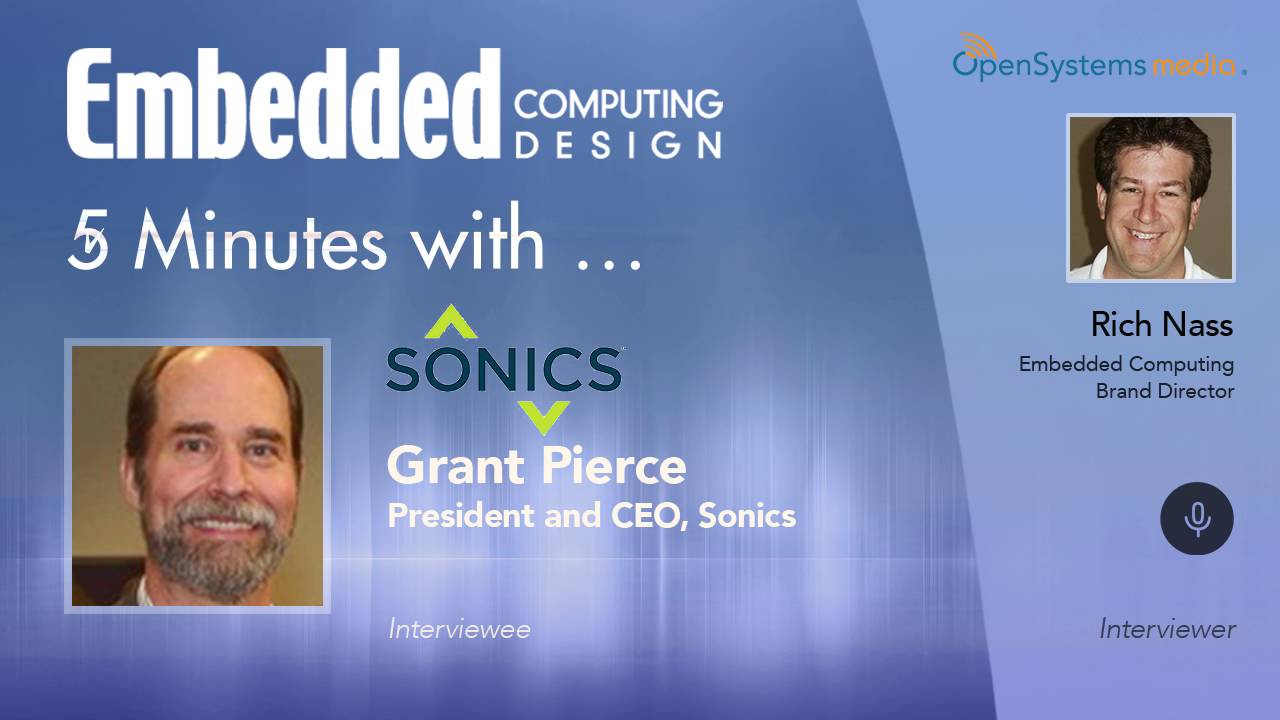
This was the subject Pierce made approachable with his Miles Davis reference in Austin. In August 2016, he also appeared in a Five Minutes With interview about power consumption. The commercial challenge included explaining why activity, by itself, was a poor measure of useful work.
A larger table to chair
In February 2017, Pierce became chairman of the Electronic System Design Alliance. He had joined its board in 2014. The organization had broadened its identity in 2016 from the EDA Consortium, reflecting an industry concerned with systems, semiconductor IP, software and design as well as the tools traditionally grouped under electronic design automation.
The board included executives from Arm, Cadence, Synopsys and Mentor Graphics, alongside other design businesses and investors. Pierce’s own company crossed the boundary between licensable hardware designs and the software used to configure them. He described that experience as useful to the alliance’s expanded remit. A career spanning accounts, software environments and chip infrastructure now had an industry-level setting.
There was also a public-facing assignment. In March 2017, he was scheduled to moderate an alliance panel on energy policy in the rotunda of San Jose City Hall. The subject had traveled from the inside of a chip to the civic meeting room. Pierce’s role required making the technical problem intelligible beyond the people who built the circuits.
New processors, familiar integration work
Another partnership arrived in July 2018, when Sonics and SiFive announced work to make Sonics networks interoperable with SiFive’s RISC-V processor IP. Their demonstration paired SiFive E Series CPUs with SonicsGN. The companies described a direct connection to the processors’ native TileLink interfaces, avoiding a bridge to older interfaces.
The setting had changed since the networking platform of 2001, but the recurring job was recognizable. A processor needs other components around it, and useful integration requires attention to the interfaces. Sonics could participate in a new processor ecosystem through the same broad concern that had animated its earlier work.
An earlier collaboration with Korea’s AlphaChips, announced in 2015, had combined SonicsGN integration with work on power-management specification and implementation. These relationships show Pierce’s company operating among other specialists. The product traveled with cooperation, design methods and the effort needed to finish a particular customer’s system.
The company’s next chapter
In March 2019, Facebook confirmed its acquisition of Sonics. The stated initial focus was augmented and virtual reality. Sonics announced that its independent business would wind down as the team moved on. Wingard took a silicon-methodology role at Facebook, while other Sonics engineering leaders also listed new positions there.
The outcome connected a long-running chip-infrastructure business to a company building its own products. Sonics had spent years helping designers assemble complicated systems. Facebook wanted deeper silicon expertise for its AR and VR roadmap. The acquisition placed the team and technology inside that effort.
For Pierce’s Sonics story, the date supplies a clear endpoint: a company co-founded in 1996 reached an acquisition in 2019 after pursuing a public offering, expanding internationally and adding energy management to its interconnect work. The path contained several kinds of business, and more than one possible ending.
The Austin seminar remains a fitting scene to remember. Pierce had an intricate product to explain and chose a musical pause as his way in. After years of running a company concerned with communication, he was asking an audience to listen for the gaps. Sometimes the valuable part of a system is the part that knows when to wait.