A government can hide a lot of complexity behind a service counter. Nunavut cannot. Its 25 communities are scattered across islands, tundra and nearly two million square kilometres. No road joins one community to another. A school renovation, a medical appointment or a crate of building materials can begin with the same unforgiving question: how does it get there?
This is why the Government of Nunavut is more interesting as an operating system than as an org chart. Created in 1999, it delivers the familiar public bundle - health, education, housing, justice, infrastructure, economic development, language services and regulation - under unfamiliar conditions. Its users are Nunavummiut, not customers. Its capital comes mostly through public revenue and federal transfers, not investors. Its return is whether a resident in Taloyoak, Arviat or Pangnirtung can actually use the service.
The map is the product brief
In a southern city, distance is an inconvenience. Here it is a design constraint with a budget code. Freight often depends on an annual sealift. Construction faces a narrow season and a national shortage of skilled labour. Health care frequently includes medical travel. Staff recruitment runs into housing shortages, while a housing project itself needs land, utilities, freight, trades and maintenance capacity. Every solution arrives towing another problem.
The government’s answer has been deliberate decentralization. Its business plans say it aims to keep more than 60 percent of the public service outside Iqaluit. That spreads jobs and institutional presence, but it also creates a demanding distributed organization. Teams must work across time, weather, languages and uneven connectivity. The relevant comparison is less Ottawa and more a remote-operations company whose branches also happen to run hospitals, schools and airports.
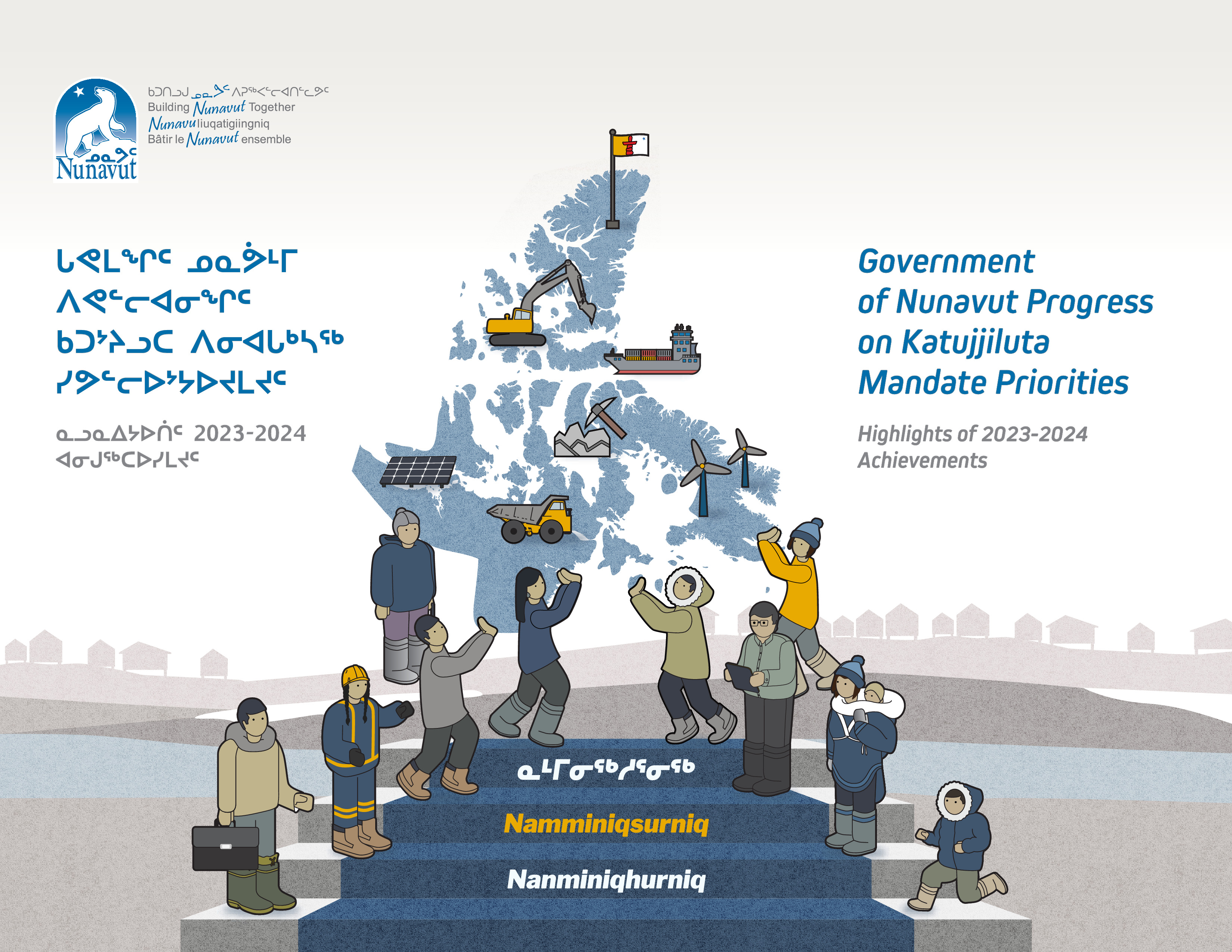
Not a startup. Still a useful one to study.
There are no conventional founders. The institution came out of decades of Inuit political work, a land-claim agreement and federal legislation. The Nunavut Act took effect on April 1, 1999, creating a public government for all residents. Members of the Legislative Assembly run without political parties. After an election, they choose the premier and cabinet from among themselves. Consensus does not eliminate disagreement; it makes negotiation a visible part of the machinery.
The culture is equally structural. Eight Inuit societal values guide the public service, including care for people, service to community, learning through practice, resourcefulness, environmental stewardship and Aajiiqatigiinniq - decision-making through discussion and consensus. Nunavut also works across Inuktitut, Inuinnaqtun, English and French. Translation is not a finishing touch. It is part of product delivery.
“It’s hard work to raise a family, sustain a community, protect language and culture, and build a territory.”Premier John Main, introducing the 2026-2030 mandate
That mandate, Ikajuqtigiikta, asks government to strengthen families, grow local employment, simplify operations, deepen partnerships and invest for the future. The language is broad because the portfolio is broad. A territorial government is the platform beneath the platforms: when housing fails, staffing gets harder; when connectivity fails, digital service disappears; when transport fails, costs rise everywhere.
A portfolio with no off switch
The closest thing Nunavut has to a business model is public finance. In the 2024-25 consolidated budget, projected revenue was roughly C$3.31 billion. About C$2.71 billion of that was expected from the Government of Canada, with roughly C$599 million generated by the territory. The following year's spending plan proposed C$2.64 billion for departments, including C$350 million for new capital work. These are not sales figures. They are the price of keeping essential systems running in a place where small scale rarely means low cost.
Health makes the economics vivid. The 2025-26 plan added C$20.4 million for out-of-territory hospital care, physicians and mental-health placements, plus C$12.8 million for visits by health professionals to communities. Both directions are expensive: either the patient travels south or the professional travels north. New local long-term care and community health funding was intended to reduce that dependence, but local care also requires buildings, beds, staff and housing for staff. The invoice simply moves along the system until capacity catches up.
There is no commercial competitor waiting to replace the territorial government. The alternatives are functional: Canada funds or delivers some services; hamlets handle local operations; Inuit organizations represent treaty rights and community priorities; contractors build; nonprofits fill gaps. The government's market position is therefore orchestration. It has legal authority and territory-wide reach, but not enough reason - or capacity - to own every last mile. Its performance depends on how well those other institutions connect.
This also explains why a digital-first slogan would be incomplete. Online information helps, but a form still has to survive language, connectivity and the physical service behind it. A polished portal cannot create a nurse, unload a sealift or prepare serviced land. Technology matters most when it reduces coordination without disguising the offline work.
The Arctic service stack
The housing plan that changed the method
Nunavut 3000 is the clearest case. Announced in 2022, it aims to enable 3,000 homes by 2030: 1,400 public units, 900 affordable rental or ownership units, 400 market homes and 300 transitional spaces. This is not simply a construction quota. It is an attempt to build a housing continuum so that public housing is not forced to absorb every kind of need.
What changed was the delivery model. The Nunavut Housing Corporation partnered with Inuit-owned NCC Development to build a large share of the program. Government reporting says the approach was producing more homes at substantially lower cost than earlier patterns, while construction began or was enabled in every community. By March 2024, 541 units had been started or enabled. The partner brought development capacity; the contracts could also support Inuit jobs, training and local economic activity.
What failed first? Not the ambition - the calendar. Nunavut’s 2025-26 budget is unusually candid about capital carryovers. Projects slip because Arctic construction is hard and trades are scarce, so money appropriated in one year can reappear in the next. In 2024-25, revised capital estimates included C$228 million carried over from unfinished work. That is not a scandalous footnote. It is the operating environment refusing to fit inside a fiscal year.
A government taking on a bigger job
At the same time, Nunavut is preparing for devolution. An agreement signed with Canada and Nunavut Tunngavik Incorporated in January 2024 schedules the transfer of responsibility for public lands, fresh water and non-renewable resources for April 1, 2027. The agreement provides ongoing federal funding of C$85.8 million annually to the territorial government after transfer, alongside funding for NTI and human-resources development.
Calling this a policy change undersells it. It is an operating-system migration: staff, records, regulatory processes, legal authority and relationships must move while government keeps running. Done well, decisions about land and resources move closer to Nunavut. Done poorly, a symbolic transfer could outrun the people and systems required to administer it. Capacity is the hinge.
The same logic explains a 2025 departmental reorganization. Municipal support and community services were separated from major transportation and infrastructure work. The change was an admission that an expanding capital portfolio needed clearer ownership. Organizational design, in this case, followed the bottleneck.
The playbook worth stealing
Design for the constraint
Do not call distance, language or thin bandwidth an edge case when most users live there. Put it in the first brief.
Make partners part of the product
If local organizations hold trust, land or delivery capacity, the partnership is infrastructure, not public relations.
Distribute presence
A central office may be cheaper on paper while becoming expensive in travel, delay and weak local feedback.
Budget for reality
Expose carryovers, bottlenecks and maintenance costs. A truthful schedule is more useful than a theatrical deadline.
A remote company can copy this without pretending to be a government. Give regional teams genuine authority. Hire for local context, not only headquarters fit. Build low-bandwidth and asynchronous paths. Treat translation and cultural interpretation as core operations. Measure whether the last community can use the service, not whether the central team shipped it.
Where the model breaks
Partnership-heavy delivery does not work when accountability is fuzzy, funding is short-term, local organizations are handed obligations without capacity, or headquarters keeps every meaningful decision. Decentralization also adds coordination cost. It pays off when geography and trust matter more than standardization - and when local teams receive money, skills and authority together.
The unglamorous advantage
Nunavut’s government will not defeat geography. It can only become more honest about what geography demands. Its advantage is that the constraints are impossible to ignore. A missed sealift is not a dashboard problem. A vacant staff house can become a vacant nursing position. A document untranslated into the language of its intended user is unfinished.
That pressure has produced a recognizable method: public goals expressed through partnerships, service presence distributed beyond the capital, policy filtered through Inuit values, and budgets that reveal the cost of distance. The results remain incomplete. Housing demand is still severe, workforce capacity is still tight, and devolution will add responsibility before it adds ease. But this is precisely why the institution is worth watching. The useful lesson is not that Nunavut has solved remote delivery. It is that it has stopped pretending remote delivery is ordinary delivery with a bigger postage bill.
Go north from here
Explore the government’s current programs, public updates, job openings and video tours through its official channels.