The family living room had acquired a new purpose. Ghita Houir Alami was back in Morocco to handle paperwork, and her cofounder, Nicholas Pipitone, had flown out to join her. Her family turned the room into an office. A startup can spend a great deal of time describing its culture; this one had brought its culture home to meet the parents.
Houir Alami later described the visit as a turning point in their relationship. Comparing their cultural backgrounds helped the pair understand each other, and they returned to work feeling more aligned on their product, priorities, and communication. The travel had a practical reason. The lasting benefit was personal.
“Having Nick meet my family brought us closer than ever.”Ghita Houir Alami
There is something pleasingly unpolished about this episode. ZeroEntropy’s work involved retrieval models, benchmarks, and the infrastructure behind AI applications. Yet one of its useful investments in teamwork involved a family visit and borrowed domestic space. Even a company occupied with artificial intelligence still depends on ordinary human understanding.
A third continent, and a practical education
Houir Alami’s route to that living room office had already crossed countries and academic systems. She grew up in Morocco and studied at École Polytechnique in France. In 2022, she announced that she would join the University of California, Berkeley that autumn. The move, she wrote, would begin an adventure on her third continent.
Her destination was a Master of Engineering in Industrial Engineering and Operations Research, with a concentration in Management Science & Engineering. The title takes some patience to say aloud. Its purpose appealed to her for a simpler reason: solving problems and making decisions in complicated real systems. She expected to study applied mathematics and AI alongside innovation and entrepreneurship.
The announcement was full of anticipation about joining Berkeley’s alumni community and learning from business leaders, entrepreneurs, and technologists. It suggests a student interested in what an education could put within reach. Mathematics provided a way into difficult problems. The Bay Area offered proximity to people trying to turn solutions into companies.
Her interests extended beyond the syllabus. An introduction to the Next Chapter community described her as speaking English, French, classical Arabic, Moroccan Arabic, and Spanish. At the time, she was also learning German on Duolingo. The same introduction listed piano, guitar, ukulele, and singing among her pastimes. Her spare time appears to have been quite well booked.
Asked about Paris and San Francisco, she appreciated different things in each: Paris’s culture and the ease of getting to know a professional sector; San Francisco’s diversity and exchange of ideas. These were observations from someone learning how places work. A move changes more than an address. It changes the conversations that become possible and the people who can be found at the other end of them.
The passage before the answer
By August 2024, Houir Alami and Pipitone had put their names on a research paper about a precise problem: how to evaluate the information an AI retrieves from legal documents. LegalBench-RAG examined the retrieval stage of a system that consults external material before generating a response. The distinction matters. An eloquent answer is only useful if the system has found the material needed to support it.
The benchmark contained 6,858 query-answer pairs drawn from a corpus of more than 79 million characters. Its emphasis was on small, relevant passages. Retrieving a whole document, or a broad chunk containing a possible answer, gives a system more to process and more opportunities to lose the point. The paper also introduced a smaller version for quicker experimentation.
This is a demanding definition of finding something. A search result can look plausible and still leave the reader doing most of the work. A precise passage brings the evidence closer to the question. In the founders’ research, the quality of that selection became something to measure, rather than something to admire in a demonstration.
Published August 2024
ZeroEntropy grew around a related frustration. Before founding it, the team had repeatedly encountered AI systems that struggled because useful information was buried in unstructured data. Developers were assembling retrieval pipelines themselves. The startup’s API brought ingestion, preprocessing, embedding, and reranking into one service, letting other teams spend more time on their applications.
In July 2025, ZeroEntropy announced a $4.2 million seed round led by Initialized Capital. It credited Entrepreneurs First with earlier backing and had participated in Y Combinator’s Winter 2025 batch. The funding announcement also introduced its first reranker. For Houir Alami, the company was becoming a vehicle for the applied mathematics she had wanted to use on concrete problems.
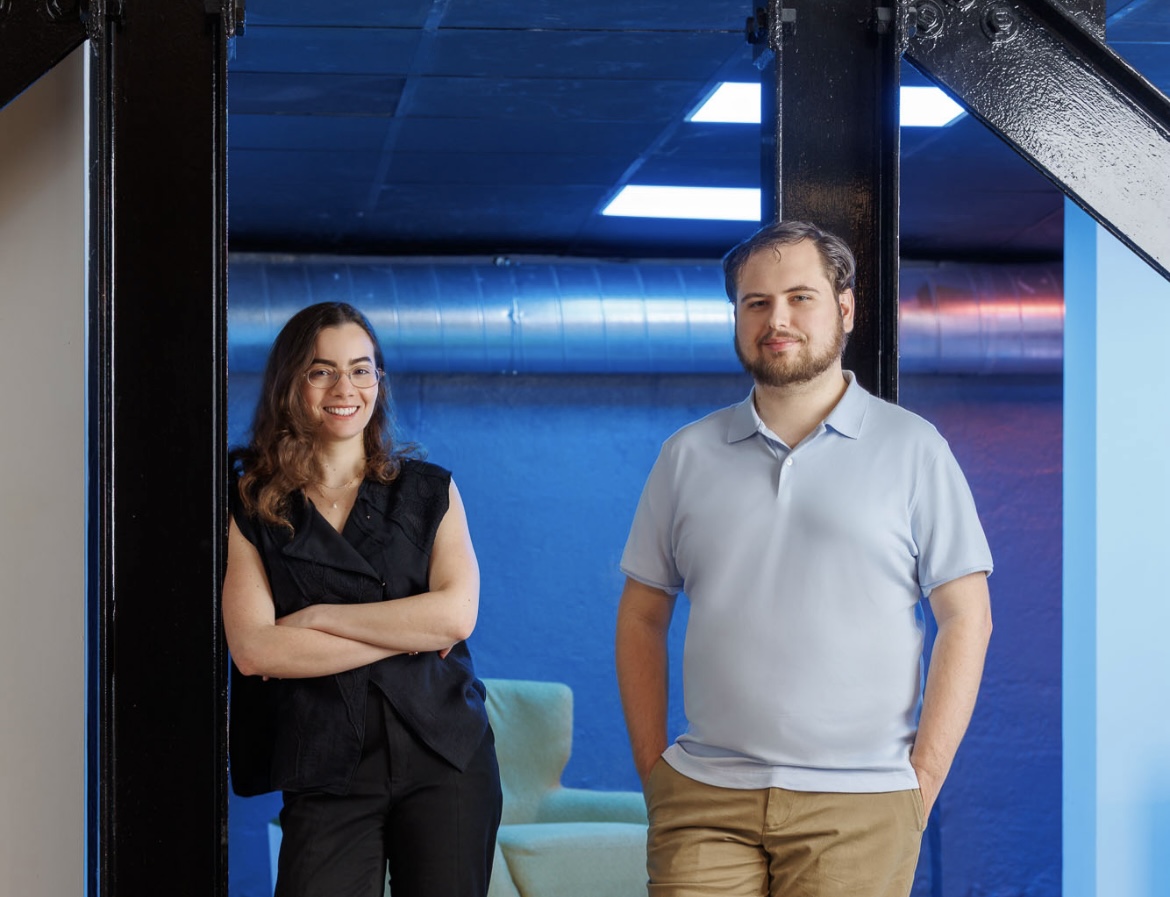
Her stated ambition went beyond supplying a search box. She wanted ZeroEntropy to become a standard for context engineering: selecting the relevant information an AI needs to respond and act reliably. She also spoke about the encouragement she received from Moroccan entrepreneurs, technologists, and women, and the pride of parents who had invested in her education. The technical goal and the family story belonged to the same career.
Fifteen minutes that mattered
One customer’s account supplies a less formal measure of how Houir Alami worked. Christopher Lee was building a retrieval feature for Knobase, had limited experience with the task, and was working against a weekend deadline. He came across ZeroEntropy and found that he could book a call directly with its founder.
He booked it, then waited to see whether she would actually appear. She did. He described her as helpful and accessible, including through Slack, and said the conversation influenced his decision to use ZeroEntropy. Later, he made a public booking calendar part of his own company’s website. A brief conversation had changed both a purchasing decision and a founder’s approach to availability.
That anecdote gives the company’s developer focus a human scale. Someone trying to build a feature did not need a polished account of the future of AI. He needed answers he could use. The founder’s willingness to spend time with him connected the infrastructure to the person trying to make it work.
Houir Alami also found a way to answer questions that kept recurring outside customer calls. After receiving messages and coffee-chat requests about Entrepreneurs First, Y Combinator, and navigating US visas, she began sharing her experience publicly. Her FAQ covered the incubator experience, the path from a YC application to Demo Day, and her experience with F-1 and O-1 visas.
She invited readers to suggest further subjects, including making use of a short visit to San Francisco and the differences between building in Europe and the United States. The questions were practical because her own path had been practical. Crossing borders, finding collaborators, and learning unfamiliar systems had all been part of getting to the work.
There is a useful continuity here. Her product helped developers find information in difficult collections of documents. Her public writing made information from her own experience easier for other founders to find. Both involved noticing where people were spending time on a problem and giving them a shorter route through it.
The customer who bought the company
Notion first encountered Houir Alami, Pipitone, and their team as a customer. By the time it announced the acquisition of ZeroEntropy on July 24, 2026, it had used the startup’s zerank-2 reranker in unified search. The results were specific: an 85% reduction in latency at the reranking step, with answer quality maintained and inference cost reduced. Overall unified search became up to 30% faster.
Those percentages describe different parts of the experience. Reranking is one stage within a larger search process. Improving that stage can help the whole system without changing every other stage by the same amount. The distinction keeps the achievement concrete: the team made a component work faster inside a product already being used.
85% lower reranking latency. Separately, Notion reported up to 30% faster unified search. Relative index; no absolute timings implied.
The acquisition brought the entire ZeroEntropy team into Notion. Houir Alami was named to lead a newly formed Model Research team. Work that had been offered through an independent startup would now continue within a company that had already tested its usefulness. The relationship had acquired substance before it acquired a transaction.
For ZeroEntropy’s existing users, the transition also had consequences. The company announced that all its models would be available under the Apache 2.0 license and that its hosted products would be sunset after September 4, 2026. It provided migration guidance and support routes. The models could continue to be used beyond the service that had originally supplied them.
Houir Alami described Notion as a product she had liked for years. Joining it, she said, felt surreal. Her message ended with a modestly direct ambition: “I hope to keep building things you love at Notion.” It left the next chapter attached to the experience of the people using what she would build.
The living-room episode remains a useful place to return. It captures a founder carrying difficult work across borders, a collaborator willing to follow, and a family making space. Now the office has changed again. The question at the center of her work remains recognizable: among all the information available, what deserves to be brought into the room?