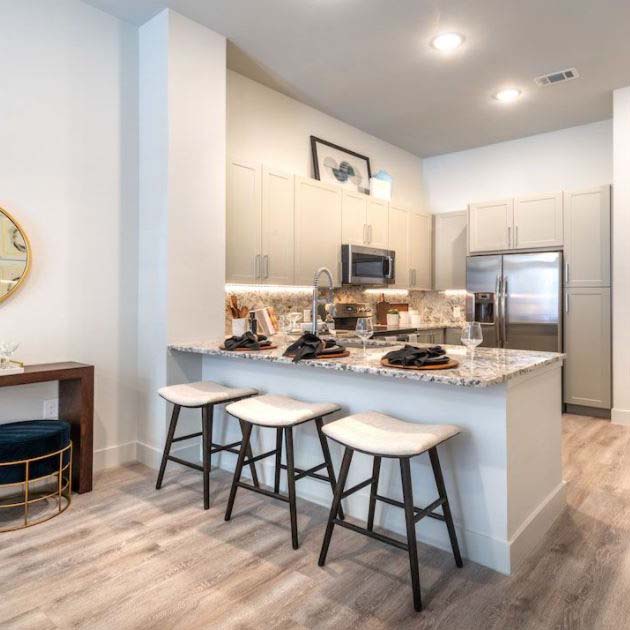
A kitchen photograph is wonderfully untroubled by logistics. The cabinet doors line up. The countertop catches the light. Three stools wait at the island, as though nobody has ever argued over a delivery window. Somewhere outside the frame, a much less photogenic sequence of decisions has made the room possible. Geoff Bennett’s career sits in that space: the distance between a product coming off a manufacturing line and a home being ready to use it.
Since February 2023, Bennett has been CEO of Trajus, the Addison, Texas, company behind Republic Elite Multifamily Interiors. Before that, he led Cascade Windows. His work has moved from windows and doors to cabinets and countertops, while retaining a connection to residential construction. These are products people see and touch every day. Getting them into place involves a world most people would prefer never to think about.
The factory gate is halfway
Bennett’s executive background includes Precision Castparts, ASSA ABLOY, Cornerstone Building Brands, and Therma-Tru Corporation. It spans public companies, private businesses, and organizations backed by private equity, with domestic and international operating experience. The common thread is responsibility for businesses that must turn materials, labor, and capital into something a customer can actually use.
At Cascade, that responsibility included a business described as a manufacturer, distributor, and installer of residential windows and doors. Each word adds a different obligation. Manufacturing concerns what gets made. Distribution concerns where it goes. Installation brings the product into contact with the building itself. A good result in one stage cannot automatically repair a poor result in another.
This is a useful way to read his career. A building product has a physical life after the sale. It occupies space. It needs handling. It has to reach a particular address. Corporate growth, in this setting, eventually encounters a truck, an opening in a wall, or someone waiting with tools. The spreadsheet has to survive the journey.
Two new points on the map
In February 2020, Cascade acquired Amerimax Windows & Doors from OmniMax International. Amerimax served the residential retrofit and replacement market and brought factories in Loveland, Colorado, and Woodland, California. The acquisition expanded Cascade’s product range in that market while adding production capacity for customers in both states.
For Bennett, then Cascade’s CEO, the deal joined an existing brand to a wider organization. “We are excited to add the Amerimax brand to our Cascade Windows family,” he said. It was a straightforward public welcome, attached to a concrete change in what the company could make and where it could make it.
The geography matters. A manufacturing acquisition has addresses as well as financial terms. Colorado and California represented places from which the enlarged business could serve dealers and builders. The products also widened the company’s exposure to work on existing homes. New construction and replacement work both need windows, but they enter the market through different circumstances.
Here, growth could be described without resorting to a cloud of corporate adjectives. There were two additional manufacturing locations. There was a broader replacement offering. There were existing customers to serve. The challenge after the welcome was to make those additions useful together.
- 2020Cascade acquires Amerimax
Colorado + California plants - 2021Cornerstone acquires Cascade
Approximately $245 million - 2023Bennett joins Trajus as CEO
February appointment
The number, and what it bought
On August 20, 2021, Cornerstone Building Brands completed its acquisition of Cascade for approximately $245 million in cash, subject to customary adjustments. At the time, Cascade had about 800 employees, six manufacturing locations, and three distribution locations across the West and Pacific Northwest. It had generated approximately $160 million in sales in the twelve months ending May 2021.
Those figures give the transaction a physical scale. Cornerstone was acquiring a workforce and a regional production network, alongside the windows and doors business. The buyer described the acquisition as an expansion of its manufacturing presence in the West. There was a map behind the price.
CenterOak, Cascade’s private equity owner, described work on distribution routes, manufacturing processes, and customer support during its ownership. Its investment account also lists labor utilization, procurement, a plant relocation, and changes to the sales organization. These are specific operating levers, each tied to how a company serves demand.
“Our experience working with CenterOak has been exceptional, and the resources they provided helped us accelerate our growth.”
Geoff Bennett / Cascade CEO, August 2021
The acknowledgment puts other participants into the picture. A transaction at this scale involves management, owners, advisers, and the people carrying out the work throughout the business.
The sale provides a dated milestone in Bennett’s operating career. Its price describes the company transaction. Its footprint explains why the business had a place in a larger manufacturer’s plans. Read together, the number and the locations tell a more useful story than either could alone.
Manufacturing locations + distribution locations
A different room, a familiar problem
Bennett’s move to Trajus in 2023 brought him inside the home. Founded in 2016, Trajus brings established interior construction products businesses under a common management team. Its stated focus is the kitchen, a room where practical use and personal taste have an unusually busy relationship. A cabinet must store the plates. It must also look right while doing so.
Trajus describes its model as giving established brands structure, more efficient processes, and tools associated with much larger companies. That model gives Bennett a setting in which operating experience and existing customer relationships have to work together. The brands bring history. The parent organization promises help with the next stage of their business.
Republic Elite combines the cabinet business of Republic Industries with the countertop expertise of Elite Multifamily Interiors. Its combined history in multifamily kitchens and bathrooms reaches back more than half a century. The work includes designing, producing, and installing, with cabinet manufacturing centers in East Texas, Georgia, and Illinois.
That combination has a practical appeal. Cabinets and countertops meet physically in a kitchen. Having them arrive through a coordinated service can make sense for the customer managing the room. Republic Elite’s offering extends to delivery and project management, putting the sequence of work alongside the choice of materials.
Three people buying the same kitchen
Trajus identifies three decision-makers in Republic Elite’s work: designers, general contractors, and owners or developers. Each looks at the same interior with different priorities. The designer wants a distinctive product. The contractor needs cost and delivery to work. The owner or developer wants the finished interior to stand apart.
These requirements can coexist, but somebody has to keep them in the same conversation. A finish chosen for its appearance has consequences for ordering. A delivery date has consequences for installation. A budget has consequences for the available choices. The kitchen is shared territory long before anyone cooks in it.
Republic Elite’s stone process gives that coordination a tangible form. It describes quarry relationships, factory inspection, shop drawings, logistics partners, localized storage, and staged delivery linked to the construction schedule. A countertop travels through several kinds of expertise before becoming the surface where somebody puts down a cup.
For an executive with Bennett’s manufacturing background, this is familiar organizational terrain. The materials differ from windows. The underlying business still depends on multiple activities reaching a customer in sequence. Looking at the finished product alone would leave much of his current assignment outside the frame.
A simplified view of Republic Elite’s stone supply and field service process.
The people beside the chief executive
The team around Bennett combines corporate operating backgrounds with experience built within multifamily interiors. Chief Revenue Officer Adam Sumrow founded Elite Multifamily Interiors. He brings the perspective of someone who built one of the businesses now inside the organization, along with years of work in the countertop category.
Chief Financial Officer Tiffany Kvitek joined Trajus in September 2023. Chief Operating Officer Steve Garwood joined in 2021, with his responsibilities expanding in December 2023 to include strategic sourcing and new product development. Bryan Jones, now executive vice president of business operations, began in the field with Republic Elite in 2007.
That range of experience puts different distances from the product around the management table: finance, sourcing, commercial relationships, and field operations. Bennett’s role sits among those responsibilities. The finished room depends on all of them, even though only a few will ever be visible in its photograph.
A life beyond the factory schedule
Bennett lists Arkansas Tech University from 1981 to 1984, with activities including the Business Club, Math Club, and varsity golf. It is a compact glimpse of an earlier chapter. The sporting interest continues: he and his wife, Tracey, enjoy sports and spending time with family and friends. They live in the Dallas-Fort Worth area.
A former direct report, Harry J. Warner, remembers Bennett’s interest in professional development and his attention to engineering and maintenance projects. It is a small workplace recollection with a specific setting: someone bringing operational work to a general manager and finding support.
Seen across these chapters, Bennett’s career returns to the work surrounding tangible products. A window needs a route to the building. A countertop needs a place in the schedule. An established brand needs people who understand both its customers and its operations. The final room looks serene. Keeping everything moving toward it is a rather more crowded occupation.