
In a lab park off Davis Drive in Durham, a small team draws a vial of blood and asks it a question the rest of the field mostly skips: not which genes are broken, but which ones are switched on.
A blood draw, asked a better question
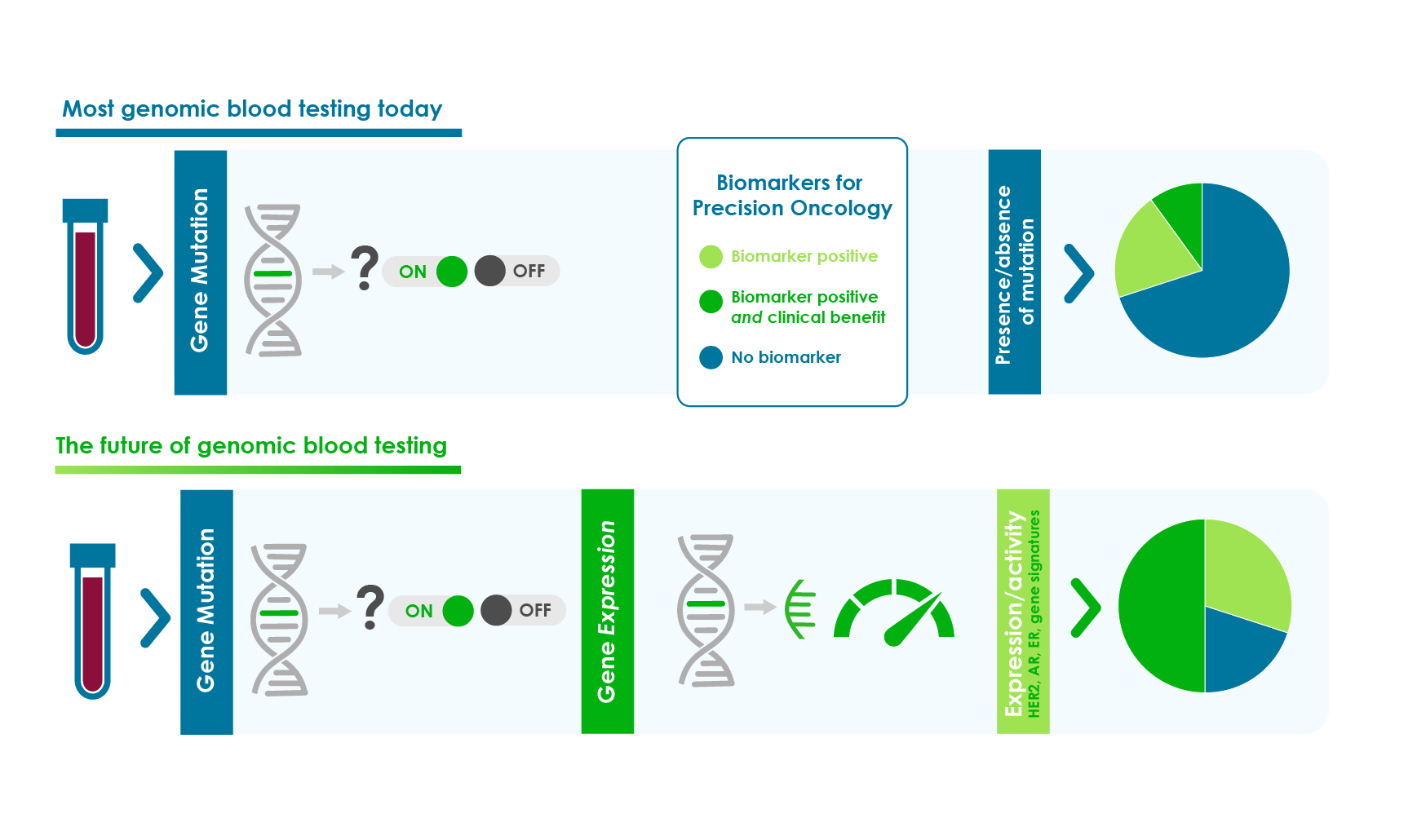
GeneCentric Therapeutics is a precision-oncology company with roughly fourteen people and an unusually specific obsession. For more than a decade, liquid biopsy has been sold as a near-magical idea: find cancer in a tube of blood, no surgery required. The catch, rarely advertised, is that almost every one of those tests is fluent in only one language - DNA mutations. Presence or absence. On or off. Typo or no typo.
The problem is that tumors do not behave according to their typos alone. Two patients can carry the same mutation and respond to the same drug in opposite directions. The behavior - the part oncologists actually want to predict - lives in gene expression: how loudly each gene is being read out. That signal is written in RNA, and RNA was long assumed to be unreadable from the cell-free fragments floating in blood.
GeneCentric's whole reason for existing is that assumption being wrong.
EXpressCT is a new technology for adapting any RNA expression test to liquid biopsy - it provides greater diagnostic utility of cfDNA beyond merely profiling variants.
- Michael Milburn, PhD, CEOMutations are a noun. Expression is a verb.
A mutation tells you a gene exists in a particular form. Gene expression tells you what it is doing right now - and in cancer, doing is everything. Whether a tumor will answer to a targeted therapy, which molecular subtype it belongs to, whether HER2 or AR or ER is quietly running the show: these are activity questions, not spelling questions.
Tissue biopsies can answer them, because you can extract RNA from a chunk of tumor. But tissue is invasive, slow, and often impossible to repeat as a cancer evolves. Blood is the opposite: easy, fast, repeatable. The field's bargain has been to accept blood's convenience and live with DNA's narrower vocabulary. GeneCentric refused the bargain.
GenomicsNext has the potential to become the "decoder ring" for translating tissue-based biomarkers into liquid biopsy.
- Clay Thorp, Hatteras Venture PartnersAcademics who decided to ship
The bet started in 2011, in the gene-expression labs at the University of North Carolina. Co-founder Charles Perou is one of the people who helped define breast cancer's molecular subtypes; co-founder and chair Myla Lai-Goldman spent eighteen years at Labcorp, a decade of it as Chief Medical and Chief Scientific Officer. David Neil Hayes rounds out the founding science. The thesis was simple and patient: gene-expression signatures are the most informative thing in cancer genomics, and almost nobody has made them practical in the clinic.
It is a nicely ironic detail that a founder who once ran the science at Labcorp now counts Labcorp among GeneCentric's investors. The student became the cap table.
Today CEO Michael Milburn and CSO Kirk Beebe run a company that looks less like a moonshot and more like a careful translation project: take twenty years of expression science and force it to survive contact with a blood tube and a billing code.
That second part - the billing code - is where most clever biology quietly dies. A signature can be brilliant in a journal and useless in a clinic if no one will reimburse it, run it at scale, or trust it enough to change a prescription. GeneCentric's founders had watched that gap firsthand, which may explain the company's almost stubborn focus on partners, codes, and clinical availability rather than splashy demos. The science was never really the question. The plumbing was.
The slow build
A fifteen-year overnight success, abridged
Three names, one idea
The trick underneath everything is fragmentomics. When cells die, they shed DNA into the blood, and the way those fragments are cut and patterned carries an echo of which genes were active. GeneCentric's EXpressCT - "Expression Signatures Through Circulating Tumor signals" - reads those patterns and infers gene expression from cfDNA. No RNA extraction, no tissue.
GenomicsNext then bundles that expression read-out with conventional DNA variant detection, so a single blood sample yields both the typos and the behavior. PurIST is the proof-of-concept made clinical: an RNA expression test that sorts pancreatic tumors into subtypes to help guide first-line treatment.
EXpressCT
Infers RNA gene-expression signatures from cell-free DNA fragmentomics. Platform-agnostic, designed to adapt existing tissue tests to a blood or urine draw.
GenomicsNext
Integrated liquid biopsy platform delivering thousands of gene-expression measurements plus high-fidelity DNA variant detection from one sample.
PurIST
RNA-based Purity Independent Subtyping of Tumors test for pancreatic cancer, used to help inform first-line therapy. Licensed from UNC.
Our technology is platform agnostic to ensure synergistic commercial goals with our partners.
- Kirk Beebe, PhD, Chief Scientific OfficerThe math the field keeps avoiding
Here is the argument in one chart. In a mutation-only world, a large share of cancer patients return no actionable biomarker at all - the test runs, the report comes back, and the oncologist is no wiser. Adding a gene-expression layer is GeneCentric's claim to move patients out of that "no biomarker" column and into a decision.
Where biomarkers come from
Illustrative - based on GeneCentric's "today vs. future" framing of genomic blood testing
The proof that matters most is partnership. PurIST has reached the clinic. Labcorp - investor and lab - has offered GeneCentric technology through its Integrated Oncology business. Tempus has carried PurIST for clinical use. Bristol-Myers Squibb appears among biopharma collaborators. For a company this size, the moat is not headcount; it is the willingness of much larger institutions to route real patients through its science.
Genomics, into the everyday clinic
The stated mission is plain: address the unmet need in precision oncology for better biomarkers, and deliver them through blood. The vision goes one step further - bring genomic assays into the everyday cancer clinic, not just the academic center or the clinical trial. A liquid-first future, as they put it, where the richest read on a tumor does not require cutting into one.
It is an unfashionably patient goal in a field addicted to announcements. GeneCentric has spent fifteen years on a single thesis and is only now commercializing the platform that thesis was built for. Skeptics will note that the giants - Guardant, Foundation Medicine, Tempus, Natera, Exact Sciences - have far deeper pockets. GeneCentric's reply is that most of them are still optimizing the DNA-mutation question, while expression remains wide open.
Whether a fourteen-person team can hold that opening is the genuine question, and it would be dishonest to pretend the answer is in. An initial $8 million Series C buys runway through 2026, not certainty. But the company has chosen the unglamorous path on purpose: prove the signatures, earn the codes, partner with the labs that already touch millions of patients, and let the technology arrive through the side door of routine care rather than the front door of hype. In oncology, that is often how the durable things show up.
The behavior of a cancer is written in RNA. The trick is hearing it from the fragments a tumor leaves in the blood.
- The GeneCentric thesis, in plain termsThe vial, asked again
Return to that lab off Davis Drive. The vial of blood has not changed - it is the same red tube it has always been. What changes is the size of the question it can answer. For most of liquid biopsy's history, that tube could only confirm whether a gene was misspelled. If GeneCentric is right, the same tube can now report whether the gene is awake, busy, and driving the disease - the difference between knowing a cancer's grammar and understanding what it intends to do.
Fourteen people are betting that the next era of cancer care is decided not by what we can detect in blood, but by how much of the tumor's behavior we can finally hear. The tube was always talking. GeneCentric just learned the rest of the language.