01 / THE SCENESomewhere, a data center is gasping for clean power
An AI accelerator pulls power the way a city pulls electricity - constantly, unevenly, and never patiently. The chip flips billions of transistors in the time it takes a fly to change its mind, and every flip demands a precise jolt of voltage delivered instantly. The trouble has never been generating the power. The trouble is the last few millimeters: the gap between the converter on the board and the silicon that needs the juice. Across that gap, voltage sags, energy leaks, and heat collects.
Ferric, Inc. spends its days closing that gap. The New York company builds integrated voltage regulators - IVRs - which are complete DC-DC power converters squeezed onto a chip small enough to sit inside the processor package itself. The pitch is almost rude in its simplicity: stop trucking power across the board and build the power supply directly into the silicon.
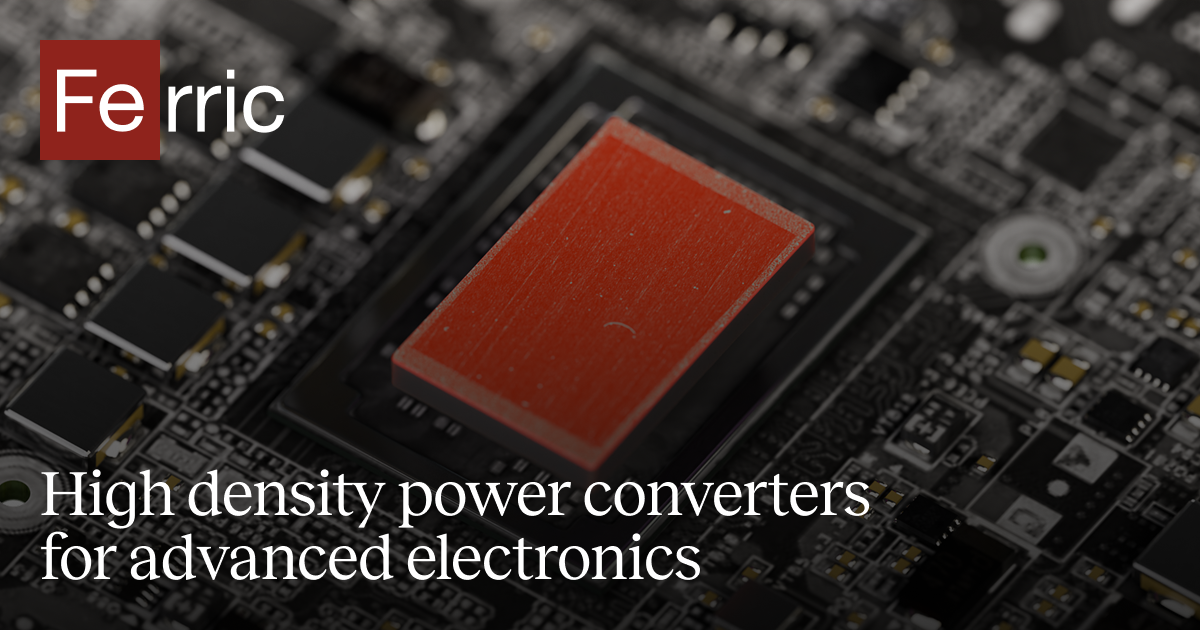
"High density power converters for advanced electronics." A modest line for a company quietly trying to relocate the power supply.
It is the kind of problem most people never think about and every hyperscaler thinks about constantly. As of 2026 Ferric is a roughly 49-person outfit on West 30th Street, recently through a Series B, with a flagship product that delivers 160 amps from 35.5 square millimeters of silicon. Small numbers, enormous consequences.
02 / THE PROBLEMThe bottleneck nobody put on a slide
For decades, processors got faster and power delivery mostly kept up by adding more parts: more inductors, more capacitors, more phases of buck converters sprawled across the motherboard. It worked, in the way that adding more lanes to a highway works - until it doesn't. Modern AI chips draw hundreds, even thousands, of amps. The wiring to feed them now competes with the chips themselves for room and budget.
The villain of the story is the humble inductor. Power converters need magnetic components to store and smooth energy, and magnetics have stubbornly refused to shrink the way transistors do. So the inductor became the boulder in the road: bulky, far from the chip, and responsible for losses that turn straight into wasted electricity and heat.
The inductor never read Moore's Law and saw no reason to start. Ferric's entire existence is an argument with that magnet.
Place the converter far from the processor and you pay in voltage droop and copper loss. Place it close and you run out of space. That is the tension - proximity versus size - and it is the one Ferric threads through everything it builds.
03 / THE BETTwo engineers decide to put magnets in the silicon
The idea came out of a lab, which is to say it came out of stubbornness. At Columbia University, professor Kenneth Shepard and his PhD student Noah Sturcken were working on a question most of the industry had filed under "interesting but impractical": could you build the magnetic inductor directly into a CMOS chip using thin films of engineered magnetic material?
In 2012 they spun the answer out into a company. Sturcken became CEO; Shepard became chairman and technical advisor. Their bet was that the magnetics problem was not a law of physics but an engineering problem nobody had been patient enough to finish. Thin-film ferromagnetic materials, laminated and tuned just so, could deliver a power inductor reportedly about ten times smaller than the conventional kind - small enough to integrate.
A decade in a cleanroom is a long time to wait for a magnet to cooperate. Ferric waited, and filed 40-some patents along the way.
It was not a fast bet. Building integrated magnetics took years of materials work, the sort of unglamorous research that does not trend. But it produced something genuinely hard to copy, which in semiconductors is the only kind of moat worth having.
04 / THE PRODUCTA power supply that fits where a logo used to go
Ferric's IVRs do something that sounds simple and isn't: they pack the controller, the power transistors (FETs), the inductor, and the capacitors - an entire power conversion system - into a single chip. The flagship Fe1766 measures about 4.2 by 8 by 1 millimeters and delivers 160 amps at roughly 93% efficiency, with a regulation bandwidth above 10 MHz so it can react to a chip's appetite almost as fast as the chip changes it.
The company describes the result as a "power chiplet" - a building block designed to be co-packaged with GPUs and other high-performance silicon, supporting a vertical power delivery architecture that scales toward kilowatt-class loads. Below it sit the Fe1736, a 16-phase converter delivering 56 amps, and the Fe1728, a flexible 8-phase part with up to four independent outputs.
160 amps from a sliver of silicon you could lose in your pocket. The boulder in the road, it turns out, was movable after all.
For a customer, the payoff is measured in things they have too little of: board space and energy budget. Ferric reports footprint and bill-of-materials reductions of up to 74%, and energy savings on the order of 30% in hyperscaler environments. Fewer parts, less heat, more compute per watt.
05 / THE PROOFReceipts, not just demos
Plenty of power-electronics startups have beautiful slides. Ferric's more persuasive evidence is that its integrated magnetics have been proven in shipping products since 2021 - reportedly inside high-volume consumer hardware. In a field where "it works on the bench" and "it works in millions of units" are separated by a canyon, that matters.
Partner
Marvell
June 2025 collaboration to advance integrated voltage regulation for AI and cloud infrastructure.
Foundry
TSMC
The world's largest foundry brings Ferric's integrated magnetics to production manufacturing.
Backing
DARPA / SBIR
Non-dilutive U.S. research support for integrated DC-DC converters using thin-film magnetics.
The funding tells a similar story of patient capital: a Series B closed in late 2024, with public trackers placing total funding somewhere in the tens of millions over the company's life. Leading processor developers are now integrating the Fe1766 - the validation that turns a clever chip into a supply chain.
In hardware, the loudest endorsement is a purchase order. Ferric is starting to collect them.
06 / THE MISSIONMake integrated power the default
Ferric's stated mission is to build the world's smallest, most efficient power converters and deliver clean power as close to the processor as physically possible. Strip away the spec sheet and it is a bet on where computing is headed: toward chips so power-hungry that the old board-level approach simply runs out of room.
The team reflects the bet - industry veterans from AMD, TSMC and Xilinx grafted onto the academic core in magnetic materials and power management. It is a culture built for the long, finicky work of making physics manufacturable, which is a different temperament than the move-fast-and-break-things crowd. You cannot iterate your way out of a bad magnetic film overnight.
Why Ferric is hard to copy
- Thin-film magnetic inductors integrated in CMOS - roughly 10x smaller than conventional.
- 40+ patents from a decade of materials research.
- Proven in shipping products since 2021, not just lab samples.
- Co-packageable "power chiplet" built for the AI-accelerator era.
- A path to volume through TSMC.
07 / TOMORROWBack to the gasping data center
AI's growth is, at bottom, an electricity story. Every new model is more transistors switching faster, and the grid, the cooling, and the power delivery all have to keep pace. The companies building the biggest computers have started treating watts as the scarce resource - because they are. A few percent of efficiency, multiplied across a fleet, is a power plant's worth of savings.
That is the world Ferric is built for. If integrated voltage regulation becomes standard - power delivered inside the package instead of trucked across a board - the change will be invisible to everyone except the people who pay the electricity bill and the engineers who suddenly have their board space back.
Return to that gasping data center. The gap between the converter and the chip - the few millimeters where energy went to die - is closing. Ferric is the company closing it.
The power supply, for most of computing history, was furniture: large, fixed, taken for granted. Ferric's wager is that it is about to become part of the chip - quiet, dense, and finally where it belongs. The boulder in the road was movable. Someone just had to spend a decade proving it.