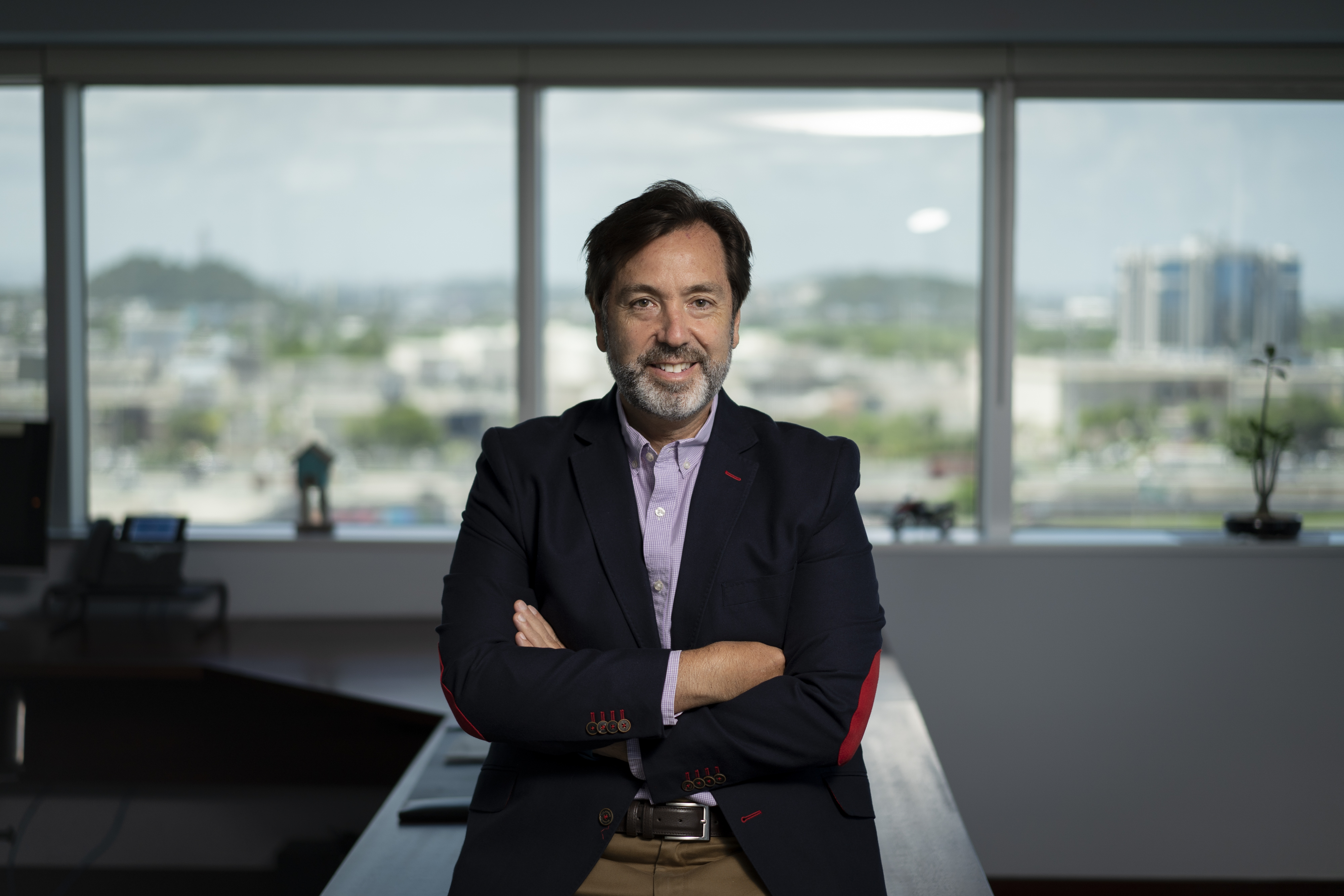
Federico Grosso made room for a meeting in which work was off the menu. It had a name, “coffee time con Federico,” and an unusually generous brief: talk about something else. For the president of an insurance business, accustomed to financial performance and commercial decisions, it was a small departure from the usual executive agenda. An agenda, after all, can become quite possessive of everyone’s attention.
The coffee sessions appeared in his leadership story in 2020, alongside more frequent town halls. Earlier, at Assurant Puerto Rico’s offices in Hato Rey, Grosso would stop in the corridors to chat with employees. The conversations did not always have a particular purpose. Communicating and listening were themselves part of the point. There is something appealingly ordinary about that picture: a company president, a colleague, and a conversation that need not earn its place on a spreadsheet.
It is also a useful place to begin understanding his career. Grosso became CEO and president of Assurant Puerto Rico in June 2017. His responsibilities include strategy, financial performance, and commercial activity across several kinds of protection. The coffee belongs in that account because it shows how he chose to spend some of the time that came with the title.
Before the coffee, the balance sheet
Grosso arrived at the presidency with a background in finance. His earlier work spanned mobile services and infrastructure, with experience in both domestic operations and multinational companies. As chief financial officer of a mobile-services provider in Puerto Rico, he led several refinancings and developed relationships within the banking industry. Those are specific responsibilities, involving the financial arrangements that allow a business to keep operating and pursue its plans.
His education followed a path between Buenos Aires and Washington. He earned a bachelor’s degree in Accounting and Business Administration at the University of Buenos Aires, then an MBA at Georgetown University. His public professional profile places the Georgetown period between 1998 and 2000. The combination gives a clear outline of his preparation: accounting, business administration, and later graduate management study.
A refinancing and an informal employee conversation have very different rhythms. One requires agreement about money and obligations; the other can proceed without a formal conclusion. Both appear in Grosso’s professional story. Reading them together offers a more rounded picture of the job he eventually took on. The executive who had worked with banks would also be responsible for employees, customers, commercial partners and the performance of an insurance operation.
A president inside a larger map
The geography matters. Grosso leads Assurant Puerto Rico, with responsibility for the business in that market. His remit includes commercial and sales efforts in property, mobile, credit and vehicle protection. These are different products, but each concerns something a customer wants to safeguard. A device, a vehicle and a property bring different practical demands to the same executive’s desk.
The local business sits within Assurant’s wider international organization. That arrangement gives his story two scales: the team in Puerto Rico and the colleagues with whom it works across the region. Neither scale makes the other disappear. A regional discussion eventually has to meet the circumstances of a particular operation, its customers and its employees.
In a public post about a visit by Latin America president Ricardo Fiuza, Grosso focused on the opportunity to show what employees in Puerto Rico were doing. The visit included a town hall and exchanges about collaboration and transformation. It is a revealing choice of emphasis. With a regional leader in the room, his short message put the local team’s work at the center of the occasion.
The choices behind flexibility
Some of Grosso’s most concrete management comments concern a decision about which changes to adopt. In 2018, he discussed Assurant’s evaluation of Puerto Rico’s labor-reform provisions. The company considered legal options, financial effects and the employee dimension. It adopted provisions concerning probation and schedule flexibility, while leaving much of the available change unused.
That account has a useful specificity. It concerns an actual choice among available options, with consequences for working arrangements. The company described flexibility that included remote days for exempt employees and alternative schedules for nonexempt workers. These were the arrangements discussed at that time; they belong to that chapter of the story, rather than serving as a current employee handbook.
Grosso’s explanation placed employee value inside the decision alongside its economics. That is where a statement about listening becomes more interesting to examine. A conversation is easy to arrange. A policy requires someone to decide what will happen afterward. The 2018 account offers one example of management describing how it weighed that employee dimension when it had room to choose.
Giving collaboration a floor plan
By September 2024, the workplace itself was part of the discussion. Grosso described a planned renovation designed around shared work. There would be open areas, meeting rooms, multipurpose spaces, telephone booths and rooms that could be reserved for individual use. Individual executive offices were absent from the proposal. Even the president’s title would not come with its own permanently assigned room.
It is a detail with some wit built into it. Executive status has often been expressed in square footage; here, the announced arrangement gave collaboration the floor space. The practical question was how to make time together useful in a business where employees also worked remotely. A shared office day needs places to meet, exchange ideas and complete different kinds of work.
The same period brought a virtual human-resources assistant to the Puerto Rico operation. Employees could use it from computers or mobile devices, with access around the clock. The office plan and the digital tool addressed different needs: somewhere to work together, and a way to obtain routine information. Neither required every interaction to pass through a president or a manager.
An award with other people’s names on it
On September 30, 2024, Assurant Puerto Rico announced its fourteenth recognition among Mejores Patronos and its fifth Best Employers certification. It placed third in the small-company category. These were distinctions for the workplace, with employee opinion central to the assessment. They give the account a dated result against which to place the company’s statements about its culture.
The survey considered engagement, agility, engaging leadership and talent focus. Those categories are broad, but their subject is everyday experience inside an organization. Employees encounter leadership through decisions, access, expectations and opportunities. An award can put that experience into a ranking; it cannot make the day-to-day work of management disappear.
Grosso credited his colleagues: “Nuestro éxito continuo es un testimonio de la dedicación y pasión de nuestro equipo.” In English: the team’s dedication and passion underpin its continued success. His accompanying commitment was to a workplace where voices were heard and contributions valued. Recognition, in that telling, came with a further obligation to the people whose experience helped produce it.
“Nuestro éxito continuo es un testimonio de la dedicación y pasión de nuestro equipo.”
Federico Grosso · September 2024
The next conversation
There is a public-facing side to his role as well. Grosso participated as a reactor at the Colegio de CPA de Puerto Rico’s twenty-third annual insurance-industry forum in 2022. That places him in a professional conversation extending beyond his own company. Insurance leadership involves colleagues and counterparties across an industry, as well as the people inside one operation.
His stated business objective remains profitable growth in Puerto Rico, serving clients, employees and shareholders. That is a demanding combination because those groups encounter the business differently. A customer needs protection to work as promised. An employee needs the working arrangements to make sense. Shareholders expect financial performance. The president’s responsibilities bring those perspectives into the same job.
One further detail puts a boundary around the title. The statutory statement for Caribbean American Life Assurance Company for the year ended December 31, 2025, lists Grosso as both president and a director. In that setting, leadership appears in its most formal form: named officers, defined responsibilities and a dated account of the business. It is a different register from a corridor chat, but both belong to the same professional life. The contrast gives the coffee story some of its texture. A president signs documents that require precision, attends meetings with defined subjects, and still has the option of making space for a conversation whose destination has not been decided in advance.
The coffee conversation remains a fitting final image because it is small enough to understand. Someone makes time. Someone else speaks. For a while, the exchange need not be about a target or a report. Grosso’s career contains the formal machinery of business: degrees, refinancings, a presidency and industry meetings. Alongside it sits this less ceremonious practice. A cup of coffee has a modest job description. Giving people room to talk is a respectable addition.