A squash court is an awkward place to discuss a business partnership. Both people are trying to win, conversation comes in installments, and nobody has brought a sensible pair of shoes. Faraz Karbasi and Courtney Ellenbogen nevertheless developed the initial idea for Aesthetic Partners there while studying for their MBAs. The setting has a certain economy: before they asked other founders to trust them with a business, they had already found a reason to keep showing up together.
The venture they built concerned a particular kind of ambition. Established owners wanted to expand. They also wanted to recognize their businesses afterward. Karbasi and Ellenbogen offered a partnership that brought resources and operating support while preserving local identities. A founder’s name could remain on the door even as the machinery behind it became more substantial.
That proposition runs through Karbasi’s subsequent work. His career now includes investing at Conant Capital, founding Kintari, and advising the company he once jointly ran. Each role brings him back to the same negotiation between the benefits of getting bigger and the value of what is already there.
A business with room for two
Karbasi has described the founding relationship without much mystery. “Courtney and I share a competitive nature,” he said in November 2023. The remark makes the squash-court origin feel less like decorative biography. Competition was part of how he explained the business itself, extending that disposition to helping the companies in its portfolio succeed.
Ellenbogen brought her own experience of investing and operating. Her earlier work included private equity at The Carlyle Group and investment banking at Deutsche Bank. She had studied economics at Duke before Harvard. Her sporting background also extended beyond campus recreation: she played on Duke’s golf team and competed in US Opens and LPGA events. The founding partnership had more than one person acquainted with a scoreboard.
They began Aesthetic Partners as a search fund while completing their MBAs. That detail places them in a particular entrepreneurial tradition: looking for an existing business to acquire and build upon. The first task is finding something worth taking responsibility for. The next is persuading the people who created it that your arrival will be useful.
For a partnership between two new entrepreneurs, that demands two kinds of confidence. Each has to believe in the opportunity. Each also has to believe in the person sharing responsibility for it. Their later co-CEO arrangement made that shared responsibility visible in the company’s leadership.
“Courtney and I share a competitive nature.”
Faraz Karbasi · November 2023
An engineer goes looking for a company
Karbasi’s academic route crossed both technical and commercial subjects. At the University of British Columbia, he earned a Bachelor of Applied Science in electrical engineering and a Bachelor of Arts in economics. He subsequently earned an MBA at Harvard Business School.
Those qualifications put two different sets of questions beside each other. Engineering concerns how a system works. Economics concerns the choices people make within one. Running a company brings both sets into the same room: a process can look elegant on paper and still disappoint the people expected to use it. An organization has to function for its participants as well as its designer.
Before Aesthetic Partners, his career included ZS Associates, Pharmascience and Persistence Capital Partners. The work spanned consulting, strategy, operations and investing. These were different vantage points on a business, from examining a problem to assessing an investment to dealing with the work of an operating organization.
At Harvard, the vantage point changed again. He and Ellenbogen moved toward becoming owners and leaders themselves. A presentation can finish with a recommendation. Ownership has a habit of leaving the recommendation on your desk until somebody does something about it.
Their decision to pursue a search fund made existing companies central to that transition. There would be histories to understand, employees to work with, and reputations formed before the new partners appeared. That makes listening part of the commercial assignment.
Electrical engineeringUBC
EconomicsHarvard
Business administration
The name stays on the door
Aesthetic Partners’ offer includes the business work that can crowd an owner’s calendar: marketing, recruiting, technology, accounting and legal support. It also assists with new locations, including finding markets, negotiating leases and assembling the practical pieces of an opening. Expansion is a considerable collection of small jobs wearing one large word.
The company organizes that support around individual partner brands. The arrangement gives local businesses access to shared capabilities while keeping their identities recognizable. That makes the founder’s existing reputation part of the proposition. Years of familiarity have value, even when familiarity is difficult to display in a financial model.
Consider the difference between having money for a new location and having people who can help open it. Capital supplies one necessary ingredient. Someone must still negotiate the space, recruit the team, arrange the technology and introduce the business to its new neighborhood. Aesthetic Partners explicitly offers assistance across that sequence.
Its approach also includes professional development and access to a network of peers. An individual owner can gain colleagues without turning every location into an identical copy. The operating question becomes how to share useful resources across businesses whose local character is part of their appeal.
In Karbasi’s public explanation, the owners wanted growth while holding onto their teams, brands and culture. Those three nouns give the promise a human scale. A team contains working relationships. A brand carries a reputation. Culture describes how people experience the place after the transaction documents have been put away.
The partnership proposition
Existing team
Established culture
Growth capital
Expansion assistance
A schematic of the business model, not a financial forecast.
A bigger table, November 2023
By November 2023, the company had added 20 practices since 2019, across California, Florida, North Carolina and Virginia. It announced a partnership with Norwest on November 13. The investment would support infrastructure and expansion, including growth at existing businesses and entry into new markets.
Norwest’s Sonya Brown and Scott Mitchell joined the board. That added another layer of relationships to a business already built around partnerships: the founders’ relationship with each other, their relationships with local owners, and now the relationship with an institutional investor.
The deal’s terms were not disclosed. The useful detail is what the participants said the investment was for. Infrastructure may lack the glamour of a launch, but it is what allows an organization to absorb more work without expecting everyone to solve the same problem independently.
Twenty additions across four states also put the founders in a different operating situation from the one they had occupied as students. Geography adds its own demands. People who once could settle an issue in the same room need ways to coordinate across locations. Growth increases the importance of the ordinary routines that keep a company understandable to its own employees.
The people doing the multiplying
In December 2024, Aesthetic Partners announced AP Academy, a professional development program that included administrative and leadership courses. The company was putting an organized training resource alongside its capital and operating support.
Karbasi’s explanation placed employees at the center of the effort. He called people “our greatest instrument of change.” For someone whose career had included investment and strategy, it was a telling choice of emphasis. A company can announce a plan centrally; the work of making it happen is distributed among the people in its locations and offices.
Training also gives a partnership something to offer after the initial transaction. Employees have their own reasons to evaluate a new owner or business partner. Opportunities to learn and advance belong in that calculation. They are more tangible than a promise that a larger organization will somehow be better.
There is a personal detail that gives Karbasi’s otherwise formal biography an unexpected change of altitude. He had completed more than 25 solo skydives when Aesthetic Partners introduced him publicly. It would be convenient to turn that into a complete theory of his management style. The actual fact is entertaining enough: alongside the degrees and executive responsibilities sits a pastime that involves leaving an aircraft on purpose.
From the operating chair to the next venture
The roles have since changed. Aesthetic Partners now lists Karbasi as co-founder and executive advisor, with Ellenbogen as co-founder and chief executive officer. Conant Capital lists him as managing partner. Its work includes backing entrepreneurs and supporting companies through acquisition and later development.
At Kintari, he is founder and CEO. The company’s biography credits him with co-leading Aesthetic Partners to 36 locations and more than $130 million in revenue. Those company-reported figures describe the scale of the operating experience he brings to the new venture. Kintari’s partnership offer again emphasizes retaining a business’s brand, team and meaningful ownership.
In April 2026, Karbasi joined Eric Kristensen for a fireside chat moderated by Timothy Bovard at the SoCal ETA Conference. The conversation brought together operators at different points in their careers. Karbasi discussed building, scaling and looking toward another sector.
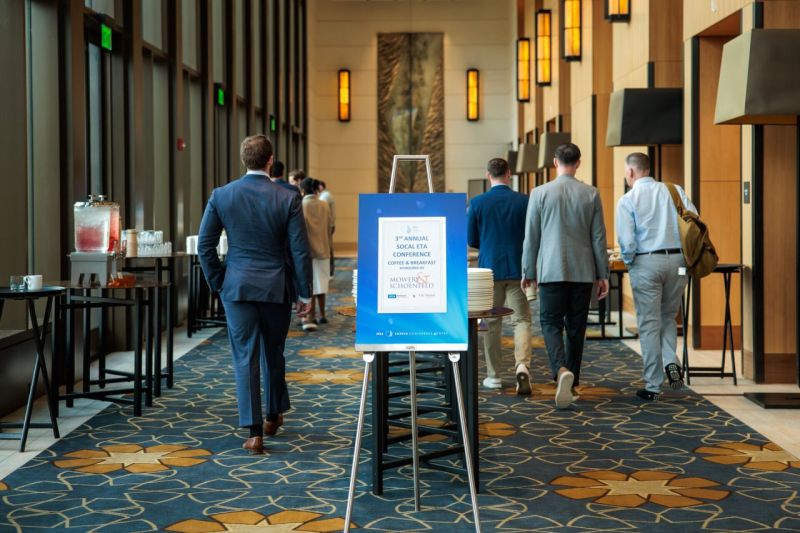
There is a pleasing continuity between the student on the squash court and the executive in that conversation. In both settings, the subject is what might be built next, and with whom. The intervening years have given those questions a larger cast of characters: co-founders, employees, local owners, board members and entrepreneurs seeking backing of their own.
Karbasi’s career offers a close view of the obligations inside a partnership. Money enters the business. So do expectations. Someone has to make the combination work for the people whose names and effort were there first. Keeping the name on the door is a beginning. Earning the invitation to stay is the continuing job.