Before Faqir Chand Kohli helped persuade the world to buy software from India, he helped decide where Mumbai’s electricity should come from. At Tata Electric, the work was load dispatch: matching generating stations to demand while accounting for the losses along the way. There were real wires at the other end of the calculations. A clever idea had to survive contact with a city.
That is a useful place to begin with Kohli. The familiar account starts with TCS and ends with an industry. His own route ran through power engineering, a scholarship that changed his route, and a succession of institutions that needed people willing to do the unglamorous work. He kept returning to a practical question: what would it take to make this work here?
In 1969, JRD Tata asked him to move into Tata Consultancy Services, established the previous year. Kohli was already an experienced electrical engineer, with degrees from Queen’s University and MIT. He had a perfectly respectable career. The new assignment offered considerably more uncertainty.
“I was happy in Tata Electric and was reluctant to leave it,” he recalled. He had been asked to take charge for a year. Temporary arrangements sometimes have a rather elastic understanding of the calendar.
A newspaper advertisement changes the route
Kohli was born in Peshawar on 19 March 1924, when the city was part of British India. He studied at Government College in Lahore, completing studies in the arts and sciences. In his final college year, his father died. The need to become independent helped steer him towards the navy.
While waiting for his commission, he saw a newspaper advertisement for a scholarship to study electrical engineering at Queen’s, in Canada. He applied, won the scholarship, and obtained permission to leave the navy’s employment. In 1946, he set out for Kingston. A career that might have gone to sea went to a university instead.
He graduated in 1948, worked at Canadian General Electric, and earned his master’s in electrical engineering at MIT in 1950. These dates trace an education across borders while another border was being drawn at home. During Partition, his family left Peshawar and rebuilt their lives in India.
His later recollection of Queen’s concerned the freedom to question what he was taught. It is a revealing choice of souvenir. Alongside an engineering qualification, he carried away an appetite for examining assumptions. Returning to India in 1951, he joined Tata Electric and put that habit to work on power-system operations.
Joins Tata Electric
As general manager
The CEO role
At IIIT Hyderabad
An export business without the right computer
At Tata Electric, Kohli helped introduce digital computing into the management of the power network. Computing belonged inside the operation, where it could alter decisions. His move to TCS extended that experience into businesses whose information still needed sorting, reconciling and processing.
The early assignments included bank reconciliation, payroll and accounting. They make poor material for a movie trailer. They make excellent material for a business: recurring problems, identifiable customers and consequences when someone gets the numbers wrong. Kohli recruited engineers, accountants and graduates in science and mathematics, building a team around work that crossed professional boundaries.
Finding business inside the Tata group proved difficult. Companies were reluctant to hand over their data-processing functions. Kohli looked outside. Bombay Telephones became an early external customer, with a project to digitise its directory. Overseas, he used academic and engineering connections to develop a relationship with the American computer company Burroughs.
One early assignment exposed an awkward detail. TCS had agreed to develop software for Burroughs but had no Burroughs mainframe in India on which to do it. Importing a machine would take time. The engineers used an ICL computer and built a software filter to bridge the systems. Their code travelled to the United States for testing. It worked.
The episode helped establish that Indian engineers could deliver software for customers abroad, even under inconvenient conditions. There is a pleasing reversal in it: the missing computer became an occasion to demonstrate competence. Contracts followed. The reputation had to be earned in working code, a form of persuasion with limited patience for adjectives.
“If we miss this opportunity, those who follow us will not forgive us.”
F C Kohli · Computer Society of India address, 1975
By 1975, Kohli was telling the Computer Society of India that information technology offered the country a chance to participate in a new industrial transformation. The warning carried urgency. Talent would need training, customers would need convincing, and institutions would need to catch up. An opportunity could be lost while everyone agreed that it sounded promising.
The apprenticeship came with another problem
Kohli’s standards could make him a demanding boss. S Ramadorai, who succeeded him at TCS, remembered brief instructions and formal exchanges through written memos. He also remembered that a logical explanation could change Kohli’s mind. Disagreement required preparation. It was unlikely to benefit from extra decoration.
Ramadorai’s early work included maintaining Burroughs hardware in India after a fourteen-week training programme. Screwdrivers, pliers and occasionally sticky tape entered the picture. Repairing equipment conserved foreign exchange and forced the team to understand the machines they supported. The lesson was tactile: independence could involve getting your hands inside the cabinet.
Kohli’s influence reached people who would later lead the company and the Tata group. N Chandrasekaran remembered being hired by him as a trainee. Such connections give a corporate succession chart a human dimension. Before the titles came the early assignments, the expectations and the experience of having someone trust you with difficult work.
He also invested in the institutions supplying that talent. His relationships with engineering colleges, including IIT Kanpur, connected education to technical practice. The point was larger than recruiting the next batch. Teachers needed opportunities to update their knowledge; students needed an education that prepared them for problems whose answers were still unsettled.
A laboratory belongs on the balance sheet
Around 1980, Kohli turned to another missing piece: a research centre. He asked academics at MIT and the University of Waterloo to consider its scope and brought in E C Subbarao from IIT Kanpur to lead the effort. JRD Tata supported the proposal.
The Tata Research Development and Design Centre in Pune gave research a home inside the business. The decision matters because a services company can always find something immediately billable to do. Research asks an organisation to spend time on questions before a customer has supplied a purchase order.
That choice fits the rest of Kohli’s career. A working system required trained people, and trained people required institutions that could keep learning. The research centre made room for that longer view. It also complicated the tidy picture of early Indian IT as simply a supply of programmers available at a lower price.
Kohli handed over the CEO role to Ramadorai in 1996 and retired from TCS in 1999. He received the Padma Bhushan in 2002. The distinction between those two departures matters: handing over executive responsibility and bringing a long institutional career to a close were separate events. Neither exhausted his interest in what computers might do.
The next customer wanted to read a newspaper
In retirement, Kohli worked on adult literacy. The ambition was concrete: help an adult read a newspaper in their own language. TCS’s Computer Based Functional Literacy approach used multimedia and word recognition, bringing visual and audio patterns together rather than beginning solely with the alphabet.
Early trials near Hyderabad reported that learners could begin reading Telugu newspapers after weeks of instruction. The programme’s accounts described roughly forty hours of learning. That was an instructional goal and a reported result from the initiative, rather than a promise that every learner would progress at the same speed.
Computer Based Functional Literacy used visual and audio patterns to help adults learn to read in their own language.
His concern with Indian-language computing followed the same practical reasoning. A technology industry selling services around the world still had work to do for people at home. Language shaped who could use those services. An interface that excluded a prospective user left an engineering problem unfinished.
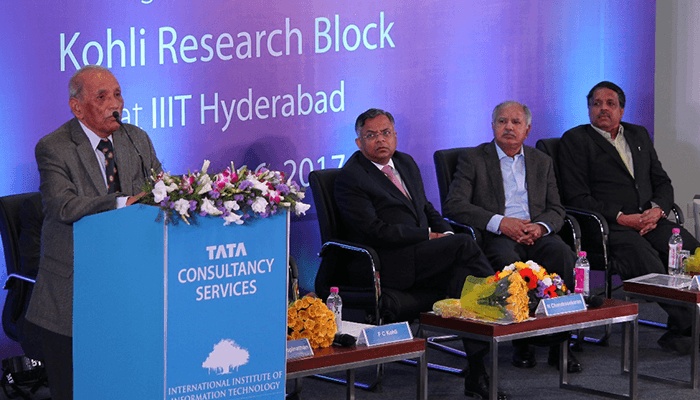
At IIIT Hyderabad, machine translation and Indian-language research interested him closely. TCS funding helped establish the Kohli Centre on Intelligent Systems in 2015. Kohli and computer scientist Raj Reddy headed its advisory board. Their association reached back to the late 1970s, another long connection between the commercial and academic worlds.
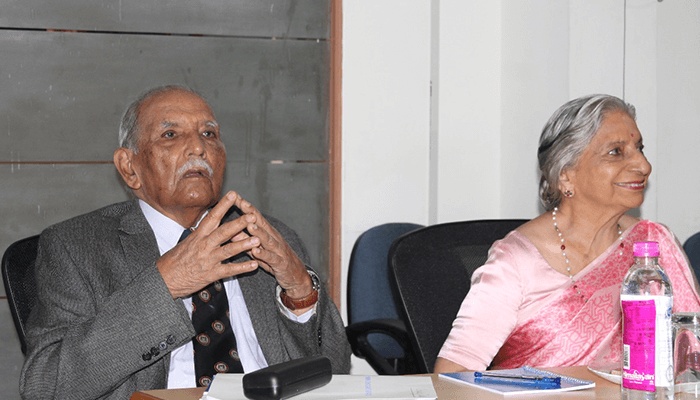
His wife, Swarn, accompanied him on visits to the institute. He made time for undergraduate students to interview him, and told its director he would return “as often as you will invite me”. A centre named in someone’s honour can become a place for ceremonial visits. Kohli appeared to regard it as an invitation to keep turning up.
He died on 26 November 2020, aged 96. At his centenary in March 2024, IIIT Hyderabad gathered researchers, heard from Swarn, and discussed how to make systems deployable, repeatable and profitable. Those are wonderfully workmanlike words for a commemoration. They leave room for the next experiment, the next difficult assignment, and someone at the far end of a system who needs it to work.