The first useful thing Fanatics learns about a customer is rarely a name. It is an allegiance. A blue cap says Yankees. A red jersey says Manchester United. A hockey sweater, purchased during a playoff run, carries a team, a player, a size, a city and a moment. For an ordinary retailer, that is an order. For Fanatics, it is the opening line of a much longer conversation.
The private company now sells licensed apparel, prints trading cards, hosts live card breaks, runs a sportsbook and casino, stages a sprawling fan convention, offers prediction markets, sells advertising and makes sports programming. More than 100 million fans encounter the platform, according to the company, and more than 900 leagues, teams, colleges and sports properties rely on some part of its commerce machinery. The old description - online sports-merchandise retailer - is accurate in the way that calling a stadium a large room is accurate.
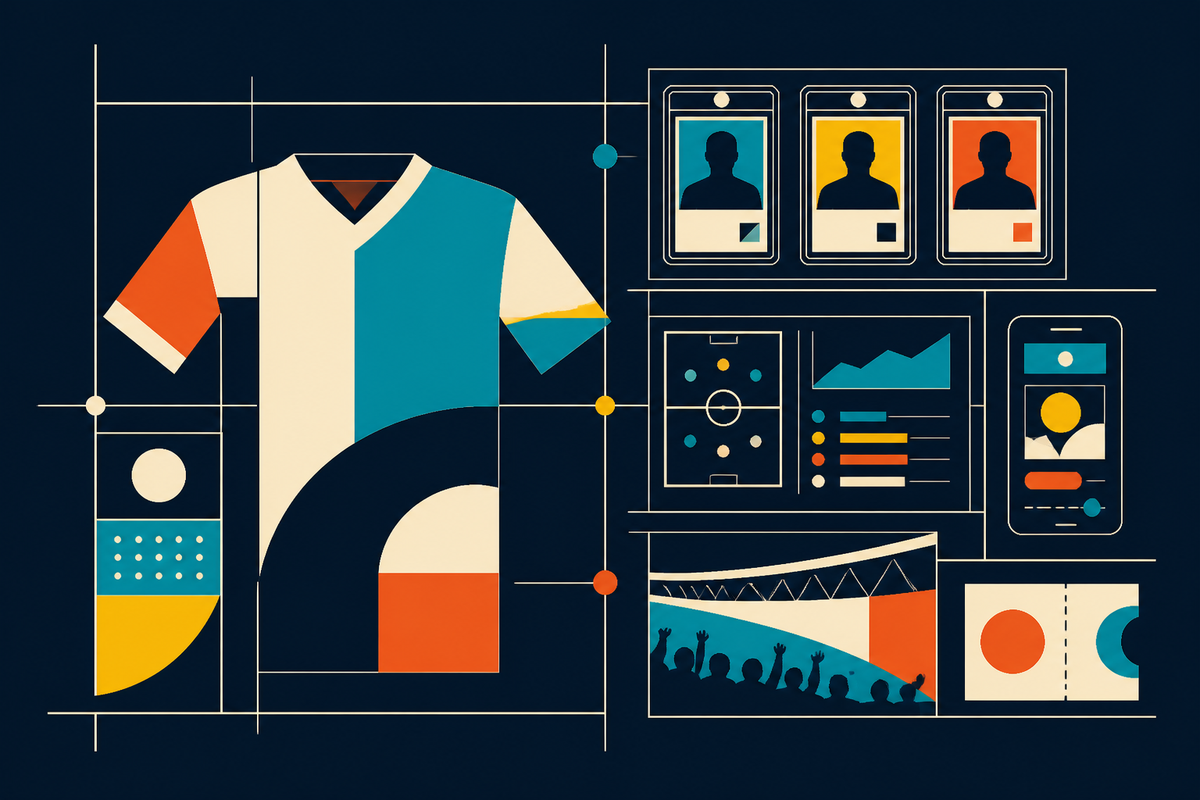
This is a company built around adjacency. People who wear their loyalty may also collect it, wager on it, travel for it and watch stories about it. Fanatics' central bet is that those behaviors belong under one account, with FanCash moving among them like an in-house currency. The strategic trick is simple to describe and difficult to execute: use the high-frequency, relatively familiar act of shopping to earn permission for everything that comes next.
01 / The originA mall shop learns to move at game speed
The origin story is pleasantly unglamorous. Brothers Alan and Mitchell Trager opened a sports-apparel store in Jacksonville, Florida, in 1995. The business shipped its first online order in 1998. GSI Commerce acquired it in 2011, and Michael Rubin combined it with GSI's licensed sports operations under the Fanatics name. Rubin is the architect and chief executive of today's platform; the Tragers are the founders of the retail business from which it grew. That distinction matters in a history full of acquisitions and corporate recombination.
Merchandise taught Fanatics that sports demand is shaped like a lightning strike. A championship, trade or breakout performance can turn an obscure name into urgent inventory before midnight. Traditional retail plans seasons in advance. Fanatics invested in a cloud commerce system, league integrations, on-demand production and a supply chain that can put newly relevant products online while the celebration is still happening. It also runs partner storefronts, mobile shops, stadium stores and event retail. The result is less a single store than a distributed piece of sports infrastructure.
“The final whistle is not the end of the game. For the merchandise operation, it is a starting gun.”YesPress analysis
That machinery solves an awkward problem for leagues and clubs. Licensing produces a thicket of manufacturers, vendors, channels, royalties and sudden demand. Fanatics can manage much of that complexity while giving a partner one commerce operator across web, mobile and venue. For shoppers, the promise is selection and official authenticity. For the partner, it is speed, reach and fewer disconnected systems. This business-to-business layer is easy to miss because the customer still sees a familiar team shop.
02 / The portfolioCards, bets and a convention floor
Fanatics moved decisively beyond apparel in 2021 by forming Collectibles and Betting & Gaming. The next January it bought Topps' trading-card and collectibles business for roughly $500 million. Topps supplied something a technology platform cannot manufacture quickly: more than 70 years of habit, nostalgia and shelf recognition. It also gave Fanatics a product with unusual range. A card can be a child's first purchase, a scarce asset, an athlete autograph, a live-stream reveal and a six-figure auction lot.
The collectibles stack now stretches from Topps packs to Fanatics Live, where hosts open cards on camera, and Fanatics Collect, which supports marketplace and vault activity. Licensing is the scarce input. Deals across baseball, basketball, football, soccer, entertainment and individual athletes allow the company to decide what becomes a set, a drop or a signed object. Competitors such as Panini, eBay, Goldin and traditional auction houses each contest a piece of that journey. Fanatics tries to connect the entire journey.
official gear
FanCash
and trade
predict
and return
Betting required a different kind of infrastructure: licenses, risk models, responsible-gaming controls and state-by-state operations. Fanatics accelerated its entry by paying $225 million for PointsBet's U.S. businesses, completing the purchase in 2024. At the time, it said Fanatics Sportsbook could reach about 95 percent of the addressable online U.S. sports-bettor market. It entered a category already led by FanDuel and DraftKings, with BetMGM and Caesars carrying casino recognition.
The differentiator is not better arithmetic. Sportsbooks can copy odds and promotions. Fanatics arrives with a population of merchandise customers whose team preferences are already legible. FanCash, earned through shopping or eligible wagering, makes that relationship tangible. The approach could lower the cost of finding casual bettors, but it also creates a responsibility: shopping data and gaming incentives cannot be treated casually. Regulation and customer trust set real boundaries around the flywheel.
03 / The connective tissueFanCash makes the org chart visible to customers
A diversified company can remain a set of unrelated logos. Fanatics ONE, launched in 2025, is meant to prevent that. Existing eligible U.S. customers were enrolled into a tiered loyalty system. Members can earn and redeem FanCash across merchandise, collectibles, event access and gaming rewards, subject to eligibility and local rules. The practical idea is more interesting than the points: a customer should feel the benefit of the portfolio without needing to understand its corporate structure.
Fanatics Fest makes the same connection physical. The New York event combines athletes, creators, card releases, autographs, merchandise and competitions. It is convention, retail floor, content studio and customer-research lab at once. The person who was previously a row in an e-commerce database turns up wearing a jersey and stands in line for a card. In 2025, Fanatics and OBB Media announced a ten-year relationship around the festival; in 2026, they launched Fanatics Studios.
Studios extends the model into films, documentaries, live programming and digital series. Early projects and relationships involve Tom Brady, LA28, ESPN, WWE, Major League Baseball and Fox Sports. Advertising, another 2025 launch, packages Fanatics' audience across shopping, scores, wagering, live card breaks and events. Prediction markets add event contracts on sports, finance and culture through regulated infrastructure supplied by Crypto.com Derivatives North America. Each new division creates inventory for another: a festival produces footage, footage carries advertising, and both can promote a collectible drop.
“The platform is not the list of businesses. It is the handoff between them.”YesPress analysis
04 / The marketA competitor changes every time the fan changes tabs
There is no single Fanatics competitor. A parent buying a birthday jersey might compare Dick's Sporting Goods, Amazon or an official team store. A collector might open eBay, buy Panini or visit an auction house. A bettor sees DraftKings or FanDuel. A prediction-market customer can use Kalshi or Polymarket where available. An advertiser compares sports media audiences. Fanatics' claim to difference lives between these categories: official rights, physical production, fulfillment, first-party affinity data and a common rewards layer.
Speed + official supply
Team shops, venue retail, licensed products and on-demand manufacturing meet sudden sports moments.
Rights + ritual
Topps, live breaks, athlete access, a marketplace and vault connect the pack to the resale market.
Known fans + rewards
The sportsbook competes in a mature field while FanCash offers a bridge back to non-gaming products.
Access + attention
Fanatics Fest, advertising and Studios turn league relationships and customer gatherings into programming.
Scale brings an unromantic counterweight. A company moving huge volumes can post a strong fulfillment percentage and still disappoint many thousands of people. Fans are unusually sensitive customers because a jersey is not just fabric and a card is not just cardboard. Quality, shipping and service failures land on objects carrying identity. Licensing concentration also attracts scrutiny from competitors and critics who worry that fewer suppliers can mean fewer choices. Fanatics' advantage and its reputational risk emerge from the same fact: it sits in the middle of so many official transactions.
The company describes a culture that values work ethic, individuality and learning, with roughly 15,000 full-time employees and 7,000 part-time, seasonal, contractor or temporary workers. Programs include Fanatics University, mentorship, leadership development and employee-led affinity networks. Yet its defining expertise is operational choreography. Designers, licensing lawyers, factory teams, data engineers, traders, compliance staff and event producers must all react to a calendar that can change with one swing, goal or buzzer.
05 / The wagerCan a platform preserve the irrational part?
Fanatics fits within the market as connective infrastructure for licensed sports consumption. It is part retailer, manufacturer, marketplace, gaming operator, promoter and media company. Oracle has cited annual revenue of about $10.5 billion in a customer profile; the last widely reported financing valued Fanatics at $31 billion in December 2022. Those numbers establish scale, but not inevitability. Betting requires disciplined economics. Entertainment requires taste. Collectibles depend on scarcity and trust. Merchandise has to arrive on time and feel worth wearing.
The most transferable lesson from Fanatics is not “become a conglomerate.” It is to notice what a first purchase reveals. A team cap contains more durable preference data than a generic click. The company built from that signal outward, choosing products linked by emotion even when their operations were wildly different. Rights and supply chains make those adjacencies defensible; the common account makes them legible.
And that leaves a delicate test. Fandom is valuable because it is excessive, local and occasionally unreasonable. Platforms prefer clean segments and repeatable funnels. Fanatics will keep expanding if it can make the machinery disappear, delivering the right object or experience at precisely the charged moment a fan wants it. The customer does not wake up hoping to enter an ecosystem. The customer wakes up hoping the Knicks win.