Erin LaCombe had a question for the Coachella Valley: what would happen if the people responsible for explaining its institutions knew one another better? A city has a spokesperson. A water district has someone who understands its projects. A reporter has a deadline. Between them lies the small, occasionally maddening business of finding the right person. LaCombe had spent years on both sides of that exchange. She could see room for an introduction.
The idea eventually became the Coachella Valley PIO Task Force, a voluntary network for public information officers. It also provides a useful way into her career. LaCombe has run television newsrooms, founded a communications firm and helped public agencies work through what they want to say. Across those jobs, her attention keeps returning to a practical matter: how information reaches the people who need it.
There is very little ceremony in that question. It can lead to a board workshop, a conservation campaign or a useful conversation between colleagues. It can also lead to a business. In 2007, LaCombe founded CV Strategies, bringing her broadcasting experience into the world of public engagement. The microphone changed hands; her interest in the audience continued.
A radio job, then a newsroom of her own
Her broadcasting career began at KROQ-FM. She has described working there while still in high school, an early entry into an industry whose product disappears into the air even as everyone works furiously to make it. Radio is an education in getting to the point. The listener is always free to turn the dial.
LaCombe graduated from the University of Southern California, with a degree in broadcast journalism. Her experience includes KFWB news radio and KTTV-Fox in Los Angeles, followed by newsroom leadership in the Coachella Valley. Her professional record spans television affiliates including KESQ, KDFX and KUNA. It is a career assembled through the local outlets that make a region intelligible to itself.
Newsroom leadership brings a particular view of communication. An organization may have spent months discussing an issue internally. The person covering it needs to understand it quickly enough to ask a useful question. Somewhere between those two timescales, an explanation has to work. Institutional familiarity can be a considerable obstacle: the people who know a subject best can forget which parts require explaining.
Her résumé lists Pacific Southwest Chapter Emmys for best newscast in 2003 and 2004, followed by communications and news-coverage awards in 2006. Those entries belong to her broadcasting years. The next phase required a different kind of persistence: taking what she understood about stories and applying it to organizations whose daily work seldom arrives with a ready-made plot.
The transition had a rough edge. In her account of a visit to a university leadership class, LaCombe described building CV Strategies after being fired from her dream job. The detail gives the founding date some human weight. A company history can make a change of direction look tidy. Living through one is a less obliging experience.
She built the firm around public organizations that needed help telling their stories. Today its work brings strategy, writing, design, photography, video and web development into the same operation. The range makes sense for a former news director: a story can require words, pictures, sound and someone willing to notice when the pieces disagree.
The work before the press release
Public engagement has an awkward relationship with glamour. A water agency can be responsible for something people depend on every day and still struggle to hold their attention for five minutes. Technical language does little to improve its chances. Yet the decisions are consequential, and residents deserve explanations they can follow without first acquiring a professional vocabulary.
LaCombe’s project record includes the iEfficient conservation campaign, bringing together 19 agencies across two counties. Her professional biography describes a four-year effort using advertising, events and sponsorships. A regional campaign asks organizations to think beyond their individual boundaries. The audience encounters a shared concern, while the agencies have to do the coordinating that makes a shared message possible.
Another assignment involved outreach for the Hi-Desert Water District’s reclamation facility and sewer system. The work included advertising, a dedicated website, videos and legislative materials. Her biography reports assessment-vote turnout above 50 percent and approval above 70 percent. The figures describe that particular process; the task behind them was to make a substantial public project understandable enough for people to participate.
Some assignments begin further upstream. In March 2025, LaCombe presented Rowland Water District’s draft fifth-edition strategic plan to its board. The plan covered customer relationships, value, organizational performance, supply reliability and system resilience. Board members gave feedback and discussed how to proceed. Here the communications work was woven into the organization’s planning, before a final announcement could be composed.
That sequence matters. A polished sentence cannot resolve a disagreement about direction. People first have to establish what they intend to do, what they owe their customers and which commitments they can defend. Only then can the public explanation carry the weight placed on it. A strategic plan is also a test of whether the people inside an organization understand one another.
LaCombe facilitated communications work during CALAFCO’s March 2025 planning retreat. The gathering addressed the organization’s direction, governance and relationships. Her portion focused on communication, conflict and trust. The work included examining strengths and weaknesses and developing shared messages, the sort of exercises that can look uncomplicated on an agenda and become rather more demanding once everyone starts talking.
“It is, in fact, the work.”
Erin LaCombe, on the effort of facilitating honest dialogue
In her reflection on the workshop, she treated the process of guiding discussion as substantive work in its own right. Participants had to contribute, question and listen. That is a revealing emphasis for someone whose earlier profession had an unforgiving broadcast clock. Sometimes communication depends on finding the concise line. Sometimes it depends on allowing enough room for the conversation that produces it.
An idea that waited a decade
The PIO network grew from an idea LaCombe had carried for roughly ten years. Tropical Storm Hilary helped sharpen her sense that the valley’s communicators needed stronger connections. Her concern also involved the changing local media landscape: fewer newsroom resources make it more important for reporters to reach informed people without wasting time finding them.
“What if all these organizations really work together on communicating for the media?” she asked. The question is modest enough to sound obvious. Making it happen requires someone to invite the participants, provide support and keep the purpose clear. LaCombe and CV Strategies colleague Jennifer Barnakian-Poland began assembling a committee with experience across the valley.
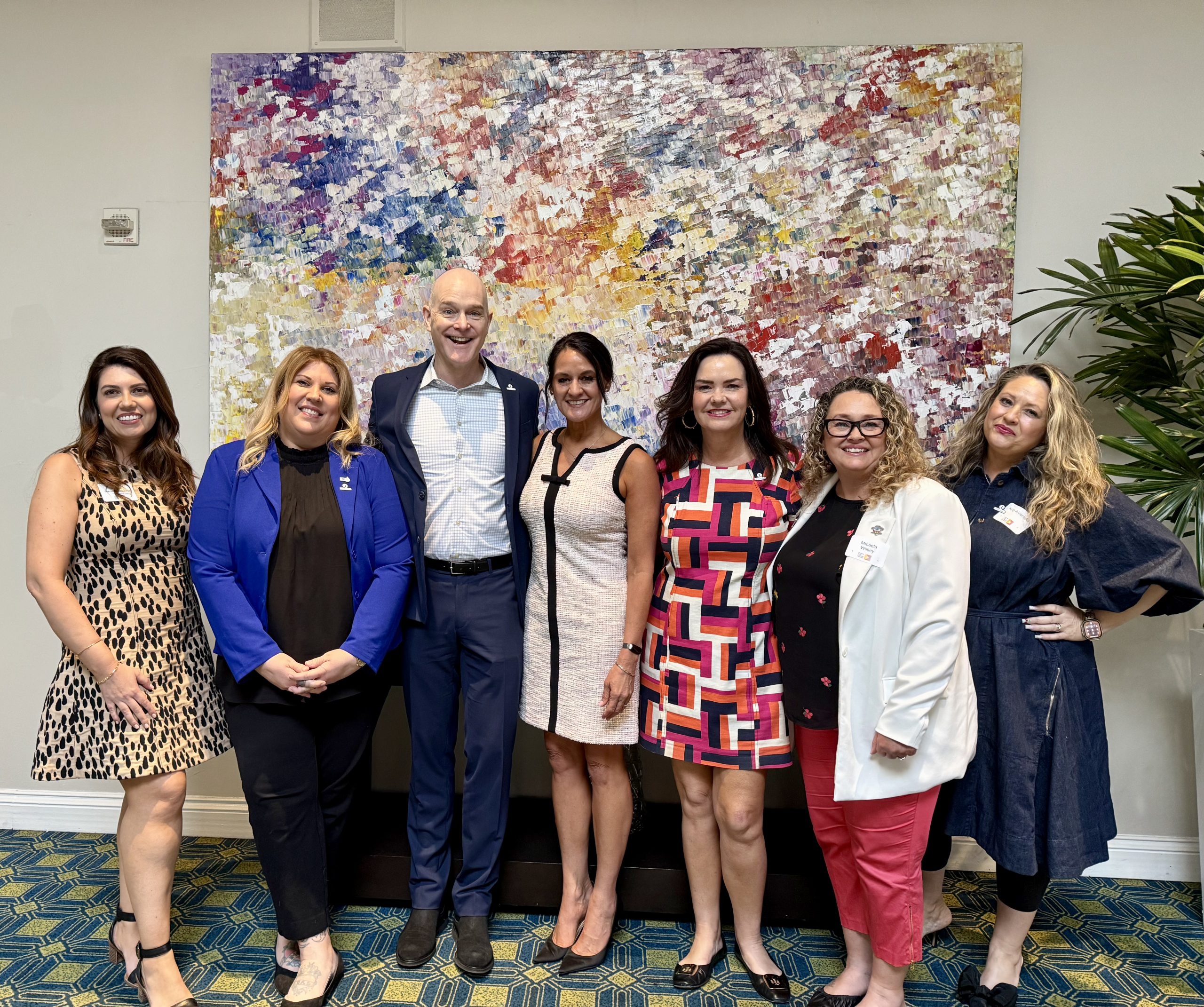
Organized in 2025, the network connects public information professionals while preserving their organizations’ independence. Its activities include professional development, exchanges of useful practices, media relationships and support during emergencies. That independence is central to the design. A city, a tribal nation and a special district have distinct responsibilities. Knowing one another can make them better colleagues without requiring them to speak with one voice.
special districtsTribal &
regional partners
The approach makes room for both preparation and everyday use. A newsroom needs a reliable contact on an ordinary Tuesday as well as during a regional emergency. A communicator can learn from a colleague whose organization faces a different set of questions. The network creates opportunities for those exchanges before the urgent moment arrives.
LaCombe’s early plans included visits to local television newsrooms so communicators and journalists could talk about helping one another do their jobs. It is an appropriate return for someone who once ran those operations. Knowing what a reporter needs does not remove the reporter’s independence. It can make the exchange more useful, with less time lost to organizational hide-and-seek.
A library, a radio station, a wider circle
Her civic work extends beyond the firm. In 2025, the Library Foundation of Los Angeles welcomed LaCombe to its board. The appointment put a communications professional alongside directors from several fields in support of a public library system. Her earlier board service includes The California Club, FIND Food Bank, the Jim Murray Memorial Foundation and the Coachella Valley Journalism Foundation.
These are different institutions with different purposes. Their place in her biography shows a professional life that includes contributing time outside the company. The journalism connection is especially tangible: the Coachella Valley Journalism Foundation’s July 2024 newsletter introduced her as part of an expanded board, placing a former newsroom leader in the company of people supporting the region’s reporting.
There is also a return to radio. KPCW lists LaCombe as a board member. Its biography places her in Park City, Utah, where she lives with her husband, Matt Toledo; the couple have five grown children. Her working life thus connects Southern California’s public agencies with a mountain community and its local station. Broadcasting remains part of the picture.
The word she left with the class
For all the institutional names in her biography, one classroom visit supplies a less formal introduction. Speaking to her son Brendan’s leadership class at Point Loma Nazarene University, LaCombe discussed the turns her career had taken. When hobbies came up, she mentioned Death Cab for Cutie and the Supreme Court Historical Society. It is a combination with rather more personality than the usual executive interests paragraph.
Asked for a single word to leave with the students, she chose values. She connected the answer to decisions about work, relationships and influence. The advice sits comfortably beside her current project: people doing different jobs, retaining their own responsibilities, and making the effort to know one another. Somewhere in the valley, another question will need an answer. It helps to know who should pick up.