There is a peculiar kind of suspense in a startup cap table. It looks like a spreadsheet, but each row is a promise: a founder's stake, an employee's options, an investor's claim on the future. Add a financing round, a conversion, an option cancellation and a new hire, and the promises begin to require arithmetic. Get the arithmetic wrong and everyone can be certain of one thing - someone will eventually notice.
Eqvista entered through that unromantic door. Founded in 2018 by Tomas Milar, the company sells software for tracking who owns a private company, what securities they hold and how those claims change. It also sells the work that becomes urgent when a company starts granting options: a 409A appraisal of its common stock. Its latest pitch is more ambitious. If the ownership record and financial data are already in the same system, why should a company wait for the next formal report to understand its value?
- What it does: cap tables, stock options, shareholder records, valuation reports and a continuously updated valuation view.
- Who uses it: founders, finance teams, advisors and investors at private companies, from small startups to later-stage firms.
- What it costs: a free cap table tier up to 20 stakeholders; Premium is listed at $2 per shareholder monthly; pre-revenue 409A work starts at $990 a year.
- The wager: accurate ownership data plus valuation expertise can produce a useful price signal between formal appraisals.
01 / The entry pointThe spreadsheet that knows too much
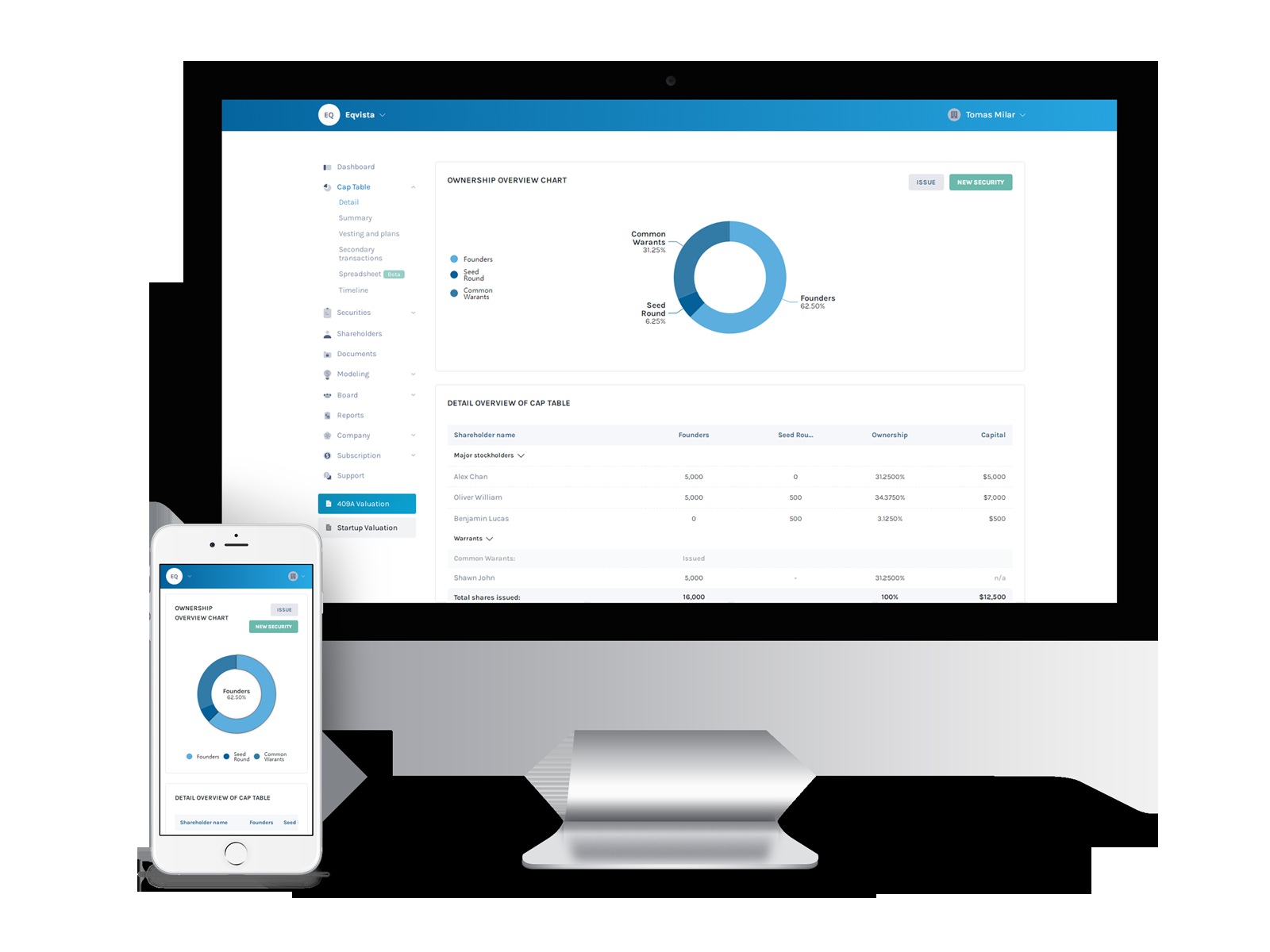
A cap table begins simply. Two founders split shares. Then comes a pool for employees. An angel invests through a SAFE. A seed round converts it. Someone leaves before vesting. The table is no longer a list; it is a history. Eqvista's platform records issuances, options, warrants, vesting and shareholder access, and models the effect of a funding round or exit. A founder can see dilution before signing a term sheet. An employee can see a grant without asking for the master spreadsheet. A finance team can produce a dated ownership view for an auditor.
The company's free tier covers up to 20 stakeholders, an unusually explicit line between an early experiment and a growing equity program. Its Premium plan is priced at $2 per shareholder per month in its published FAQ. For firms moving from another provider or a spreadsheet, Eqvista offers staff-assisted migration: collect the old records, reconstruct the transactions, check mistakes and send the result back for customer review. Eqvista says most moves take three to five business days. When old records contain errors, they take longer. This is where the glossy promise of automation meets the stubborn fact that yesterday's paperwork still has to add up.
02 / The paid answerWhat is one share worth?
A startup can know exactly how many shares exist and still lack a defensible price for its common stock. That matters when it sets the exercise price for employee options. A 409A valuation gives a fair market value at a particular date. Eqvista lists annual plans from $990 for a pre-revenue company, $1,290 for a friends-and-family or angel-stage company, $1,990 at seed and $2,590 at Series A. Later stages are quoted individually. The company says the plan includes valuation refreshes during the subscription year and Premium cap table features, with scope and material events subject to its terms.
The human element is deliberate. Eqvista says its in-house valuation team includes NACVA-certified analysts and other finance specialists who review reports and support audits. That is its commercial distinction from a bare software ledger: the same provider holds the ownership data and prepares the appraisal. The customer buys fewer handoffs, though the report still depends on sound financial inputs and professional judgment.
“Every company should know what it is worth, in real time.”Tomas Milar, founder and CEO
Milar has described the company's beginning as small 409A cases. The limitation of that work was also its opportunity. A report answers a tax and compensation question on one date; a founder's decisions continue the next morning. Revenue moves, a financing closes, market multiples shift. The last PDF does not move with them. Eqvista's change of mind was to treat valuation less as a completed document and more as a maintained view.

03 / The new ambitionA ticker without a trading floor
In 2026 Eqvista introduced Real-Time Company Valuation and a companion mobile app. The company describes an engine that updates estimates using cap table changes, financial performance, fundraising activity and market comparisons, with analysts involved in the process. The app shows valuation drivers and peer context and lets a user monitor more than one company. Eqvista also introduced Eqvista 100, a proposed benchmark for private-company price signals.
Ownership
Shares, options, SAFEs, vesting and transaction history.
Fair value
Analyst-reviewed 409A work for a formal point in time.
Price signal
A modeled view changes as company and market inputs change.
That distinction matters. A live valuation estimate is not a traded stock quote. Private shares cannot acquire a public market's certainty simply because the screen refreshes. Nor does a continuous model erase the role of a formal appraisal. What it can do is give a board or founder an earlier signal that the old number deserves another look. For an investor discussion, option pool plan or possible tender offer, earlier can be useful.
Eqvista's market is crowded with equity software, valuation shops and the enduring competitor called Excel. Carta is a familiar platform alternative; Pulley was another. Eqvista's chosen edge is to bring the ledger, valuation staff and ongoing price estimate together. That pairing also explains its 2021 tZERO relationship, which offered introductions for clients exploring secondary liquidity. Ownership comes first, then price, then perhaps a transaction. Each step needs the one before it to be credible.
04 / The arithmetic of trustWhat a founder can borrow
The practical lesson is smaller than Eqvista's market-sized ambition. Build the record before you need the answer. Put every grant, conversion, cancellation and vesting date in one place. Reconcile the past before importing it. Ask what an employee's options cost and what a new round does to everyone else's stake while there is still time to change the plan. If an appraisal is required, know which facts and documents the analyst needs. Software can make the workflow repeatable; it cannot rescue an invented date or a missing agreement.
The limits are equally concrete. A company with stale financials, disputed ownership or infrequent updates cannot get a trustworthy live estimate by pressing refresh. A highly unusual business may resist neat public-company comparisons. A buyer's actual price can differ from any modeled fair value. Eqvista's story is compelling because it begins with those mundane constraints, not because it has abolished them.
Its public scale figures should be read in their own terms. Eqvista now says it serves more than 25,000 companies and has valued more than $9 trillion in company assets cumulatively. These are company-reported measures of activity, not a pot of money it manages. In 2022 it opened a crowdfunding campaign seeking $5 million; the announced target does not by itself show how much closed. The most revealing number may be the smallest one: 20 free stakeholders. It is an invitation to record ownership before the cap table becomes an emergency.
A startup may never have a ticker in the public-market sense. But it will always have a price hiding somewhere in the choices it makes: the options it grants, the capital it raises, the shares it allows to change hands. Eqvista's idea is that a company should be able to see that price taking shape while there is still time to act on it.
More to exploreFollow the trail
Eqvista website · 409A plans · Real-Time Company Valuation · Newsroom · Blog · LinkedIn · X · Facebook · Cap table demo · YouTube channel