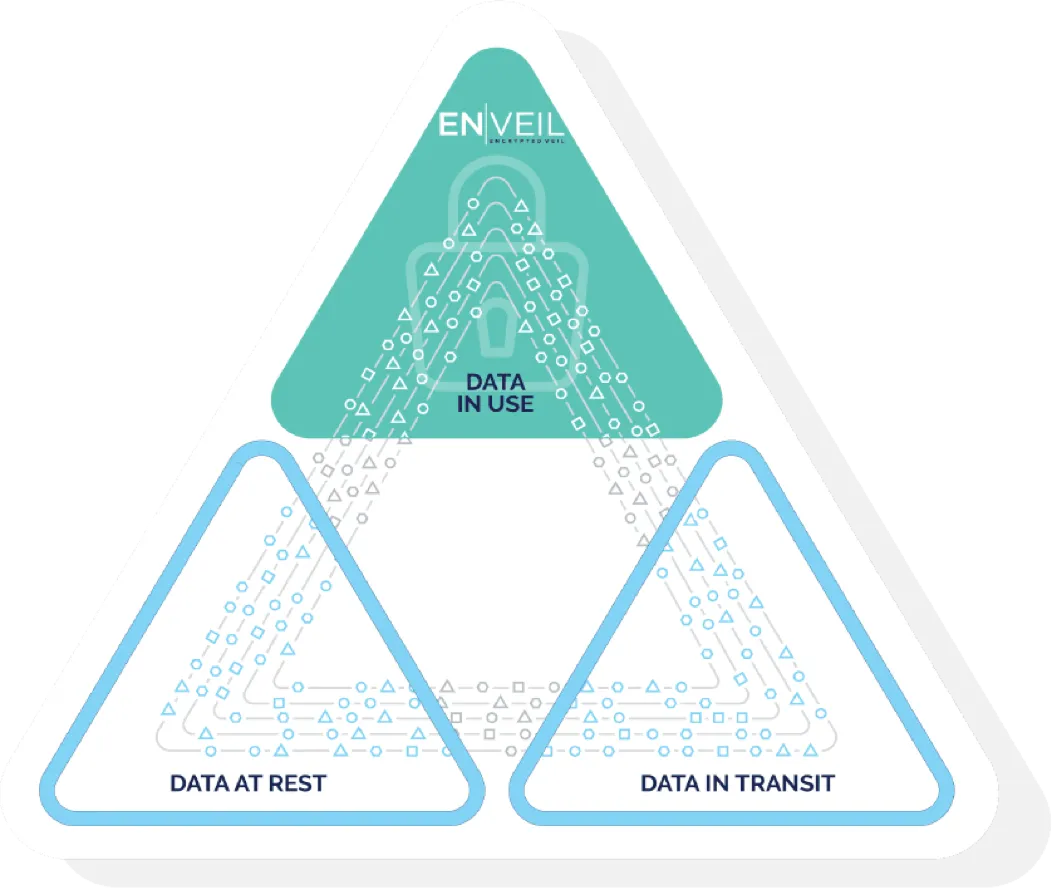
The hardest part of keeping a secret is doing something useful with it. A database may be encrypted while parked on a server and encrypted again while traveling over a network. Then an analyst asks a question, the system opens the envelope, and the sensitive bits appear in working memory. Security people call this “data in use.” Enveil built a company in that awkward moment.
Its flagship product, ZeroReveal Search, lets a user search, cross-match, watchlist, or analyze data without showing the data owner what the user is looking for. The owner does not hand over a complete database. The searcher receives only the authorized result. The query, result, and underlying records remain protected during processing. It is a neat inversion of the cloud era’s usual instinct: instead of hauling every valuable dataset into one trusted warehouse, send protected computation toward the data.
A mathematician leaves the building
Ellison Anne Williams did not arrive at cybersecurity by learning a catchy acronym. She trained in pure mathematics, earning a doctorate in algebraic combinatorics plus graduate degrees in set-theoretic topology and computer science. She then spent roughly 12 and a half years at the National Security Agency and Johns Hopkins Applied Physics Laboratory. There she encountered homomorphic encryption, a class of techniques that allows computation on ciphertext. Run the right operation on encrypted material and, once an authorized party decrypts the result, it matches what ordinary computation would have produced on plaintext.
The promise had floated around cryptography for decades. The product was the problem. Williams has described early homomorphic encryption as painfully slow, bulky, and expensive. She helped develop a more parallel approach, then took the core through the NSA’s technology-transfer process. Enveil launched in 2016. The name is short for “encrypted veil,” which is either charmingly literal or the rare security-company pun that survived procurement.

That reaction matters because the first failure was not a bad logo, a wrong pricing tier, or a feature nobody clicked. It was practicality. Academic cryptography could prove the operation was possible while taking too long or consuming too many resources for a useful workflow. Enveil’s change of mind was to stop treating homomorphic encryption as a universal magic trick. The company focused on defined operations such as search and equality matching, parallelized the work, and wrapped it in software that sat above existing data systems.
The proxy is the product
ZeroReveal is a two-party system. The Client lives inside the searcher’s trusted environment. It encrypts a database query, watchlist, analytic, or machine-learning model. The Server sits where the target data lives. It processes the encrypted operation without learning its contents, then sends back an encrypted response. The Client handles authorized decryption. Standard APIs connect the pieces, and the source database does not need a wholesale conversion into some new proprietary storage format.
This architecture explains both the differentiation and the sales pitch. Data clean rooms usually create a governed place for parties to bring selected data. Confidential computing uses protected hardware environments. Tokenization substitutes sensitive values. Differential privacy adds carefully calibrated noise to aggregate outputs. Enveil’s preferred lane is decentralized computation: leave the asset under its owner’s control and hide the other party’s interest. The company also uses secure multiparty computation and trusted execution environments where the use case calls for them. It is selling a toolbox behind a sharply phrased promise, not loyalty to one mathematical hammer.
Who pays to hide a question?
Banks are the cleanest example. A financial institution may want to know whether a prospective customer appears in another institution’s risk intelligence, yet neither side can casually disclose customer records, investigative methods, or the very subject of a search. Enveil says its software can support cross-jurisdictional KYC, anti-money-laundering work, fraud detection, and customer due diligence without creating a pooled copy. The useful output is a better lead, not a free tour of somebody else’s database.
Healthcare has the same geometry with different nouns: patient records, research datasets, regulated identifiers, and institutional boundaries. Government adds classification levels and contested networks. In 2024, the U.S. Army selected Enveil for Project Linchpin, an effort to create a trusted AI and machine-learning operations pipeline. The stated use includes taking a model trained on sensitive data, encrypting it, and evaluating it against information in lower-trust or third-party environments, including at the tactical edge.
A Defense Innovation Unit project pushes the pattern into orbit. Enveil’s Hybrid Space Architecture work supports secure search and analysis across commercial and government space-data holdings. Its 2024 integration with Figure Eight Federal applies encrypted search to a global location-data feed. Vertosoft distributes the software through public-sector procurement channels. AWS supplies a cloud partnership. Mastercard, Capital One, and USAA have the unusual double role of strategic investors; Williams told TechCrunch in 2022 that those large backers were also paying customers.
The price of making theory behave
Enveil does not publish a menu of per-seat prices. This is enterprise and government software sold through demos, direct engagements, integrations, distributors, and contracts. The visible cost is the capital required to make difficult math boring enough for production. Enveil raised more than $5 million in early strategic backing, a $10 million Series A in 2020, and an oversubscribed $25 million Series B led by USAA in 2022. Total disclosed funding passed $40 million. The company said revenue had grown more than 300 percent between the Series A and Series B, but as a private company it does not publish audited revenue.
The money bought more than faster equations. Enterprise buyers need deployment support, integrations, auditability, procurement routes, and independent assurance. In 2018, ZeroReveal became the first Data in Use security product to achieve NIAP Common Criteria certification, followed by placement on the NSA’s Commercial Solutions for Classified list. Enveil was named a 2020 World Economic Forum Technology Pioneer and later a Gartner Cool Vendor. These badges do not make an algorithm faster. They make a risk committee less lonely.
Product expansion followed trust. ZeroReveal Machine Learning arrived in 2020 with encrypted evaluation. Encrypted Training, or ZMET, followed in 2022, using secure multiparty computation to support federated learning across distributed datasets. Search 6.0, released in July 2025, added scheduled queries, broader data support, improved cloud and server integration, and a smaller form factor for edge and Internet of Things deployments. Enveil reported processing more than a gigabyte per second per thread, with many searches on commodity hardware constrained by memory bandwidth rather than homomorphic-encryption overhead. That is a wonderfully unglamorous milestone: the exotic math becomes less annoying than the computer around it.
What builders can steal
The copyable part is not the NSA pedigree. It is the sequence. First, choose a costly boundary where the customer already wants an answer but cannot move the data. Second, shrink the breakthrough into a narrow operation with measurable value. Third, fit above existing infrastructure instead of demanding a database migration. Fourth, certify the risky layer. Only then widen the product from search into analytics, training, and evaluation.
It works best when
- The data cannot legally or safely be pooled.
- The operation is defined and repeatable.
- Hiding intent matters as much as hiding records.
- A better answer has clear financial or mission value.
It is a poor fit when
- Centralization is already safe and cheap.
- The workload needs arbitrary, changing computation.
- Extreme latency or tiny hardware budgets dominate.
- Bad identity, permissions, or governance is the real problem.
The conditions are important. Cryptography cannot decide whether an employee should have asked the question. It cannot repair poisoned source data, vague consent, sloppy access control, or a model that should never have been deployed. Advanced encrypted computation also carries integration and compute overhead, even when optimized. If ordinary controls can safely centralize the data, the clever approach may be unnecessary. If the desired computation changes every week, a purpose-built encrypted workflow may become a corset.
Where Enveil fits: between foundational cryptography libraries and broad data platforms. It competes with privacy-computation specialists such as Duality, Inpher, Decentriq, TripleBlind, and Zama, but its real alternative is often procedural: copy the data, create a clean room, restrict the analysis, or abandon the question.
The useful secret
Enveil’s mission is ambitious, but its product logic is practical. Data becomes more valuable when combined, and more dangerous when exposed. The company charges into that contradiction with a proxy, a stack of certifications, and math that has spent years learning table manners. Its customers are not buying invisibility. They are buying permission to do work that policy, ownership, or classification previously made too awkward.
That is the payoff behind the $40 million bet. The future of data collaboration may not be one enormous warehouse with perfect guards. It may be a collection of stubbornly separate databases that can still answer one another, selectively, while keeping their mouths shut.