Fourteen minutes is an awkwardly precise amount of time. It is longer than a polite pause and shorter than most meetings. For eMindful, it became a way to sell something difficult to package: the habit of paying attention. Its One-Percent Challenge asked people to practice mindfulness for roughly one percent of the day, every day, for a month. The arithmetic was modest. The behavioral request was considerable.
- The offer: eM Life combines live mindfulness teaching with recorded practice.
- The buyer: employers, health plans, benefit partners, and individuals.
- The distinction: a teacher, a timetable, and outcomes measurement sit beside the content library.
The company’s daily sessions make that request tangible. Mindful Dailies last 14 minutes; live classes run multiple times a day. Someone can choose a session, join a teacher, and practice. A recording remains available when the calendar misbehaves. There is an appointment to attend, rather than an endlessly negotiable intention to become calmer sometime after lunch.
Approximately 1% of a day.
A small appointment with a stubborn habit.
A Wall Street education in attention
Founder Kelley McCabe Ruff came to this work with an unusually relevant résumé. She had held senior technology roles at Salomon Brothers, Lehman Brothers, and Citigroup, and had practiced mindfulness since 1997. Technology executives understand systems. They also spend a great deal of time watching intelligent people struggle to behave sensibly inside them.
Her company offered live, webinar-style courses to major employers and health insurers. McCabe Ruff collaborated with researcher Ruth Wolever and Aetna to investigate programs addressing stress and metabolic syndrome. This placed mindfulness in a particular setting: an organization with employees, health costs, and a reason to ask whether a pleasant experience produced a measurable change.
The resulting business occupies the space between personal meditation and workplace health benefits. Its subject is everyday behavior: stress, sleep, eating, relationships, and the decisions people make while managing chronic conditions. An employee seeking help with stress and a benefits manager buying population-wide access approach the same platform with quite different questions.
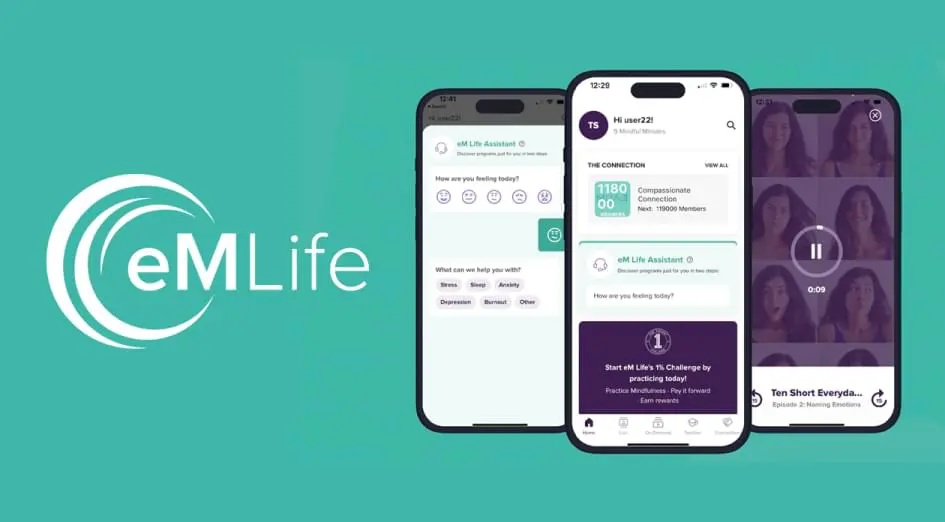
The public platform separates live programs from daily practice and offers sessions with one episode or several. Its registration flow distinguishes personal accounts from employee accounts. Those are useful choices for a prospective user: first identify the route through which you have access, then choose between a scheduled class and a recording. The product makes room for both an introduction to mindfulness and a practice repeated around an ordinary working day.
The library did not explain everything
In January 2022, researchers published an observational analysis of eMindful’s workplace challenge in the Journal of Medical Internet Research. There were 8,341 registrations across 44 companies. Live participation was associated with reduced perceived stress; recorded sessions alone did not account for the same improvement. Regular practice helped, and recordings could supplement live instruction.
That finding supports a narrower, more useful claim than declaring a winner among meditation apps. Delivery deserves attention. A recording supplies guidance whenever someone wants it. A live session adds a particular time, a teacher, and the possibility of interaction. The results are consistent with that distinction, although they cannot establish which ingredient caused the difference.
28.9% completed both assessments. Enrollment and measured follow-up are different counts.
Follow-up was incomplete, participants selected their own activities, and eMindful supported the research. These qualifications matter. The study offers evidence about this program’s use in the workplace, rather than a guarantee for every employee. It also gives buyers a practical question: how many people who sign up come back, and how many remain available to measure?
The buyer sits in benefits
Distribution helps explain eMindful’s commercial choices. The company sells access through organizations and partners while also offering personal accounts. In September 2021, Carebridge announced that its employee assistance clients and dependents could add unlimited eM Life access. The offer included live sessions and hundreds of hours of recorded material. An existing benefit became a route to a new practice.
For employees, this can put mindfulness alongside familiar support services. For the vendor, it provides a channel into an organization without requiring each person to discover the product independently. The business needs both audiences: people willing to practice and institutions willing to sponsor access. A beautiful meditation recording cannot negotiate a benefits contract.
In October 2016, eMindful raised a $6.85 million Series B led by LFE Capital. The stated uses were engagement marketing, new product development, and sales expansion. That allocation is revealing. The work included attracting participants and reaching buyers, as well as improving the instruction they would receive.
Wondr Health acquired eMindful in July 2021. Wondr’s existing focus was weight management and chronic disease prevention; eMindful brought mindfulness into the combination. Then-CEO Rob Butler called mindfulness “one of the most effective tools of behavior change.” The strategic idea was to connect emotional well-being with the physical habits already addressed by Wondr.
“Mindfulness is one of the most effective tools of behavior change.”
Rob Butler / Wondr Health CEO at the 2021 acquisition
Give the habit somewhere to go
eMindful also experimented with motivation beyond personal improvement. Its 2022 challenge matched practiced mindfulness minutes with charitable giving through The Connection. Rewards included mentoring sessions and trees planted in a participant’s honor. A private practice acquired a public destination. For someone unmoved by another promise to feel better, that supplied a different reason to return.
The company applied some of its wellness thinking internally, too. In 2021 it reported free staff access to eM Life, volunteer time, walking meetings, remote-work options, and unlimited paid time off. Those historical benefits are more informative than a declaration that a company values balance: they describe what it actually offered employees.
The lesson readers can borrow is practical. Make the desired behavior short and specific. Give people a person to learn from and a time to begin. Let recordings support repetition. Measure return visits and outcomes alongside enrollment. This approach depends on people having the time, access, and willingness to attend; an inconvenient live schedule can defeat a sensible curriculum.
A sensible workplace trial would therefore start with the calendar as well as the curriculum. Ask whether shifts, meeting schedules, and time zones allow people to join. Decide in advance what improvement would count, and keep track of people who stop participating. These are recommendations drawn from the model and its measurement limits. They give a buyer something firmer to discuss than how many videos a vendor can put behind a login.
For a benefits buyer comparing eM Life with Headspace, Calm, or an independent mindfulness teacher, the useful question is what kind of learning the workforce needs. eMindful’s answer preserves live instruction inside a digital product. The screen distributes the classroom. The teacher gives people a reason to enter it.