A hospital instrument has an administrative life almost as complicated as its medical one. It must be processed, located, recorded and ready for the next procedure. The software following that journey is hardly glamorous. But glamour is a poor qualification for a system whose users need the right thing in the right place.
In a historical Embarcadero case study, Getinge’s T-DOC sterile supply system had reached four million lines of source code. It served 1,200 hospitals in 44 countries. Its developers had a choice familiar to anyone responsible for an old, useful application: replace the machinery, or keep extending it. They stayed with Delphi.
- The business: paid tools for designing, compiling and maintaining native applications.
- The attraction: visual interfaces, database access and existing code that can keep earning its keep.
- The catch: language, platform and license choices matter before the first screen is drawn.
That decision gives Embarcadero a more interesting identity than a list of software boxes. The company sells productivity, certainly. But its particular currency is continuity. A working application contains years of decisions about how a business operates. Starting over can mean paying to discover them again.
The expensive thing hiding in the source code
Getinge’s chief architect, Lars Sondergaard, put the attraction plainly. The team had expanded a small system into a large one while continuing to use the same development tool. Database access, compatibility and a shared codebase helped it add capabilities without repeatedly rebuilding its foundations.
“We have never had to rewrite the T-DOC system”Lars Sondergaard · Getinge chief architect · historical customer account
This account belongs to the Delphi XE7 era. It records one customer’s experience, rather than predicting every hospital’s results with a current release.
What changed the team’s mind about replacing Delphi? In the account, nothing sufficiently persuasive arrived. The burden of proof stayed with the proposed replacement. That is a rather sensible reversal of the usual technology conversation, in which the newest tool is permitted to arrive wearing a crown.
A database company inherits Borland’s workbench
Embarcadero’s own beginning was in databases. Incorporated in 1993 under the name Client Worx, it became Embarcadero later that year and introduced Rapid SQL in December. Early tools addressed Sybase and Microsoft SQL Server. ER/Studio subsequently broadened the database story with support for several vendors.
The pattern was already visible: make complicated technical work easier without requiring customers to live inside one supplier’s system. The company went public in 2000 and private again in 2007. Then, in 2008, it bought Borland’s CodeGear developer-tools business. Delphi and C++Builder joined the portfolio.
One price deserves its footnotes. Borland’s May 2008 SEC filing described an approximately $29.8 million purchase price, less CodeGear accounts receivable expected to total $7.4 million, with a working-capital adjustment still to come. That was an announced transaction structure, not a clean final cash figure. In 2015, Idera announced an agreement to acquire Embarcadero; those terms were undisclosed.
Today, the company is an Idera business. Its development tools occupy a specific corner of the market: professional teams building substantial native software, often with existing Delphi or C++ investments. This is a different purchase from choosing a text editor. It is a decision about the workshop around the code.
The workshop, and its different doors
RAD Studio combines Delphi and C++Builder in an integrated development environment. Developers design interfaces visually, write business logic, connect data, compile and debug. The convenience lies in having these jobs within a coordinated set of tools. Dragging a component onto a form may save time; the component’s behavior and integration matter more than the gesture.
Delphi uses Object Pascal and is marketed for native applications across Windows, macOS, iOS, Android and Linux. The Visual Component Library, or VCL, serves Windows development. FireMonkey supplies the cross-platform interface route. Supported targets and features depend on the edition and toolchain. A single codebase is a starting advantage, not permission to skip platform-specific testing.
C++Builder supplies a visual development environment for modern C++, with current product positioning focused on Windows applications. Buyers should resist treating every RAD Studio platform claim as a promise for both languages. The bundle contains different doors, and those doors do not all open onto the same street.
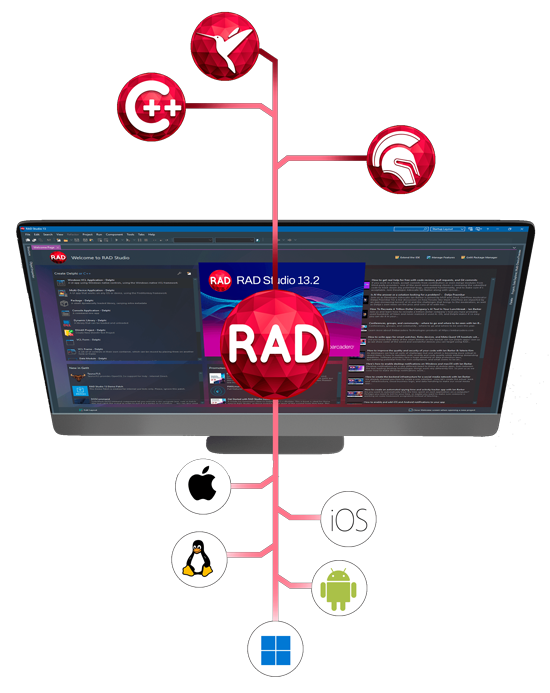
Beyond the interface, InterBase supplies an embedded or server SQL database with encryption, recovery and change tracking. Its Change Views feature supports synchronizing data changes. RAD Server lets developers publish application services through REST APIs, with on-premises or cloud deployment. Together these products offer routes from a screen to stored data and a back end, rather than merely supplying the screen designer.
The robot that already spoke Pascal
Storojet offers a second, pleasingly physical example. Its automated warehouse system uses autonomous storage robots, elevators and a central controller. The company chose Delphi because its developers already had experience with the technology. The system was first presented publicly in 2019.
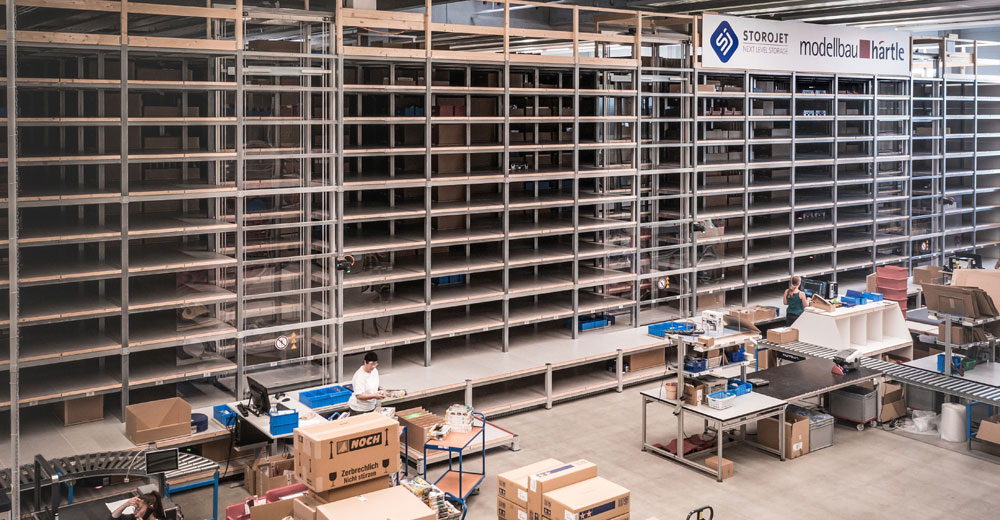
The case’s best detail is the compromise. The robots use small Linux computers. Their Object Pascal code was generated through a parallel development project, then compiled with Free Pascal and distributed over Wi-Fi. The central system was written in Delphi. That distinction matters: this was a practical combination of tools, rather than a claim that one commercial compiler did everything.
The lesson travels well beyond Delphi. Existing expertise can be an engineering asset. Storojet adapted familiar skills to a new deployment problem instead of making unfamiliarity a condition of progress. Readers can copy the decision process: identify what the team already knows, separate central services from device code, and test the actual deployment path.
The license bill has company
Embarcadero earns money through commercial software licenses, renewals and associated support, sold directly and through resellers. RAD Studio has Professional, Enterprise and Architect editions. Paid IDE purchases include a perpetual license for the purchased version and a first year of Update Subscription, which provides updates, upgrades and support benefits.
There is a free entrance, with limits. Delphi and C++Builder Community Editions are available separately for eligible users. Embarcadero’s upgrade guidance specifies annual revenue below US$5,000 and fewer than five developers. At the threshold, a paid edition is required. A small project should check the EULA before mistaking a free download for an unrestricted company license.
RAD Studio 13 Professional, with one year of maintenance, in Embarcadero’s published Japanese price-change table. Listed excluding tax from April 1, 2026; regional pricing and edition choices differ.
The relevant comparison includes the rest of the work. Visual Studio and .NET are alternatives for Windows development; Qt is an option for C++ interfaces. Flutter, Electron and individual platform tools enter the conversation for other application types. These are project-dependent choices, not interchangeable products. A paid component library can save integration effort, while an established team on another stack may have little reason to move.
Now the old code has an AI visitor
On May 28, 2026, Embarcadero introduced Kai, a paid AI add-on for RAD Studio, Delphi and C++Builder. Its pitch reaches beyond completing a line: an agent can work with project context, generate code and interfaces, compile, inspect errors and assist with fixes. Model and agent choice are part of the product, including local options.
RAD Studio 13.2 followed on September 17 with compiler, platform and interface improvements, including LLVM 20 for the Delphi Linux Intel 64-bit compiler and expanded Windows on Arm capabilities. The direction fits the company’s existing business: make established applications easier to modernize.
What failed first in the new AI workflow? The September 25 Kai 1.1.1 maintenance notes identify concrete rough edges: local-model integration, file creation and unit modification, and MCP configuration usability. The update refined those areas. Embarcadero also says results depend on context-window size, tool-calling capability and the local inference setup. An offline model still needs the capacity to understand the work.
For a prospective customer, the practical experiment is modest: take one representative application, compile it, connect its real database and try a contained change. Measure the effort and review the output. Continuity is valuable only when the application still fits its job. Embarcadero’s interesting wager is that an old codebase can acquire new abilities without first being granted a funeral.
Open the workshop
Explore the tools, sample projects and people behind them.