Elyce Arons had been looking for her fisherman sweater for years. Then Kate Spade cleaned out a closet. Among the bags of clothes offered up for Arons and her daughters sat the roll-neck sweater Arons remembered from college. It had spent roughly three decades with her best friend. This is an unusually effective way to preserve knitwear, provided you are willing to endure a rather long loan period.
The sweater eventually became a Frances Valentine design and sold out. In that small domestic comedy lies a useful introduction to Arons, the company’s co-founder and CEO: she notices what lasts, remembers who wore it, and sees a reason to make it again. A garment can carry a friendship across thirty years. It can also, with the right adjustments, find a customer who has never heard the original story.
Arons has co-founded two fashion companies and written a memoir. The public name on the first company was Kate Spade; the private name for her friend was Katy. Keeping those two perspectives in view gives her story its particular texture. She helped build the business people could see while living the friendship they could only glimpse. Today, the clothes, the book and her increasingly visible presence on camera bring those worlds together.
Parachute pants meet a popped collar
They met at the University of Kansas in August 1981, on move-in day at GSP Hall. Katy Brosnahan dressed in a polo shirt, khaki shorts and loafers. Arons arrived with purple parachute pants and green, pointed boots. Their clothes were making different arguments. Their sense of humor soon settled the matter. They liked practical jokes, vintage shopping and the same television heroine.
Mary Richards, the working woman at the center of The Mary Tyler Moore Show, had made journalism look like a life worth pursuing. Both young women studied it. Before there were bags to ship or collections to plan, there were walks to class, shared ambitions and the possibility of earning a living together. The eventual business did not arrive fully formed. They considered a travel agency and a vintage shop. Taste was the common interest; the commercial shape was still up for discussion.
Arons came from a working farm near Sedgwick, Kansas, the youngest of four daughters. Wheat and Angus cattle were part of the family’s daily business. Fashion was present too: her mother illustrated clothes for Wichita retailers and brought a designer’s eye to the household. A farm and a fashion magazine might seem like unlikely companions. In Arons’s childhood, they belonged to the same address.
Her mother later turned the farmhouse into a restaurant. Arons remembers strangers recommending it to her without realizing whose daughter they were addressing. There was a practical example of enterprise at home, alongside the chores. As her mother reminded the children, “the cattle don’t know it’s your birthday.” Work happened before celebration. That rule has a certain agricultural bluntness, and a fair amount of relevance to running a company.
After two years at Kansas, Arons and Brosnahan transferred to Arizona State University. Andy Spade entered their circle there. New York followed. The friendship had survived a change of campus and was about to face a considerably more expensive change of scenery.
The bag was simple. The work was considerable.
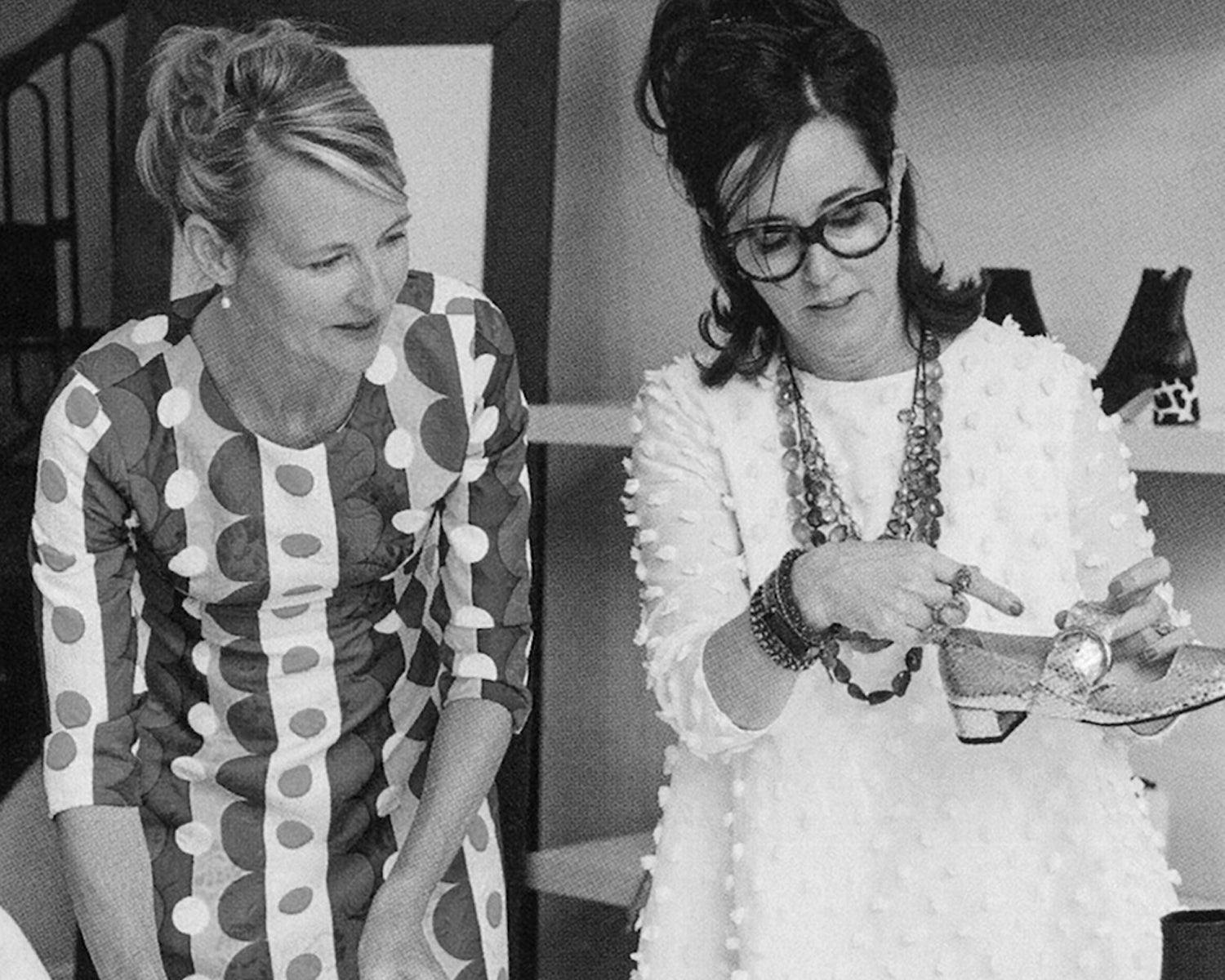
Arons began her career in publicity and marketing. Her fashion jobs included J.G. Hook and Marithé + François Girbaud, while Katy worked at Mademoiselle. Those years gave them different views of the same industry: one worked on communicating and selling fashion, the other on finding accessories that made sense in a photograph. A future company was accumulating useful experience before anyone called it a company.
Katy wanted a straightforward American handbag: clean shapes, accessible pricing, something a woman starting her career could buy. The market offered plenty to admire, but did not reliably offer the bag she wanted. The early work involved craft-paper shapes and finding a pattern maker and manufacturer through the classified pages of Women’s Wear Daily. It was an unromantic route to a product with considerable visual charm.
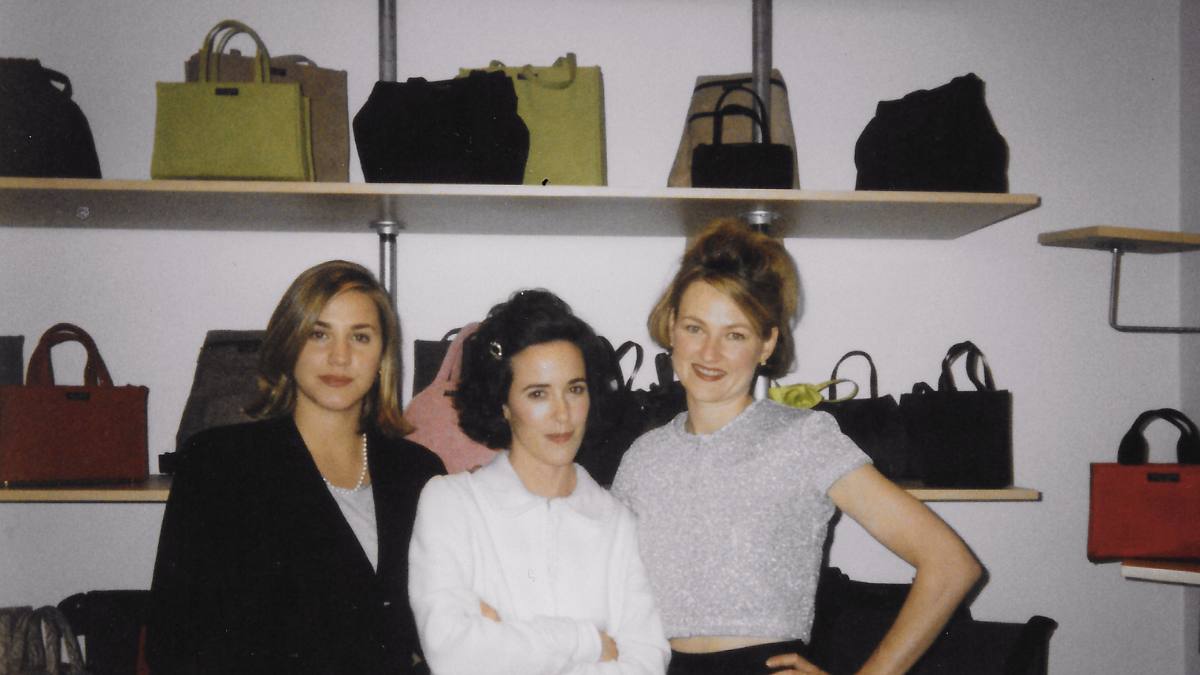
Kate Spade launched in 1993 with four founding partners: Katy, Andy Spade, Arons and Pamela Bell. The company began in a New York apartment. Its early story is often compressed into the pleasing image of a clever bag becoming a familiar name. That compression leaves out the difficulty of persuading suppliers to work with a small company whose founders were learning how to manufacture their idea.
The experience also changed what success felt like. In 1995, Vogue came to photograph the team at their office on 29th Street. Arons remembers borrowing the top Katy had worn to her wedding and having her makeup done professionally for the first time. A magazine shoot could still feel wonderfully improbable to someone who had come from Kansas. Borrowing a friend’s clothes remained entirely normal.
The business expanded into a wider world of products, from shoes to stationery and home goods. Neiman Marcus bought a majority stake in 1999; the founders exited in 2006. For Arons, the decision also belonged to family life. She had three daughters, and after years in which weekends and weekdays had blurred together, time had acquired another value. The work had mattered enormously. So did having the chance to leave it for a while.
University of Kansas
Four founding partners
Shoes and handbags
A friendship in print
A second company, with room for the old clothes
The wish to make things returned. Arons recalls a birthday dinner in 2012 with Katy and Andy Spade and her own husband, also named Andy, when the conversation turned to starting again. By 2016, Frances Valentine had launched. The new company began with shoes and handbags, carrying forward the founders’ appetite for color and their preference for things they actually wanted to wear.
Time as shoppers had sharpened their thinking. A desirable design and an acceptable price did not always meet on the same shelf. Starting another business gave them a way to put those qualities together. Prior experience helped, but the retail landscape had changed. Selling online brought another set of decisions and another education. A successful first company did not remove the need to learn the second one.
Katy died in 2018. Arons continued leading Frances Valentine, and clothing gradually became part of its story. Two pieces provided the opening: an embroidered caftan Katy had worn on vacations and an embroidered sweater found years earlier at a thrift shop. They were remade for the Love Katy collection. Customers bought them, then bought the next production runs, and began asking for other clothes visible in the campaigns.
A swing coat and cigarette pants followed. That sequence matters. The move into apparel grew through specific garments and customer requests. The old wardrobe supplied ideas; customers helped decide how far those ideas could travel. Arons’s task was to carry a recognizable sensibility into more categories without treating every new category as an excuse to abandon it.
Frances Valentine’s founder page describes a company built around lasting friendship and personal confidence. Those ambitions become more persuasive when attached to actual clothes: a sweater worth recovering, a caftan worth repeating, a coat someone has asked to buy. The sentiment has something practical to do. It must become a garment that fits, wears well and earns its place in another person’s closet.
A caftan and a sweater opened the door to apparel at Frances Valentine.
Gold counts as a neutral
Ask Arons for an uncommon neutral and her answer is “Gold!” She mixes eras and genres rather than keeping everything obediently within one period. In conversation with Barbara McLaughlin, she described personal style as something learned through trying things on, taking risks and making mistakes. There is room in that view for a bad outfit. It is part of the education, ideally preserved in as few photographs as possible.
Her interest in interiors follows the same appetite. She has written about Dorothy Draper and the Greenbrier’s exuberant decorative world as influences on Frances Valentine. Her New York home mixes antiques, contemporary furniture, art, color and prints. The relationship between a room and a wardrobe is easy to see: both can be assembled over time, with enough confidence to let objects from different decades get along.
Arons’s advice to young people also has a familiar tone: “Be kind to everybody.” She talks about relationships returning in unexpected ways, and the importance of respecting the people one meets. For a business rooted in a long friendship, that counsel carries particular weight. Being gracious is an everyday practice. It affects how people remember a workplace long after they have forgotten its seasonal collection.
“Be kind to everybody.”Elyce Arons
The next find is still out there
In June 2025, Gallery Books published We Might Just Make It After All: My Best Friendship with Kate Spade. The memoir became a New York Times bestseller. Its title recalls the television show that had helped point two college friends toward a working life. Arons also narrated the audiobook, giving the recollections her own voice rather than handing that job to somebody else.
The book made room for the apartment years, the shared adventures and the ordinary exchanges behind a publicly familiar fashion name. Arons has spoken about laughing while looking through old photographs and wanting to preserve details before they faded. Writing extended the work of remembering beyond a clothing collection. Readers could follow the friendship through rooms and conversations a handbag label could never contain.
The public work has continued. Arons returned to the University of Kansas in September 2025 for a campus visit and fireside chat. LIM College announced her as its 2026 commencement speaker and honorary-degree recipient. Inc. lists her among its Female Founders honorees for 2021, 2025 and 2026. These are different settings for the same accumulated experience: a business career now being shared with readers, students and other founders.
By October 2026, the vintage hunt had become a series of its own. Mission Vintage follows Arons through shops in four YouTube episodes, showing how found pieces can feed new designs. The project grew out of a habit of visiting vintage stores while traveling. It also puts independent shop owners and collectors in the frame. Her travels have supplied more than a calendar of appearances; they have supplied places to look.
That makes a fitting next chapter for someone whose friendship began, in part, with secondhand clothes. Arons is still interested in the detail that makes a piece worth picking up, the shape that deserves another life and the person who will want to wear it next. The fisherman sweater took thirty years to come back. Fortunately, she has other things to look for while she waits.
Spend a little more time with Elyce
Read We Might Just Make It After All, explore Essentially Elyce at Frances Valentine, or follow her on Instagram and LinkedIn.