At 8:47 on a Tuesday night, a child is stuck on fractions. A parent is tired, the teacher is elsewhere, and nobody has time to become a curriculum designer. The rescue may be a sheet of paper. It may also be a pancake flipping game. Education.com has spent two decades betting that the useful answer matters more than the grand theory of education.
- Education.com offers printables, games, lesson plans and guided digital work for pre-K through eighth grade.
- Parents, teachers and homeschoolers use the same library for different moments of the day.
- A free membership samples the catalogue; Premium opens unlimited content and assignment tools.
- IXL Learning acquired the company in 2019, after it reported serving more than 23 million adults.
The name sounds almost suspiciously broad. In 2008, the company really was broad: its pitch included reference articles about bullying and school readiness, parent discussion boards and SchoolFinder, an application for researching schools. It was a destination for adults worried about a child’s education. A $9.75 million Series B led by California Technology Ventures backed that ambition, with Azure Capital Partners and TeleSoft Partners joining the round.
The press release from that period also described advertising to brands that wanted to reach parents. That was an understandable business: gather a large audience, offer information, sell attention. But a parent searching for advice and a teacher preparing tomorrow’s lesson share a more urgent problem. They need something they can use. Education.com’s later product choices followed that mundane truth.
The printable was a signal
When Education.com launched Brainzy in 2014, it said people were downloading 20 million worksheets a year from its site. The number is historical, but the behavior is revealing. A worksheet is a tiny commitment. Search, print, hand it over, begin. Every download was also a clue about the subject, grade and skill that an adult needed help with right then.
Brainzy turned that evidence into a guided digital learning world for children aged three to seven. It arrived with more than 300 games, videos and read-along stories, a sequence of early reading and math skills, and a cast that included Officer Ice Cream and Penelope Pegacorn. The characters were silly. The reasoning was practical: children might keep playing, while adults could see a progression instead of a pile of unrelated games. At launch, a monthly subscription cost $6.99; the annual plan was advertised at an equivalent of $3.99 a month. Those are 2014 launch prices, not current prices.
“Brainzy emerged from a longstanding dialogue with educators and parents about their supplemental education needs.”Greg Goff, Education.com president, 2014
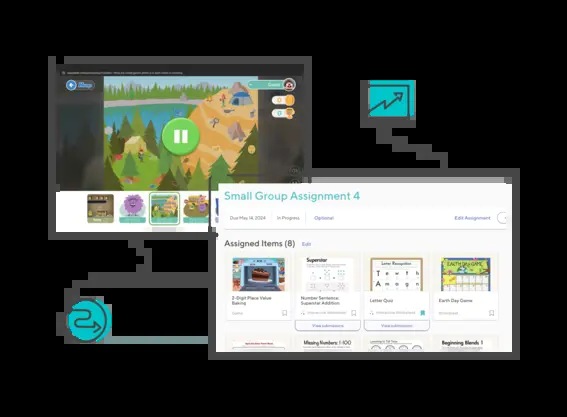
This is the company’s most useful product idea: the worksheet can become several things without losing its job. It can be printed, assigned, played, or turned into a digital exercise. Education.com later organized essential math and language arts skills into Guided Lessons. Its interactive worksheets allow a learner to submit work digitally and receive immediate grading. A premium teacher can assign a game or worksheet, then inspect the result. The object changes form; the need for timely practice does not.
Three adults, one library
A parent wants to make an evening of homework less fraught. A teacher wants tomorrow’s class ready before the copier jams. A homeschooler may need an entire sequence, with activities and explanations at several levels. Education.com serves all three by indexing material by grade, subject and format. Its library covers math, reading, writing, science and social studies, plus hands-on activities and lesson plans. The site now lists roughly 41,000 resources; that is a current catalogue count, not a count of students or learning outcomes.
The combination makes the company different from a pure video course or an open marketplace of teacher uploads. Education.com packages a large, centrally organized set of materials and connects print with digital practice. Its free Basic membership gives users a small monthly sample of resources. Premium permits unlimited access and adds the richer assignment workflow. Schools and districts are also a named customer group for its standards-aligned supplemental program. Public materials do not establish a current Premium price, so the sensible shopping step is to check the live offer before subscribing.
That structure has limits worth remembering. A worksheet can reveal what a child gets wrong; it cannot, by itself, explain why. A game may make repetition tolerable; it does not replace a teacher’s judgment about what to teach next. And a family needing help with a child’s specific learning difficulty may need more than a searchable catalogue. Education.com works best as supplemental practice when an adult can choose a suitable resource and respond to the result.
The door into the classroom
The 2017 Nearpod partnership produced more than 300 interactive lessons, bringing Education.com’s content into a platform already used by schools. Its Renaissance alliance connected materials with assessment and planning. Then, in 2019, Education.com added Google Classroom sharing, roster import and sign-in. These arrangements answered a plain question: even an excellent lesson has little value if moving it into a teacher’s day is a nuisance.
The Google Classroom arrangement also illustrates a distinction shoppers can miss. Education.com’s support pages say a teacher can share work through Classroom, but scores and completion tracking for that route are limited. Its own Premium Assignments tool supplies the fuller tracking experience. The product is a bundle of content and workflow, and the route a teacher chooses changes what they can see afterward.
IXL Learning bought Education.com in November 2019. The sale price was not disclosed. At that point the company described more than 30,000 digital and printable resources and more than 23 million teachers, parents and homeschoolers served. The acquisition paired a broad resource library with IXL’s personalized learning business. In 2021, Education.com pushed beyond its original elementary concentration by adding math and English language arts for grades six through eight. Its 2025 Story Challenge drew entries from several countries, a modest reminder that a site built around everyday schoolwork had become a global destination.
What the worksheet knew
There is a lesson here for anyone building a service around expertise. Education.com did not need to persuade adults that learning mattered. They already believed it. The difficult part was finding a small, repeatable unit of help, making it easy to discover, and letting each use suggest the next product. The 20 million downloads were less a trophy than a map of where people were stuck.
The result is neither a replacement school nor a magic cure for homework. It is a practical shelf: a fraction game when a child needs another try, a printable when the Wi-Fi is sulking, a lesson plan when a teacher needs to begin. The domain promised all of education. The durable business came from doing one ordinary piece of it, over and over, at the hour people needed it.