Founder · Scientist · Engineer
Eduardo
Eduardo
Abeliuk
He looked at the lab bench and saw a software problem. So he built the software - and a company around it.
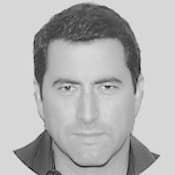
Eduardo Abeliuk · eyes on the genome
He looked at the lab bench and saw a software problem. So he built the software - and a company around it.
We're using the power of data science not just to understand biological processes, but to design them.
Before there were genomes, there was a Facebook app. While at Stanford, Abeliuk co-founded KissMe, a small social experiment built on the brand-new Facebook platform. It went off like a flare - roughly a million users in about four weeks - and was acquired within a year. He was, by his own account, part of Stanford's now-famous "Facebook Class," a course where students shipped apps to the world before the ink on the platform was dry.
The numbers were intoxicating, but the real takeaway was procedural: build the thing, ship it fast, watch what happens, automate the rest. He carried that reflex into his next venture, Classroom.tv - later Umine - an early online-instruction platform aimed at Latin America, well before MOOCs became a buzzword.
Then came the pivot that defines him. Deep in his PhD, planning experiments, Abeliuk kept running into grunt work. "I found myself wasting significant time performing tasks that I felt could be automated with good software." Most people grumble and keep pipetting. He started a company.
That was a strong motivation to start TeselaGen - to develop enterprise-grade software that could speed up R&D in biotechnology.
His doctoral work wasn't theory for theory's sake. It was the kind of computational biology that goes looking for things and finds them.
During his PhD he predicted novel small RNA molecules - one, CrfA RNA, tied to how bacteria respond to carbon starvation.
He helped develop a technique coupling high-throughput DNA sequencing with transposon mutagenesis to pin down which genes an organism truly cannot live without.
His thesis dug into bacterial cell division using high-throughput genetic and molecular biology techniques - the messy biology that later inspired clean software.
His work has appeared in peer-reviewed journals across molecular systems biology and genetics, racking up more than a thousand citations.
By integrating advanced technologies into our software platform, we aim to empower more research groups to conduct high-level studies in-house.
Knowing that our platform is being used to accelerate the next generation of cell and gene therapies is incredibly fulfilling.
These technologies are enabling faster, more accurate analysis of complex biological data - which can help us design better drugs, products, and processes.
DNA, after all, is a form of data storage, and the processes of life involve the transfer and interpretation of this data.
The resume reads like someone who couldn't decide between physics, electronics, and biology - so he refused to. The throughline is engineering: take a hard system, model it, then bend it to your will.
The endgame isn't one company's software. It's a world where a small research group can run experiments that today only a handful of elite labs can afford - where designing a drug, a product, or a process is a matter of intent plus good tooling. He wants to make biology something you engineer on purpose, not something you stumble into by trial and error.