Rain gave Dragos Bulugean something to do. In 2018, stuck in a hotel room in Frankfurt, he began coding a diagramming tool for software architects. There are less demanding ways to pass a wet afternoon. His choice would eventually become Archbee, although the first product did little to suggest that outcome. After a few months without traction, he scrapped it.
The interesting part of the story comes after the abandoned diagrams. He restarted with documentation for engineering teams, then polished that product and launched it on Product Hunt in 2020. It reached the top spot. But the customers' attention kept gathering around a comparatively modest feature: publishing their documentation on their own domains.
A founder can spend months building a product and discover that buyers have elected a minor feature to lead it. Bulugean followed their vote. By the next stage of Archbee, customer-facing documentation had become the focus. The diagrams had supplied the beginning; the publishing feature supplied a direction.
A buyer he could understand
Before that hotel room, there had been a more ambitious attempt. In 2015, Bulugean worked on an internal venture to predict sales for large fast-food chains using AI. He could build the software. Selling it was another matter. The prospective market included McDonald's, Wendy's and 7-Eleven, companies whose purchasing processes require more than a convincing demonstration.
He later described lacking the skills, understanding and time to navigate their long sales cycles. It was a useful admission for someone hoping to build a substantial business. An impressive prototype did not shorten the distance between a working model and an enterprise purchase.
Software developers offered a different starting point. He understood their work and the problems that interrupted it. During consultancy projects, he had watched technical knowledge become difficult to share as teams expanded. Experience had given him access to the problem before he had a product to sell.
His early thinking shifted toward founder-market fit: the connection between a founder's experience and the people buying the product. The phrase helped him name an instinct he already had. In this account of his career, the first commercial setback becomes a practical filter for the next idea. Choose a customer whose frustrations you can recognize without arranging a briefing.
The backend developer learns to face forward
Bulugean's route to building an entire application ran through a change in his own skills. He had worked in backend Java, then tried Angular in 2013. He enjoyed it, returned to backend work with Node.js, and initially doubted that React would become widely adopted. In 2015, reading about its philosophy changed his mind.
He learned React alongside his Java consultancy. That meant he could build a complete product himself when the diagramming idea arrived. His account puts the initial build at two months of spare-time work. The significance is pleasantly practical: learning the frontend removed a dependency. He could test an idea without first persuading another developer to join him.
He graduated from the automation faculty in Craiova in 2011. The later founder had therefore spent years doing the work his future customers did. By 2021, Archbee was operating from a Bucharest origin through AiurLabs, its Delaware-registered company, and had reported more than 100 customers worldwide.
Those details describe a business crossing borders without losing its technical roots. A founder educated in Craiova, a product developed in Romania, and customers elsewhere could meet in a browser. Documentation, at least, travels without a suitcase.
The ten-dollar beginning
His early engineering notes have the charm of a product assembled while its maker is still deciding what it should become. The diagramming experiment began partly because he wanted to learn SVG. It used JavaScript and a diagramming framework, with Node.js and MongoDB behind it. Hosting cost ten dollars a month on a machine in Germany.
A few people kept using it. Answering questions on Quora brought a small trickle of visitors, enough to keep the experiment going. This was a modest kind of encouragement, measured in returning users rather than a launch party. Small traffic still contains people making a choice.
When he moved toward a knowledge base for developer teams, he rewrote the frontend in React and Next.js and adopted strict TypeScript. He wanted a codebase he could work on for years, with other people eventually contributing. Even the database decision had a detour: a plan to develop with MySQL and switch back to PostgreSQL on deployment did not work out. MySQL stayed.
He also wrote openly about depending on open-source software while contributing little back. That admission adds texture to the founder's technical story. The application was his, but much of the machinery making it possible had been built by other people.
The hosting bill for the original diagramming project. A historical detail, not Archbee's current operating cost.
Customers choose the next version
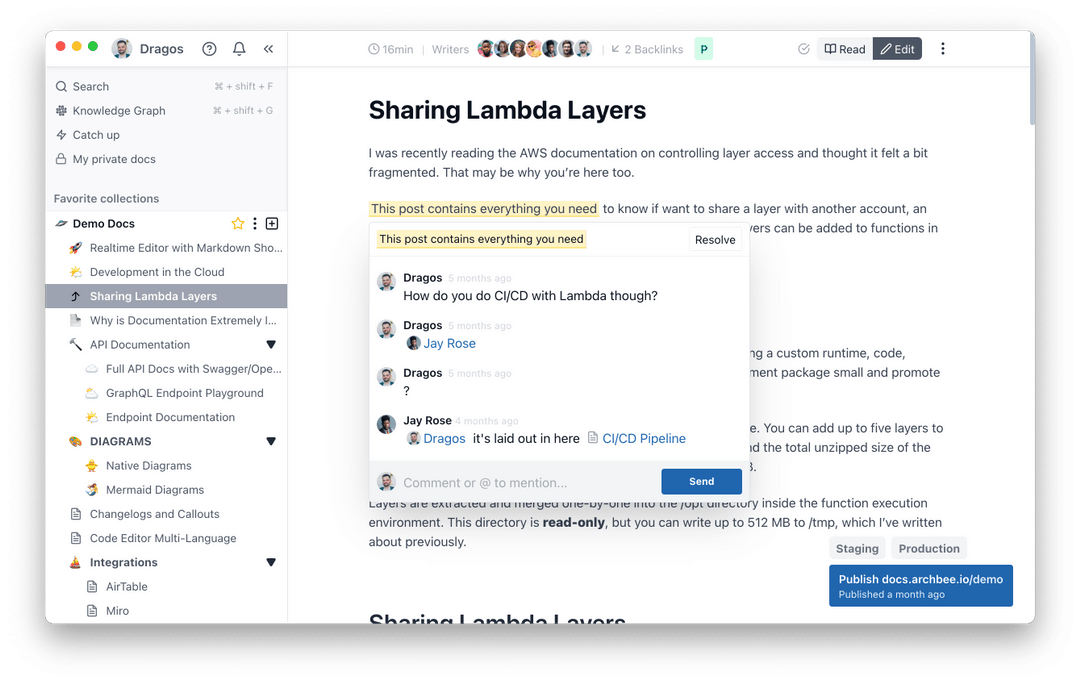
The changes in Archbee make more sense as successive answers to usage than as a single master plan. The internal documentation version collected API references, Markdown, diagrams, changelogs and GitHub integration. It attracted some customers, but Bulugean's later account was frank about the limited traction.
The next version improved the experience and brought the Product Hunt launch. The discovery that publishing was drawing interest changed the question. Instead of concentrating only on what a team knew internally, Archbee could help that team explain its product to the people trying to use it.
That move changes the stakes of a document. An internal note can save a colleague a question. A customer-facing guide can help someone complete an integration or understand a product without booking a call. Publishing makes the writing part of the product experience, with the company's own domain attached to it.
- 2018Diagramming experiment
- 2019Internal engineering docs
- 2020Product Hunt launch
- 2022Archbee 3.0 focuses on customer-facing docs
A team that answers its own tickets
By 2021, Bulugean was describing a remote team built around complementary abilities: backend development, frontend development and growth. He expected people to find their own way through unfamiliar tasks. He also set a specific requirement: every team member should spend at least a tenth of their time doing customer service.
For a documentation business, that arrangement is particularly apt. A support question demonstrates exactly where someone has become stuck. It puts the people building the product near the people using it, with fewer opportunities for a complaint to acquire a diplomatic translation on its way through the company.
His public answers also allow a small glimpse beyond software. Asked what he would do if he were not building Archbee, he suggested working for another startup or starting an esports team. The alternative still involves assembling people around a shared objective. It is also considerably more entertaining than another spreadsheet.
“It's a means to an end.”
Dragos Bulugean, on technology
That terse description of technology suits the decisions in his story. He learned what let him build, changed what customers did not use, and assigned time to hearing their questions. The tools matter because there is work to finish.
Confidence has a practical use
Archbee joined Y Combinator's Summer 2021 batch. Bulugean later explained the value in terms that reached beyond the accelerator's reputation: access to people experienced in starting and running companies, and the clarity and confidence that came with it. He also thought the association mattered to customers evaluating the young business.
That is a different challenge from shipping a working application. A buyer has to decide whether a vendor will be there to maintain it. The founder who once struggled to sell an AI prototype was now considering how trust affected the sale of a documentation platform.
In February 2022, he described plans to test acquisition channels and hire across development, marketing and sales. The early team included backend engineer Petre Sosa, frontend engineer Daniel Stefan and growth marketer Claudiu Dascalescu. The solo project had acquired colleagues with defined responsibilities.
His stated ambition was to make Archbee a command center for technical writing, including keeping documents relevant to the code and product components they describe. That ambition addresses the less glamorous half of publishing: somebody must continue caring for the page after the announcement has scrolled away.
The reader asks back
Archbee's current direction brings questions directly into its documentation portals. Its Y Combinator profile describes generative AI answering users and developers, with product and engineering teams at companies including Adobe, Cisco and Bosch using the platform. The early concern with sharing technical knowledge has expanded to helping readers retrieve an answer.
In a 2025 public post, Bulugean argued for treating documentation as a product experience. He wanted search that could understand intent, analytics connecting content to user behavior, and help that felt integrated into the product. He also pointed out that language models had joined humans among the readers of documentation.
He ended by asking technical writers and documentation managers which feature they most wanted, or which limitation they would remove. It is a recognizable move from the founder whose customers once promoted a small publishing feature into the center of his business. Present a view, then ask the people doing the work where it breaks.
The rain in Frankfurt gave him time to build something. The subsequent years gave him reasons to change it. What makes Bulugean's story worth following is the distance between those two activities. Coding supplied a product he could show; listening supplied a product someone else could use.